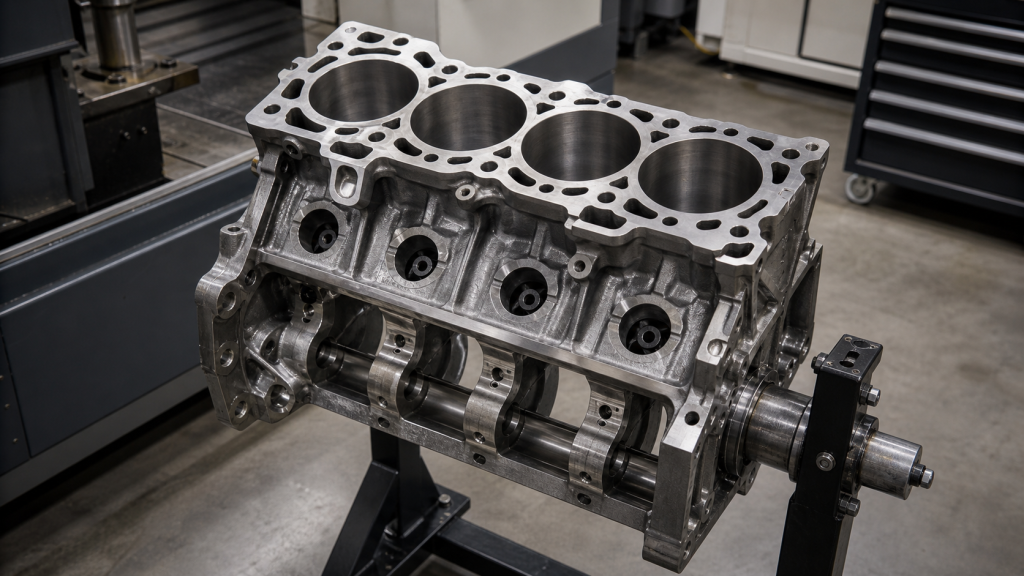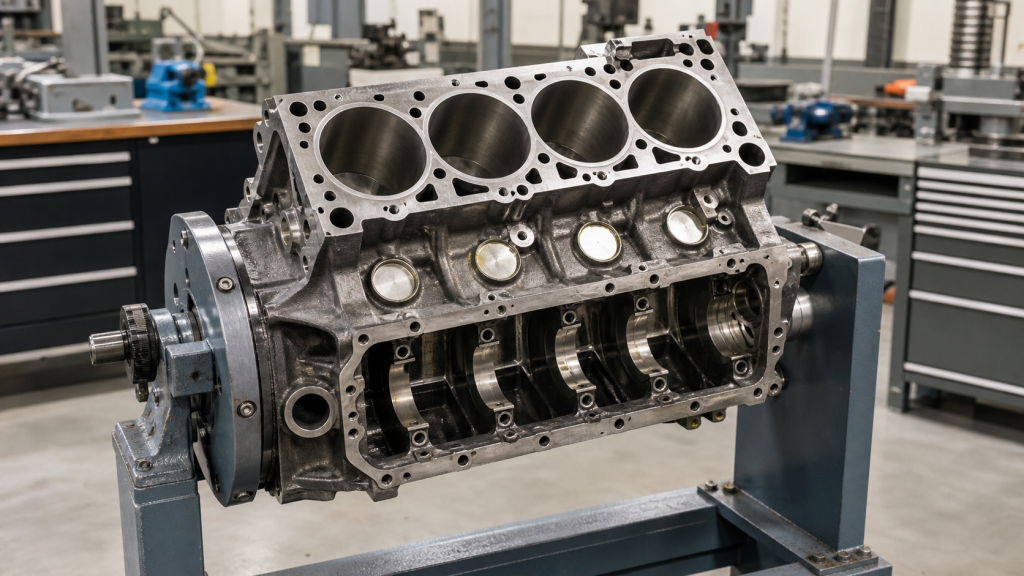
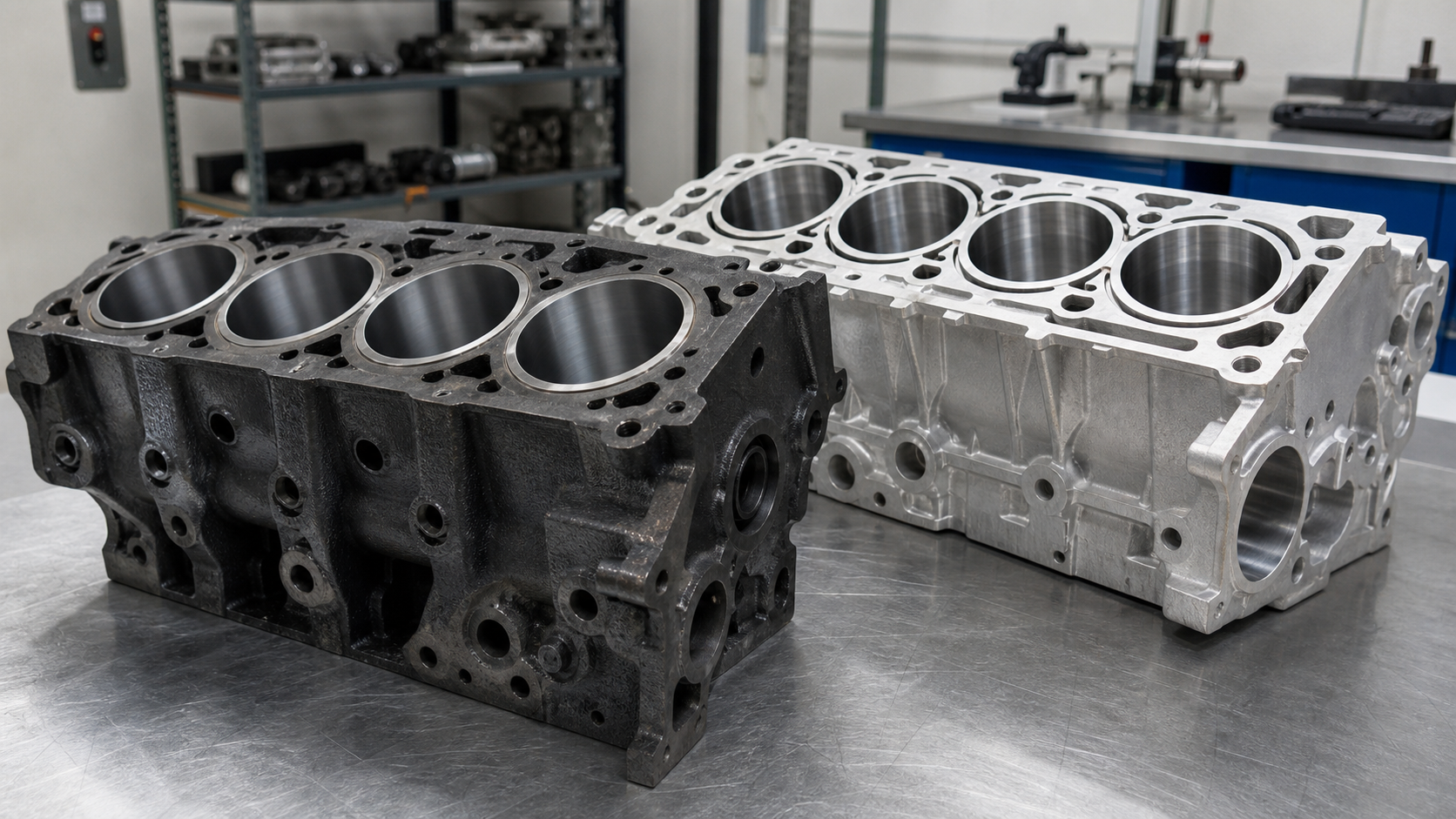
Two aluminum engine blocks can deliver completely different results. One might survive high boost in a turbocharged street car, while the other cracks cylinder bores under the same load. The difference is not the aluminum alloy itself but the deck design: open-deck blocks flex more between cylinders, while closed-deck or semi-closed designs tie the cylinder walls together. This example reveals why engine blocks cannot be classified along a single axis. Material, deck support, liner strategy, cylinder arrangement, and crankcase structure each contribute independently to load capacity, weight, repairability, and production cost.
Understanding types of engine blocks requires a design matrix. A cast iron V8 with a bedplate behaves differently than a cast iron V8 with conventional main caps, even when both use the same material and cylinder layout. Similarly, an open-deck aluminum inline-four differs fundamentally from a closed-deck aluminum inline-four in strength, thermal expansion, and machining requirements. This article separates these classification axes so you can identify which combination suits your load, cooling, repair, and production needs.
Key Takeaways
- Engine blocks vary across independent axes: material (cast iron or aluminum), deck design (open, semi-closed, closed), liner strategy (parent bore, dry liner, wet liner), cylinder arrangement (inline, V, flat, other), and crankcase structure (conventional caps, girdle, bedplate).
- Aluminum saves weight compared to cast iron, but open-deck aluminum designs flex more under high cylinder pressure than closed-deck designs, requiring cylinder-head clamping force and coolant passage placement to be matched to the deck type.
- Wet-liner blocks allow bore repair without re-sleeving the casting, while parent-bore and dry-liner designs require precision machining for liner installation or overboring to the next piston size.
- Bedplate crankcase structures tie all main bearing caps together in a single assembly, reducing main bearing movement and allowing higher specific output, but they complicate disassembly and require flat-deck machining across the entire bedplate sealing surface.
- Material, deck, and crankcase decisions must align with the engine’s intended duty: high-revving naturally aspirated engines tolerate open decks better than turbocharged engines, while heavy-duty diesel blocks nearly always use cast iron, wet liners, and bedplates.
Engine Block Types Need More Than One Classification Axis
Most discussions of engine blocks sort them by cylinder arrangement—inline, V, flat—and then treat material as a secondary choice. This approach hides critical differences. An aluminum inline-six with an open deck and parent bores behaves very differently than an aluminum inline-six with a closed deck and dry liners, even though both share the same material and cylinder count. The first design allows more thermal expansion and requires tighter head-gasket control, while the second resists cylinder distortion under boost but demands higher machining precision during assembly.
A useful classification separates material, deck structure, liner strategy, cylinder arrangement, and crankcase design. Each axis affects different performance and service outcomes:
- Material determines weight, thermal conductivity, and machining cost.
- Deck design controls cylinder-bore rigidity and head-gasket sealing under pressure.
- Liner strategy defines bore repair options and dimensional stability.
- Cylinder arrangement sets overall package size, balance, and cooling-passage routing.
- Crankcase structure influences main bearing movement, block rigidity, and disassembly complexity.
When evaluating a replacement block or designing a new engine family, inspect each axis independently. A block that excels in one category—lightweight aluminum, for example—may require closed-deck structure or a bedplate to handle the same cylinder pressure as a heavier cast iron design.
Cast Iron vs Aluminum Blocks
Cast iron blocks dominated production engines for decades because cast iron resists wear, holds tight machining tolerances, and supports high cylinder pressures without distortion. Modern gray iron castings with graphite flakes deliver good machinability and vibration damping. Compacted graphite iron (CGI) offers higher strength and fatigue resistance, allowing thinner walls and reduced weight while maintaining rigidity. Cast iron blocks typically weigh more than aluminum equivalents, but the material’s stiffness and wear resistance simplify manufacturing and allow parent-bore designs without liners.
Aluminum blocks reduce engine weight, improving vehicle fuel economy and handling. Aluminum’s higher thermal conductivity moves heat away from combustion chambers more quickly, helping to control knock in high-compression or turbocharged engines. However, aluminum expands roughly twice as much as cast iron for the same temperature change, requiring careful clearance management and often necessitating cylinder liners to prevent bore wear. Aluminum’s lower elastic modulus means the block flexes more under load, so high-boost or high-revving aluminum engines usually need closed-deck designs or additional ribbing to maintain head-gasket seal.
When comparing cast iron vs aluminum engine blocks, match material to duty cycle. Heavy-duty diesel engines, marine engines, and industrial power units nearly always use cast iron because continuous high load and long service intervals demand maximum rigidity and wear resistance. Passenger cars, light trucks, and racing engines favor aluminum when weight reduction or thermal management justifies the higher machining cost and the need for liners or reinforced deck structure.
Open, Semi-Closed, and Closed Deck Designs
Deck design describes how the casting connects the cylinder walls to the head-sealing surface. In an open-deck block, the cylinder walls stop below the deck surface, leaving a gap between adjacent cylinders. Coolant passages surround the top of each bore, improving cooling but reducing rigidity. Open-deck designs are lighter and simpler to cast, but the unsupported cylinder walls can distort under high cylinder pressure, allowing head gaskets to fail or bore roundness to change. Open decks work well in naturally aspirated engines and moderate-boost applications where peak cylinder pressure remains within the design’s structural limits.
Closed-deck blocks connect the cylinder walls to each other and to the deck surface through cast or machined bridges. Coolant enters through drilled passages rather than open valleys, so the deck surface forms a continuous load path. Closed decks resist cylinder distortion under high boost, making them the preferred choice for turbocharged and supercharged engines. The tradeoff is reduced coolant flow around the top of each bore, requiring careful passage design to avoid hot spots. Closed decks also complicate core placement during casting and may require EDM drilling for coolant passages.
Semi-closed decks compromise between the two. The casting includes partial bridges between cylinders, leaving smaller openings for coolant flow. Semi-closed designs improve rigidity compared to open decks while retaining better cooling than fully closed designs. Many modern production turbo engines use semi-closed decks with optimized coolant routing to balance strength, weight, and thermal management.
Confirming deck type requires visual inspection or reference to the engine family’s service manual. Remove the cylinder head and examine the deck surface. Open decks show wide valleys between cylinders; closed decks show a continuous or nearly continuous surface with small drilled passages; semi-closed decks show partial bridges. When selecting a replacement block for a high-boost application, verify that the new block’s deck design matches or exceeds the original’s rigidity, especially if you are switching from cast iron to aluminum.
Parent Bore, Dry Liner, and Wet Liner Blocks
Liner strategy determines how the block’s bore surface is created and how bore wear is repaired. Parent-bore blocks machine the cylinder bores directly into the casting. Cast iron blocks frequently use parent bores because iron’s wear resistance and dimensional stability allow long service life without liners. Aluminum parent-bore blocks are less common; the softer material wears more quickly unless treated with thermal spray coatings, Nikasil, or plasma-transferred wire arc processes. Parent-bore designs simplify manufacturing but limit repair options: once the bore wears beyond the largest standard oversize piston, the block requires sleeving or replacement.
Dry-liner blocks press or slip hardened steel or cast iron liners into the casting. The liner’s outer surface contacts the block’s coolant jacket or a machined register, but coolant does not touch the liner directly. Dry liners allow aluminum blocks to achieve the wear resistance of cast iron bores, and worn liners can be removed and replaced without scrapping the block. Installation requires precise machining of the liner bore and careful press-fit or shrink-fit procedures to prevent liner movement or fretting. Dry liners must seal combustion pressure through the head gasket alone, so deck flatness and gasket clamping are critical.
Wet-liner blocks place the liner in direct contact with coolant. The liner includes sealing rings at the top and bottom, isolating combustion gases and coolant from the block casting. Wet liners simplify bore repair: remove the old liner, clean the block, and install a new liner with fresh seals. This design is common in heavy-duty diesel engines and some marine engines where field repairability outweighs the added complexity of sealing two surfaces. Wet liners can move slightly under load, so cylinder-head torque sequences and liner protrusion above the deck must be checked during assembly. Wikipedia’s engine block article notes that wet liners allow modular construction, where the same block casting accommodates different bore sizes by changing liner dimensions.
Inline, V, Flat, and Other Cylinder Arrangements
Cylinder arrangement affects block length, width, height, and cooling-passage complexity. Inline engines place all cylinders in a single row. Inline designs deliver simple coolant and oil routing, even firing intervals for three-, four-, and six-cylinder configurations, and straightforward cylinder-head attachment. Inline-four and inline-six engines dominate passenger cars and light trucks because they package well in longitudinal or transverse installations and require only one cylinder head. Inline engines grow long as cylinder count increases, limiting their use in short-wheelbase vehicles.
V engines arrange cylinders in two banks separated by an angle, typically 60 or 90 degrees. V configurations shorten overall engine length, making them suitable for larger displacements in constrained engine bays. V6, V8, and V10 engines are common in trucks, SUVs, and performance cars. The V layout requires two cylinder heads and more complex coolant crossover passages, but it allows symmetric cooling around each bank. The angle between banks affects balance: 90-degree V8 engines achieve natural balance with a flat-plane or cross-plane crankshaft, while 60-degree V6 engines often use offset crankpins or balance shafts to smooth vibration.
Flat or boxer engines place cylinders horizontally opposed, creating a low center of gravity and symmetric cooling around the crankshaft. Flat-four and flat-six engines appear in sports cars and some light aircraft. The design requires wide engine bays but allows lower hood lines. Coolant and oil passages must serve two separate banks, increasing plumbing complexity.
Less common arrangements include W engines, which nest two V banks into a single block, and radial engines, which arrange cylinders around a central crankshaft. Radial designs appear in aircraft and some historical motorcycles but are rare in automotive applications. When evaluating blocks for a swap or rebuild, confirm that the cylinder arrangement matches your vehicle’s available space, drivetrain orientation, and cooling system capacity.
Conventional Main Caps, Girdles, and Bedplates
Crankcase structure defines how the crankshaft’s main bearings are supported. Conventional main caps bolt individually to the block’s crankcase, one cap per main bearing journal. This design simplifies disassembly and bearing replacement, but each cap can deflect slightly under load, allowing the crankshaft to move and potentially causing bearing wear or oil-film breakdown. Two-bolt and four-bolt main caps improve rigidity; four-bolt caps are standard in performance and diesel engines. Some blocks use cross-bolted main caps, where horizontal bolts pass through the block’s side walls into the cap, further reducing cap movement.
Main bearing girdles tie multiple caps together with a single beam or cage that bolts to the block. The girdle spreads load across all main bearings, reducing individual cap deflection. Girdles are common in high-revving racing engines where crankshaft speed and inertia loads challenge conventional caps. Installation requires flat, parallel machining of all cap surfaces, and removal demands that the entire girdle assembly be unbolted as a unit.
Bedplates integrate all main bearing caps into a single structural member that forms the bottom of the crankcase. The bedplate typically bolts to the block with numerous fasteners and may include the oil-pan sealing surface, eliminating the traditional main cap and separate pan rail. Bedplates are nearly universal in modern diesel engines and appear in high-output gasoline engines where rigidity justifies the added weight and complexity. The bedplate’s large sealing surface requires precision machining to ensure flatness across the entire interface. Disassembly is more involved than with conventional caps, but bedplates deliver superior main bearing stability and allow engineers to design thinner, lighter block walls because the bedplate itself contributes stiffness.
When inspecting a used block or specifying a replacement, confirm main cap type and condition. Conventional caps should show no fretting or galling on the parting line. Bedplates require flatness measurement across the sealing surface and careful torque sequencing during installation. Openex’s engine block guide describes how bedplate designs have become more common as specific output increases, reflecting the need for greater rigidity in modern engines.
Select by Load, Weight, Cooling, Repair, and Production Needs
Choosing the right block type requires matching design features to operating conditions and service expectations. Start with load and duty cycle. Heavy-duty diesel engines, marine engines, and commercial vehicle powerplants demand cast iron blocks with closed or semi-closed decks, wet liners, and bedplates. Continuous high-load operation and long service intervals justify the added weight. Turbocharged gasoline engines benefit from closed-deck aluminum blocks or cast iron when boost pressure and thermal loads exceed the structural capacity of open-deck designs. Naturally aspirated engines can use open-deck aluminum or parent-bore cast iron without structural risk in typical street applications.
Weight and fuel economy considerations favor aluminum. Passenger cars and light trucks gain measurable efficiency from aluminum blocks, especially when combined with aluminum heads and other lightweight components. The thermal conductivity advantage also helps control knock in high-compression engines. However, aluminum demands tighter machining tolerances and usually requires cylinder liners, increasing production cost. If weight is not a constraint—in stationary power, marine, or industrial applications—cast iron remains the simpler and more durable choice.
Cooling requirements shape deck and liner decisions. Engines with tight bore spacing or high specific output need aggressive coolant flow, favoring open or semi-closed decks. Engines with moderate heat flux or generous coolant capacity can use closed decks without thermal issues. Wet liners improve heat transfer directly from the bore to coolant, while dry liners and parent bores require efficient coolant circulation around the outside of the bore. Verify that coolant passages match the engine’s heat rejection: turbocharged and high-compression engines produce more heat per displacement than naturally aspirated designs.
Repairability during service life affects liner choice. Fleet operators, marine users, and heavy equipment owners value wet-liner blocks because bore wear can be corrected by replacing liners without machine shop work. Parent-bore and dry-liner blocks require boring, honing, or liner installation, increasing downtime and cost. If the engine is expected to reach high mileage or operate in dusty, abrasive conditions, wet liners extend usable life. Racing and short-duty engines may accept parent-bore designs because the block will be refreshed or replaced before wear becomes critical.
Production and machining complexity rise with closed decks, bedplates, and dry liners. Closed-deck blocks require more complex cores during casting and may need EDM drilling for coolant passages. Bedplates demand precision flat-deck machining across large surfaces and careful assembly torque sequences. Dry-liner installation requires precision bore machining and interference-fit control. When sourcing a replacement block or designing a new engine family, balance performance needs against manufacturing cost and availability.
Before purchasing a replacement block, confirm:
- Material and deck design match or exceed the original block’s load capacity for your boost, compression, and duty cycle.
- Liner type and condition align with your repair expectations and machine shop capabilities.
- Cylinder arrangement and engine mounts fit your vehicle’s chassis and drivetrain.
- Main cap or bedplate structure matches your crankshaft type and torque specification.
- Coolant passages and fittings connect to your existing cooling system without modification.
Obtain the block’s casting number, check its service history if available, and verify critical dimensions—bore diameter, deck height, main journal size, cam bearing diameter—against the engine family’s specifications before final purchase.
FAQs
Can I use an open-deck aluminum block with a turbocharger?
Open-deck aluminum blocks can handle moderate turbocharger boost in well-built engines with proper head gasket clamping and coolant system capacity. The safe boost threshold depends on deck thickness, coolant passage design, head gasket type, and cylinder-head stud pattern. High-boost applications require closed-deck or semi-closed-deck aluminum blocks, or a switch to cast iron. Confirm deck type by removing the cylinder head and inspecting the casting between cylinders. Consult the engine family’s service manual or a builder experienced with that specific block for boost limits.
How do I identify whether a block uses wet or dry liners?
With the cylinder head removed, look for sealing rings at the top and bottom of the bore. Wet liners include rubber or metal seals that isolate coolant from the block casting; you may see the liner’s flange sitting proud of the deck surface. Dry liners sit flush with the deck and lack visible seals because coolant does not contact the liner directly. The service manual for the engine family will specify liner type, dimensions, and protrusion limits.
Does a bedplate block require special tools for disassembly?
Bedplate blocks require standard socket and torque wrenches, but you must unbolt the entire bedplate as a single assembly rather than removing individual main caps. Some bedplates have specific torque sequences and angle-tightening procedures; follow the service manual exactly. The bedplate sealing surface must be checked for flatness with a precision straightedge and feeler gauges. Any warpage beyond the service limit requires machining or bedplate replacement. The service manual provides the flatness specification for your engine family.
Can a parent-bore aluminum block be repaired after bore wear?
Parent-bore aluminum blocks can be sleeved with steel or cast iron liners if bore wear exceeds the largest standard oversize piston. The machine shop must bore out the worn aluminum, press or shrink-fit the new liner, then bore and hone the liner to final size. The process is more complex than replacing a wet liner and requires experienced machinists. Some aluminum blocks with Nikasil or thermal-spray coatings cannot be re-coated after machining, limiting repair options to sleeving or block replacement.
Why do some V8 engines use four-bolt main caps while others use two-bolt caps?
Four-bolt main caps resist deflection better than two-bolt caps, reducing crankshaft movement under high load and allowing higher bearing pressures. Engines with long stroke, high torque, or high revving benefit from four-bolt caps or bedplates. Two-bolt caps are sufficient for moderate-output engines where bearing loads stay within the cap’s stiffness limit. When rebuilding or upgrading, confirm that four-bolt caps align with your crankshaft’s journal size and bearing spec; simply adding bolts without proper machining and torque procedure may not improve rigidity and can introduce assembly errors.
Conclusion
Engine blocks vary across independent axes—material, deck design, liner strategy, cylinder arrangement, and crankcase structure—and each choice affects load capacity, weight, cooling, repairability, and production cost differently. A cast iron inline-six with conventional main caps behaves differently than a cast iron inline-six with a bedplate, and an open-deck aluminum V8 requires different boost limits than a closed-deck aluminum V8. Effective block selection starts by separating these design decisions rather than treating all blocks of the same material or cylinder count as equivalent.
Your next step is to confirm the casting number, measure or inspect the current block’s condition, and compare candidates against the engine family’s service manual before purchasing a replacement. Document bore wear, deck flatness, main bearing clearances, and coolant passage condition. Request the replacement block’s liner type, deck design, and crankcase structure from the supplier, and verify that critical dimensions match your crankshaft, pistons, and cylinder head. A complete inspection and specification match reduces the risk of compatibility issues and ensures the new block meets your load, weight, and repair expectations.