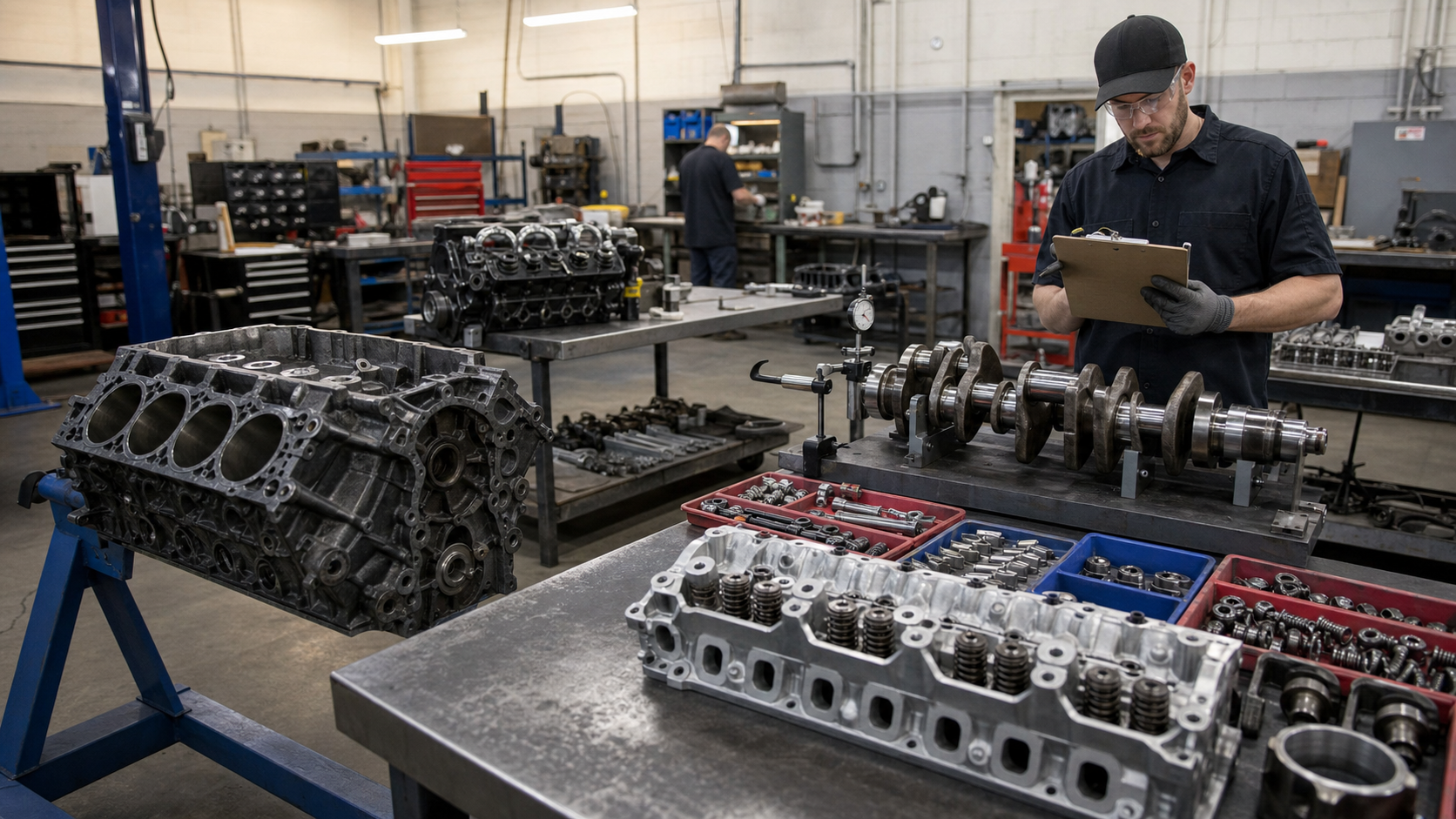
No shop can finalize a rebuild quote before teardown and measurement. The advertised price represents minimum scope—typically fresh bearings, rings, and gaskets assuming the core needs no machining. Actual cost depends on what inspection reveals: block deck flatness, crankshaft journal condition, cylinder bore taper, valve guide wear, and camshaft lobe geometry determine whether you reuse, machine, or replace each component. Timeline follows the same pattern: parts availability, machine-shop queue depth, and whether block or heads require repair welding all control when the engine returns to service.
Key Takeaways
- Rebuild quotes adjust after teardown reveals measured wear against service-manual specifications
- Cost divides into teardown labor, cleaning and inspection, machining operations, replacement parts, assembly labor, and validation testing
- Timeline depends on inspection findings, parts lead time, machine-shop capacity, and whether cylinder heads or block need repair beyond standard operations
- A refresh replaces wear items; a full rebuild machines datum surfaces and restores clearances to specification
- The decision gate occurs after cleaning and measurement, when you compare rebuild cost and downtime against replacement options
A Rebuild Price Is a Scope, Not a Single Part
Engine rebuild cost reflects the work scope you authorize. A valve adjustment with ring replacement might require minimal labor and consumables. Complete teardown with block resurfacing, crankshaft grinding, cylinder boring, valve job, and new bearings, seals, and timing components involves substantially more work. Shops often advertise a base price assuming minimal core damage—no cracks, bore wear within first oversize, intact threads, clean coolant passages. Engines rarely meet that standard after extended service or cooling-system failure.
The quoted scope determines your cost. If the estimate includes only ring and bearing replacement without machining, the shop expects to reuse existing bore finish and crankshaft journals. When teardown shows excessive cylinder taper or out-of-round journals, you face additional machining charges or the choice to stop the project. Confirm whether quotes include machine work, what core-condition assumptions apply, and what triggers price revision.
Define Refresh, Rebuild, Remanufacture, and Replacement
A refresh replaces wear components—rings, bearings, gaskets, seals, timing chain or belt, water pump, oil pump—without machining block or crankshaft. This works when inspection confirms bearing clearances, cylinder taper, and surface finish remain within service limits.
A rebuild includes machining to restore datum surfaces. Block deck gets resurfaced to correct warpage and restore head-gasket clamping. Cylinders are bored to next oversize or honed to restore crosshatch pattern. Crankshaft journals are ground undersize when wear or taper exceeds limits. Cylinder heads receive valve job—seat machining, guide replacement or knurling, spring testing, pressure testing for cracks. Parts include oversize pistons and rings, undersize bearings, and new valves if seat cuts would exceed minimum margin.
Remanufacture is an industrial process where cores are machined to standard oversize dimensions, fitted with new or reground crankshafts, and assembled with consistent torque and sealant procedures. Remanufactured long blocks include new pistons, rings, bearings, camshaft, timing set, oil pump, and often cylinder heads. Pricing sits between full rebuild and new crate engine, with core-charge requirements.
Replacement means installing a used engine from salvage, a remanufactured long block, or a new crate engine. Used engines carry unknown service history. New crate engines include warranty coverage and updated components addressing known design weaknesses.
Teardown Findings That Change the Estimate
After removal and cleaning, the machine shop measures each component against service-manual specifications.
Block condition: Check deck flatness with the method and limit specified for the engine and selected gasket. Measure cylinder bore diameter at several depths and in perpendicular planes, then compare taper, out-of-round, and diameter with the service data and available piston sizes. Pressure-test the water jacket when leakage is suspected. Crack location, material, and approved repair procedures determine whether machining, sleeving, specialist repair, or replacement belongs in the quote.
Crankshaft journals: Measure main and rod journals with micrometer. Check for taper and out-of-round. Journals worn beyond undersize bearing range require new or reground crankshaft. Inspect for scoring, heat discoloration, or cracks using magnetic-particle testing on iron cranks or dye-penetrant testing on steel forgings.
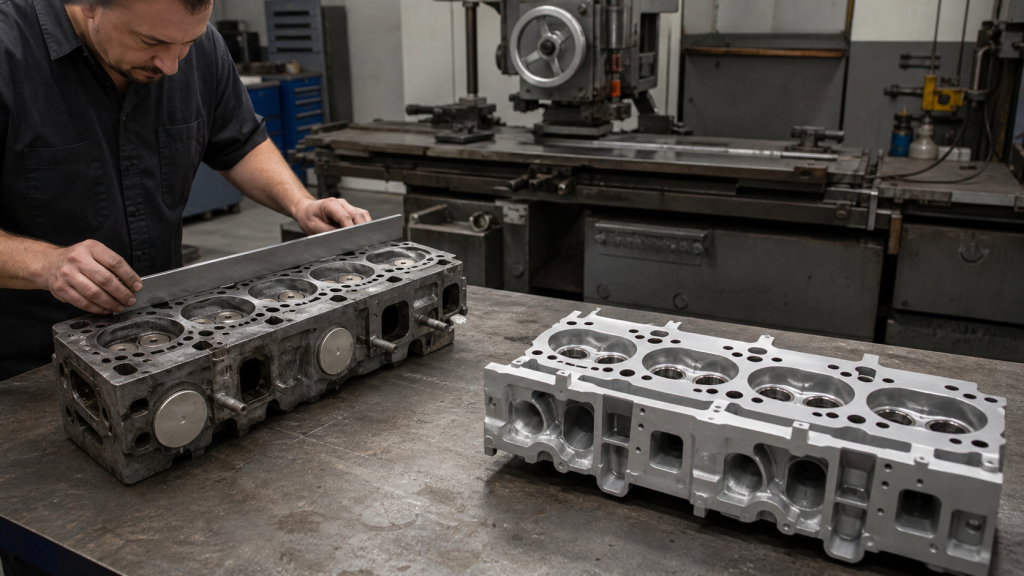
Cylinder heads: Measure deck flatness. Excessive warpage requires resurfacing, reducing installed height and potentially requiring thicker head gaskets or block milling to maintain compression ratio. Pressure-test with air or water to locate cracks between valve seats, around ports, or in combustion chambers. Measure valve-guide inside diameter and compare to valve-stem diameter. Excessive clearance causes oil consumption and requires guide replacement or knurling. Check valve-seat width and concentricity. Measure valve-spring installed height and tension against specification.
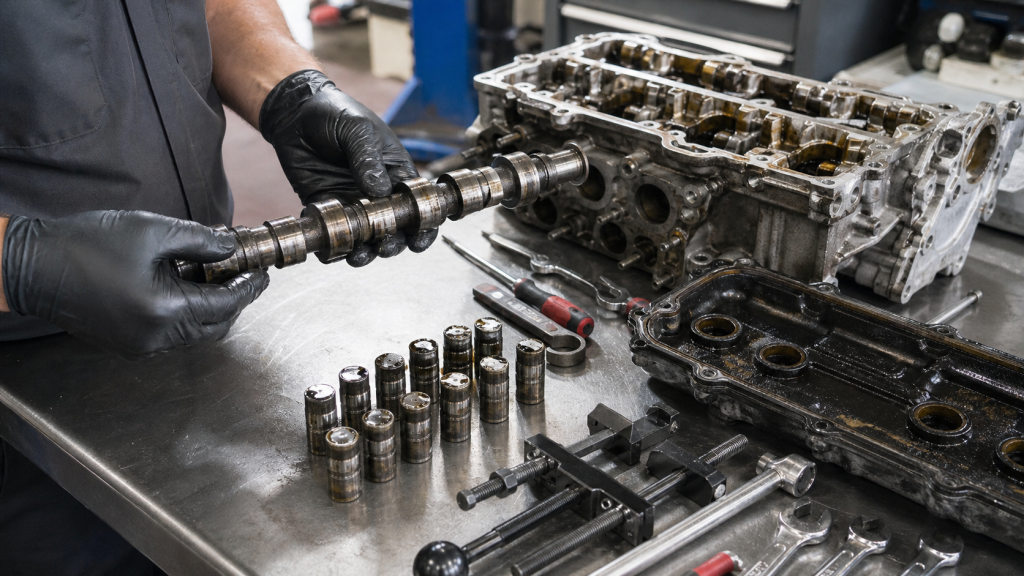
Camshaft and lifters: Measure lobe base-circle diameter and lift against specification. Inspect lifter faces for pitting, galling, or flat spots. Overhead-cam engines require cam-journal measurement and bearing clearance checks.
Each finding adds cost. Boring cylinders, grinding crankshaft journals, performing complete valve jobs with guide work, or welding cracks all increase the estimate. Core replacement—block, crankshaft, or heads—substantially changes the project scope.
Machining, Parts, Labor, and Testing Cost Buckets
Rebuild cost divides into four categories:
Machining operations: Block resurfacing removes warpage and restores deck flatness. Cylinder boring and honing restore correct diameter and surface finish. Crankshaft grinding removes taper and out-of-round from journals. Valve job includes disassembly, cleaning, guide work, seat machining, lapping, spring testing, and reassembly. Align honing main bearing bores is required when caps are replaced or bore alignment shifts. Hot tank cleaning and inspection prepare components for measurement.
Hard parts: Replacement components include pistons and rings sized to final bore diameter. Main and rod bearing sets matched to journal diameter. Timing chain or belt kit with guides and tensioner. Camshaft and lifter sets when lobe wear exceeds limits. Oil pump. Complete gasket and seal kits. Cylinder heads may need new valves depending on seat condition.
Labor: Disassembly and cleaning precede measurement. Reassembly follows machining completion and parts arrival. Time required depends on engine family, timing system complexity, and whether you assemble the engine on a stand or during vehicle installation. Shop rates vary by region and shop specialization.
Testing: After assembly, perform cold compression test and leak-down test to verify ring seal and valve seating. Run the engine on stand or in vehicle. Check for oil leaks, coolant leaks, abnormal noise, and correct oil pressure. Warm engine to operating temperature and verify thermostat operation, cooling-fan engagement, and stable idle. Recheck critical fastener torque after first heat cycle.
A Realistic Rebuild Timeline and Its Dependencies
Rebuild duration depends on inspection findings, machine-shop availability, and parts sourcing.
Removal and teardown: Engine removal time varies with vehicle design—front-wheel-drive inline engines with good access differ from rear-wheel-drive V-configurations requiring transmission removal. Strip external accessories. Disassemble engine: remove cylinder heads, oil pan, timing cover, pistons, crankshaft. Clean all components. Perform initial inspection and record measurements.
Machining and procurement decision: Send block, crankshaft, and cylinder heads to machine shop. Machining duration depends on shop queue depth—no backlog means quick turnaround, high-demand periods extend wait time substantially. After machining, finalize parts list based on measured clearances. Order oversize pistons, undersize bearings, and special components. Common parts ship quickly. Engine-specific pistons, performance camshafts, or imported components extend lead time.
Assembly: Install main bearings and crankshaft. Verify bearing clearance with Plastigage or micrometer. Install pistons and rods with new rings. Torque rod bolts to specification. Install camshaft with new bearings and timing set. Install oil pump, oil pan, timing cover with new gaskets and sealant. Install cylinder heads with new gaskets. Torque head bolts in sequence to specification, often using multi-step pattern with angle-torque final stage. Install valve-train components. Adjust valve lash when required. Install external accessories.
Installation and break-in: Reinstall engine in vehicle. Reconnect electrical, fuel, cooling, exhaust systems. Fill with appropriate break-in oil. Prime oil system before starting. Crank engine without fuel or spark to build oil pressure. Start engine and vary RPM to seat rings and cam lobes. Check for leaks. Perform initial test drive.
Clean rebuilds with in-stock parts and available machine-shop capacity complete faster than projects encountering core damage, special-order parts, or shop backlogs. Each complication extends timeline: block welding, core replacement, or custom machining all add waiting time.
Rebuild vs Used, Remanufactured, Long Block, or Complete Engine
Compare rebuild cost and downtime against alternatives before committing to teardown.
Used engines from salvage carry unknown service history. You pay installation labor before discovering compression quality, oil consumption, or bearing condition. Some yards offer limited warranty coverage, but replacement labor is rarely included. Used engines make sense when rebuild estimates are high, vehicle market value is low, or parts availability is poor.
Remanufactured long blocks arrive machined, assembled, and tested. Transfer your cylinder heads, oil pan, timing cover, and accessories, or purchase complete engine with heads installed. Remanufactured engines include warranty coverage for defects. The advantage over rebuilding is consistent quality, immediate availability, and no teardown-surprise risk. The disadvantage is less control over parts quality and machining procedures.
New crate engines include longer warranty coverage and updated components addressing known design weaknesses. Choose crate engines when vehicle value justifies investment, rebuilding reveals extensive damage, or performance upgrades are planned.
Rebuild makes sense when core condition is acceptable, engine design is straightforward, parts are available, and you want control over parts quality and machining standards. Rebuilding often becomes the only option for rare engines, marine or industrial applications, or performance builds requiring custom machining.
Quote, Warranty, and Acceptance Checklist
Before authorizing rebuild work, confirm:
Scope definition: Does the quote include disassembly, cleaning, inspection, machining operations, reassembly, installation, and testing? Are machine-shop charges itemized separately? Which parts are included?
Core assumptions: What condition must block, crankshaft, and cylinder heads meet for quoted price to hold? What triggers additional charges?
Parts specification: Are bearings OE, name-brand aftermarket, or economy-grade? Are pistons cast or forged? Are rings file-fit or pre-gapped? Are gaskets composite, MLS, or OE specification?
Warranty terms: What is covered—parts only, parts and labor, consequential damage? What is duration and mileage limit? What maintenance or break-in procedures does warranty require? Does warranty transfer with vehicle sale?
Payment and timeline: When is payment due? What is estimated completion date? What happens if teardown reveals additional damage?
Testing and documentation: Will the shop perform leak-down and compression testing after assembly? Will they provide measurement report from teardown? Will they supply photos of damaged components?
Request written quote with itemized costs. Compare quotes from multiple shops. Ask for references or examples of similar rebuilds. Confirm shop experience with your engine family.
FAQs
Can you rebuild an aluminum block with worn cylinders?
Aluminum blocks can be bored to oversize if sufficient wall thickness remains, sleeved with cast-iron or steel liners when at maximum oversize, or replated if originally Nikasil-coated. Repair method depends on bore wear, wall thickness, and whether service manual permits sleeving. Some aluminum blocks use pressed-in liners replaceable with standard or oversize liners. Check service manual for maximum bore diameter and approved repair procedures before committing to rebuild.
How do you calculate bearing clearance and why does it matter?
Bearing clearance is oil film thickness between bearing surface and crankshaft journal. Measure journal diameter with micrometer. Measure bearing inside diameter by installing bearing, torquing cap, and measuring with inside micrometer or dial bore gauge. Clearance equals bearing ID minus journal OD. Excessive clearance causes low oil pressure and bearing knock. Insufficient clearance causes bearing seizure. Service-manual specifications vary by journal diameter and engine speed range.
What causes different quotes for the same rebuild?
Quote variation reflects scope differences, parts quality, machining procedures, and labor efficiency. Low quotes may exclude machine work, use economy bearings and gaskets, or assume perfect core condition. High quotes may include align honing, performance timing components, and forged pistons. Compare itemized scope, parts brands, warranty terms, and shop reputation rather than total price alone.
Should you upgrade components during a rebuild?
Upgrade when original design has known weaknesses or performance goals justify cost. Common upgrades include forged pistons for forced induction, upgraded rod bolts for high RPM, performance camshaft for increased power, roller timing chain for improved durability, and high-volume oil pump for improved lubrication. Balance upgrade cost against vehicle’s intended use. Daily-driver rebuilds rarely need forged internals. Performance or racing engines justify upgraded components that may exceed base rebuild cost.
How do you verify a remanufactured engine before installation?
Inspect assembly for cleanliness, correct part numbers, and absence of shipping damage. Verify all passages are open and free of casting flash. Check that all fasteners are present and torqued. Perform cold compression test: all cylinders should read within acceptable tolerance of each other and meet specification for engine family. Rotate crankshaft by hand to confirm smooth rotation without binding. Prime oil system before starting. If engine includes cylinder heads, verify valve timing with dial indicator or compare cam timing marks to service manual. Document pre-installation condition with photos for potential warranty claims.
Conclusion
Engine rebuild cost and duration are project variables controlled by teardown findings, parts availability, and scope you authorize after inspection. Start by defining what rebuild means for your application—refresh with new wear items, full machining and assembly, or replacement with remanufactured long block. Request itemized quotes separating machine work, hard parts, labor, and testing. After teardown, compare measured clearances and surface condition against service-manual limits to decide which components can be reused, machined, or must be replaced. Use that measurement report to validate revised quote and timeline before authorizing reassembly. When rebuilding approaches significant cost or causes extended downtime, compare against remanufactured long block or used engine with warranty coverage.