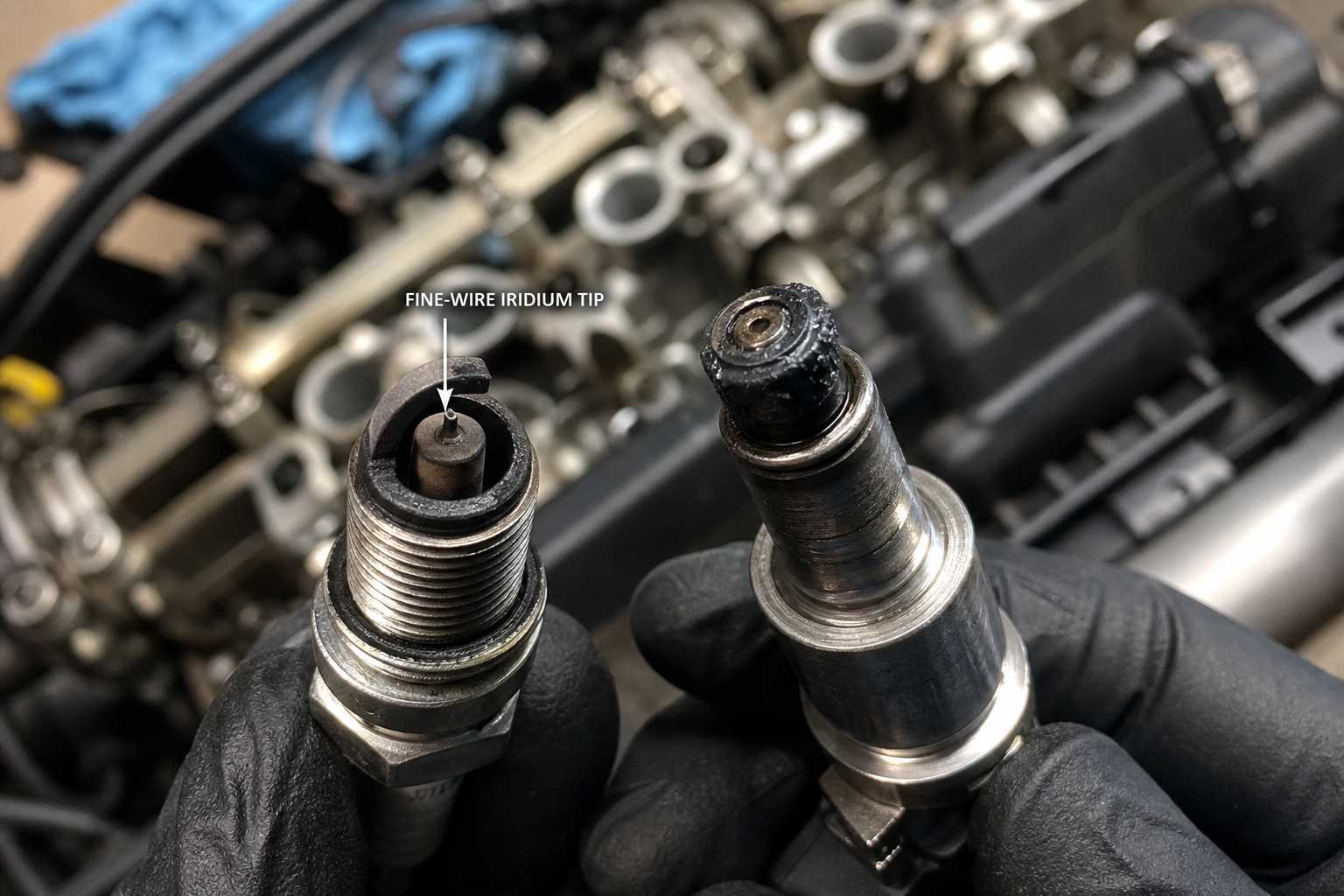
The fine-wire iridium center electrode helps preserve ignition performance under demanding conditions.
Introduction
Direct injection engines spray fuel directly into the combustion chamber at high pressure, often during the compression stroke. This changes the thermal and electrical environment the spark plug must operate in. Peak cylinder pressure rises—frequently exceeding 1,500 psi in turbocharged gasoline direct injection (GDI) applications—and the air-fuel mixture near the plug electrodes becomes leaner and more stratified than in port injection designs.
Under these conditions, the spark kernel must ignite reliably despite higher voltage requirements and electrode temperatures approaching 1,800°F. Many automakers specify iridium or platinum fine-wire spark plugs for GDI engines because the smaller electrode diameter concentrates the electrical field, the refractory metals resist erosion, and the design maintains the factory gap for 60,000–100,000 miles. Not every direct injection engine requires iridium, but the combination of pressure, heat, and extended service intervals drives most OEM specifications toward fine-wire precious-metal designs.
Key Takeaways
- **Higher cylinder pressure** in DI engines demands a more focused spark kernel; fine-wire iridium electrodes concentrate voltage and reduce quenching.
- **Electrode erosion accelerates** when combustion temperatures exceed 1,600°F and peak pressure tops 1,200 psi; iridium’s 4,471°F melting point resists wear better than copper (1,984°F).
- **Gap growth over time** causes misfires; iridium plugs maintain factory gap (typically 0.028–0.032 inches in GDI engines) longer than copper equivalents.
- **OEM specifications vary**; always check the service manual—some naturally aspirated DI engines accept platinum or even copper plugs at shorter intervals.
- **Cost trade-off**: iridium plugs run $15–$30 each versus $3–$8 for copper, but 100,000-mile service life offsets the premium in labor-intensive V6/V8 installations.
How Direct Injection Changes Combustion Conditions
Gasoline direct injection (https://en.wikipedia.org/wiki/Gasoline_direct_injection) eliminates the intake manifold fuel mixture present in port injection systems. Fuel enters the cylinder during intake or compression, mixing with air in a shorter window. Three factors increase stress on spark plugs:
- **Peak pressure rise**: Compression ratios of 10.5:1 to 13:1 are common; turbocharging adds boost pressure. Combined cylinder pressure during ignition can exceed 1,500 psi in high-output GDI engines, compared to 800–1,000 psi in many port-injected designs.
- **Stratified charge operation**: Some GDI systems run lean overall but create a richer pocket near the spark plug. The plug fires into a dynamic mixture with steep fuel gradients; electrode position and kernel strength matter more than in homogeneous mixtures.
- **Carbon and deposit sensitivity**: Direct injection leaves no fuel wash over intake valves. Carbon can accumulate on piston crowns and plug tips, altering heat transfer and insulating the ground electrode. A plug that fouls or runs too hot will misfire under the already-demanding electrical load.
The electrical demand to ionize the compressed mixture rises roughly in proportion to pressure. A plug gap that fired reliably at 900 psi may require 50% more voltage at 1,400 psi, pushing the ignition coil closer to its output limit and increasing the risk of misfire if the plug electrode is worn or the gap has opened beyond specification.
Why Fine-Wire Electrodes Matter Under Pressure
Electrode diameter directly affects the electric field strength at the spark gap. A 2.5 mm copper center electrode spreads the voltage over a larger surface area; a 0.6 mm iridium electrode concentrates it, making ionization easier.
Field intensity comparison (simplified):
|
Electrode Material |
Typical Center Diameter |
Relative Field Strength |
Voltage Requirement at 1,400 psi |
|
Copper |
2.5 mm |
1.0x |
Baseline (high) |
|
Platinum |
1.1 mm |
1.8x |
15% lower than copper |
|
Iridium |
0.6 mm |
3.2x |
25% lower than copper |
The finer electrode also reduces flame kernel quenching. When the spark ignites the mixture, the flame front expands from the gap. Large electrodes absorb heat and can extinguish the kernel before it becomes self-sustaining, especially in lean or high-EGR conditions common in modern GDI calibrations. A 0.6 mm iridium tip minimizes this heat sink effect.
Comparing Spark Plug Materials for DI Applications
Material choice affects both initial performance and longevity:
Copper (nickel alloy)
- Melting point: ~1,984°F
- Thermal conductivity: excellent (pulls heat away from tip)
- Erosion resistance: poor; gap grows 0.001–0.002 inches per 10,000 miles under high pressure
- Service life in GDI: 15,000–30,000 miles typical before misfire risk rises
- Use case: racing, frequent plug changes, engines with OEM copper spec and short service intervals
Platinum
- Melting point: 3,215°F
- Thermal conductivity: moderate
- Erosion resistance: generally better than basic nickel plugs; gap growth is slower under normal service
- Service life in GDI: 60,000 miles in moderate-pressure NA engines
- Use case: cost-sensitive GDI applications, engines under 10.5:1 compression, non-turbo
Iridium
- Melting point: 4,471°F
- Thermal conductivity: lower than copper (runs hotter, burns off deposits)
- Erosion resistance: excellent; gap growth <0.0003 inches per 10,000 miles
- Service life in GDI: 80,000–120,000 miles in turbocharged and high-compression engines
- Use case: OEM-specified for most GDI turbo engines, extended service interval designs
Some plugs use an iridium center electrode and platinum ground electrode to balance cost and durability. The center electrode sees the highest current density and temperature, so iridium protects the critical wear point while platinum on the ground side extends overall life.
Gap Sensitivity and Misfire Margin
Spark plug gap in GDI engines is tighter than older designs—often 0.028–0.032 inches versus 0.040–0.060 inches in 1990s port injection systems. Tighter gaps reduce voltage demand, critical when cylinder pressure is high.
As the gap widens through electrode erosion, three failure modes emerge:
- **Voltage overshoot**: The coil must supply more voltage to jump the larger gap at high pressure. If demand exceeds coil output (typically 30,000–45,000 volts), the plug misfires.
- **Arc duration shortens**: A worn plug may still fire, but the arc collapses faster, weakening the flame kernel. Partial burns cause rough idle and emissions spikes.
- **Secondary path formation**: If the ground electrode erodes unevenly, the spark may jump to the shell threads instead of the intended gap, causing intermittent misfires that are hard to diagnose.
Example gap drift over mileage (turbocharged 2.0L GDI, OEM iridium plugs):
- 0 miles: 0.028 inches (factory spec)
- 50,000 miles: 0.030 inches (still within tolerance)
- 100,000 miles: 0.033 inches (borderline; some misfires under heavy load)
- 120,000 miles: 0.036 inches (consistent misfire codes, reduced fuel economy)
Copper plugs in the same engine would reach 0.036 inches by 30,000–40,000 miles, explaining why OEMs do not specify them for extended-service GDI applications.
When Copper or Platinum Plugs Are Sufficient
Not all direct injection engines demand iridium. Check the service manual and consider these factors:
Naturally aspirated DI with moderate compression (10.0:1 to 11.0:1):
- Peak cylinder pressure around 1,000–1,200 psi
- Platinum plugs often meet OEM spec at 60,000-mile intervals
- Example: some Mazda Skyactiv-G engines specify platinum
Racing or high-performance tuning:
- Frequent plug inspection and replacement every 5,000–10,000 miles
- Copper plugs offer superior heat transfer, preventing pre-ignition in boosted applications
- Tuners may use copper even in GDI setups when they can service plugs often
Diesel direct injection:
- No spark plugs; compression ignition only
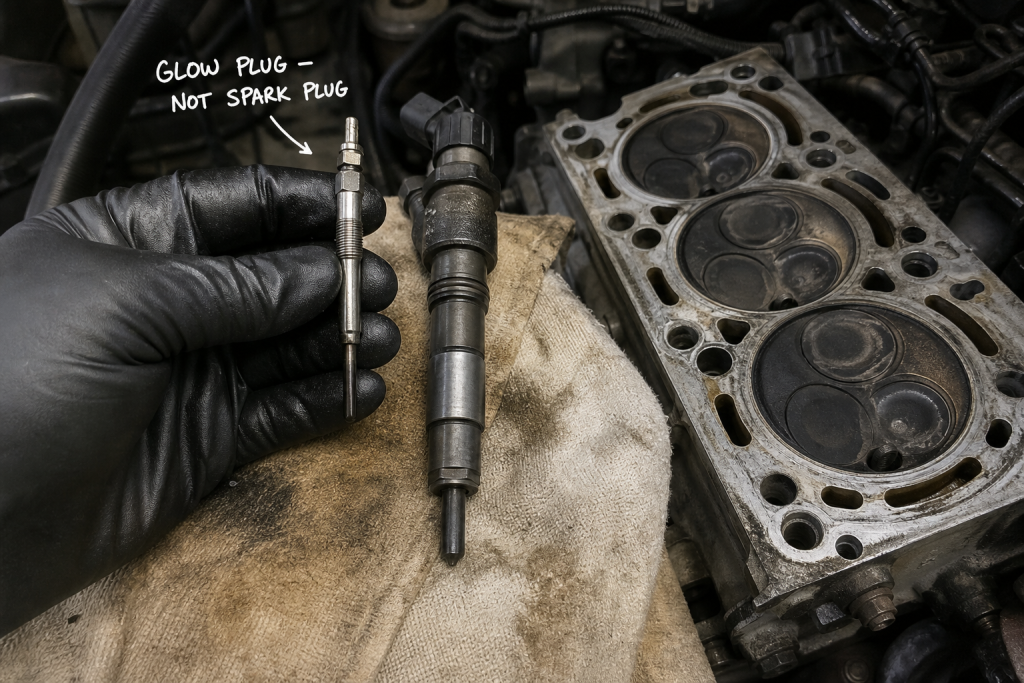
- Glow plugs serve a different function (cold-start assist) and are not subject to erosion from spark discharge
Older GDI systems (early 2000s):
- Some first-generation GDI engines used platinum at 30,000-mile intervals; iridium adoption spread as service intervals extended and turbocharging became common
If the owner’s manual specifies a plug part number, cross-reference it before substituting. Installing copper plugs in an engine calibrated for iridium’s voltage characteristics can cause misfires even when the plugs are new, because the coil output map may not provide enough margin for the larger electrode diameter.
FAQs
Can I use platinum plugs instead of iridium if the manual calls for iridium?
Not recommended unless the manual lists platinum as an acceptable alternative. Iridium specs usually indicate the engine operates near the electrical or thermal limit of platinum’s durability. Using platinum may work initially but risks misfires before the next service interval, especially under high load or in hot climates.
How do I know if my plugs have worn beyond safe limits?
Measure the gap with a wire feeler gauge. If it has grown more than 0.004–0.005 inches beyond the factory spec, or if you see rounded or pitted electrodes, replace the set. Misfire codes (P0300-series) under acceleration or sustained highway speed are late-stage symptoms; the plugs have already caused incomplete combustion and may have damaged the catalytic converter.
Do all cylinders need the same plug type?
Yes. Mixing plug types creates uneven combustion timing and can confuse the engine control module’s misfire detection algorithm. Even if one cylinder seems to run fine with a copper plug while others use iridium, the mixture of different voltage requirements will cause drivability issues and may trigger false diagnostic codes.
Why are iridium plugs so expensive?
Iridium is one of the rarest elements in Earth’s crust—annual global production is under 10 metric tons. The metal must be laser-welded onto the electrode because it is too brittle to machine conventionally. Manufacturing costs are high, but the plug’s 100,000-mile service life in a V6 engine saves two or three labor-intensive plug changes over the vehicle’s life, offsetting the material premium.
Conclusion
Direct injection engines create combustion conditions—cylinder pressures often exceeding 1,400 psi, stratified mixtures, and tight spark timing windows—that push conventional copper spark plugs past their reliable service life within 20,000–30,000 miles. Iridium’s high melting point, fine-wire electrode geometry, and resistance to erosion allow spark plugs (https://en.wikipedia.org/wiki/Spark_plug) to maintain the factory gap and deliver consistent ignition performance for 80,000–120,000 miles, matching the extended service intervals most GDI engines require.
Not every direct injection engine mandates iridium. Naturally aspirated designs with moderate compression and shorter service schedules may specify platinum or even copper. Always verify the plug specification in the service manual and cross-reference part numbers before installation. Installing the wrong plug type—whether under-spec copper in a turbocharged GDI or over-spec iridium in an engine tuned for copper’s thermal characteristics—creates either durability problems or unnecessary cost.
For mechanics and parts buyers selecting plugs for GDI engines, prioritize OEM specification over brand or price. The plug gap, electrode material, and heat range are calibrated to the engine’s pressure profile, ignition map, and service interval. A plug that works in one direct injection engine may cause misfires in another if the pressure and thermal conditions differ. When in doubt, the factory part number remains the safest choice.