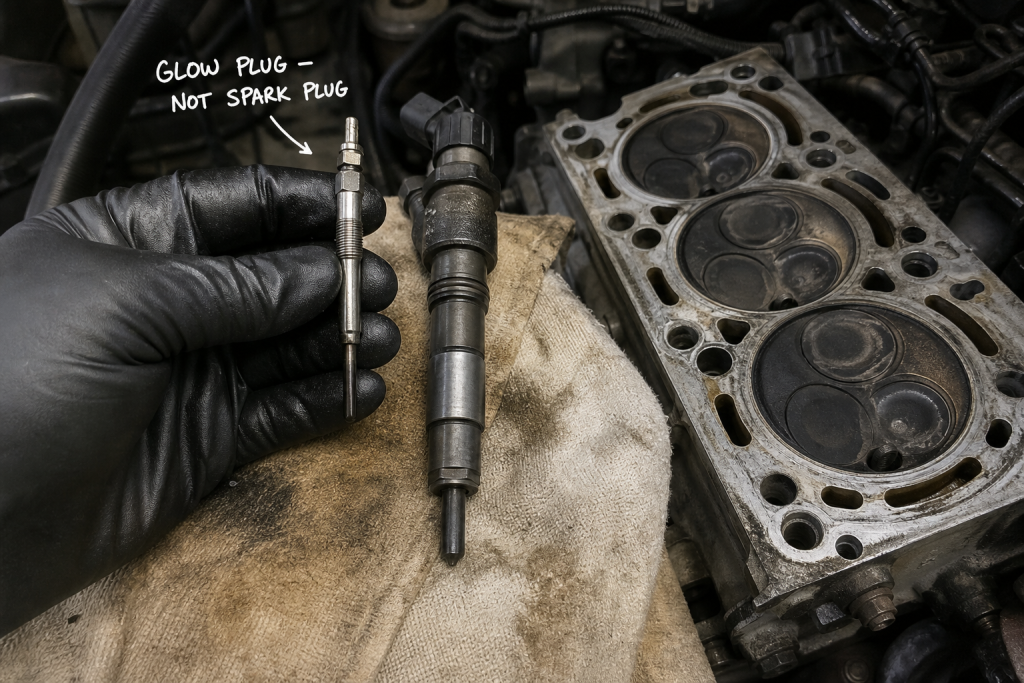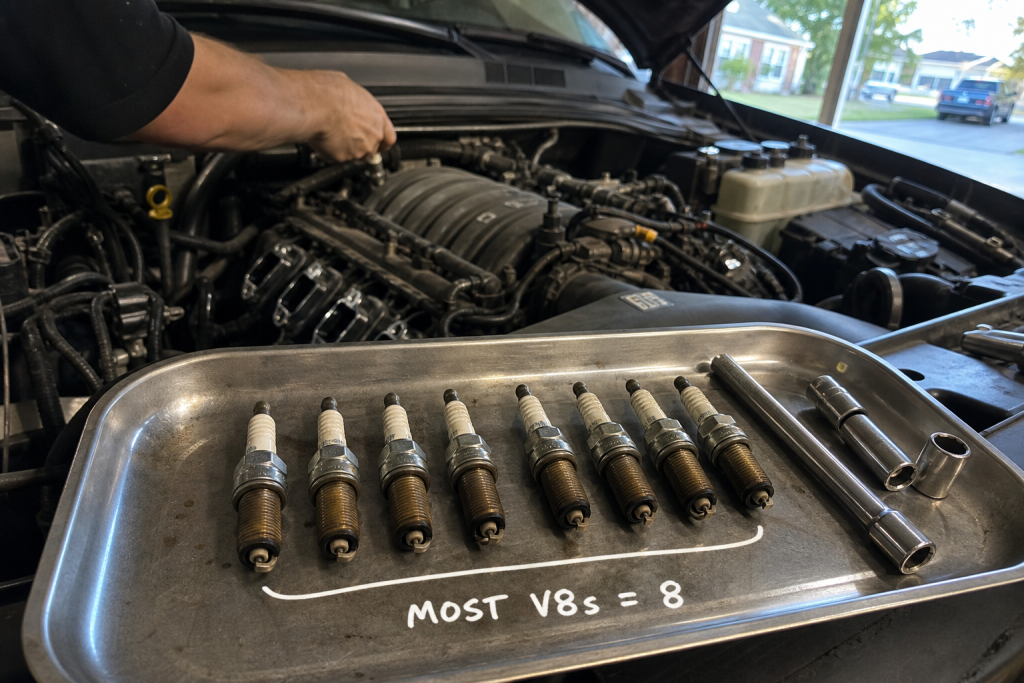
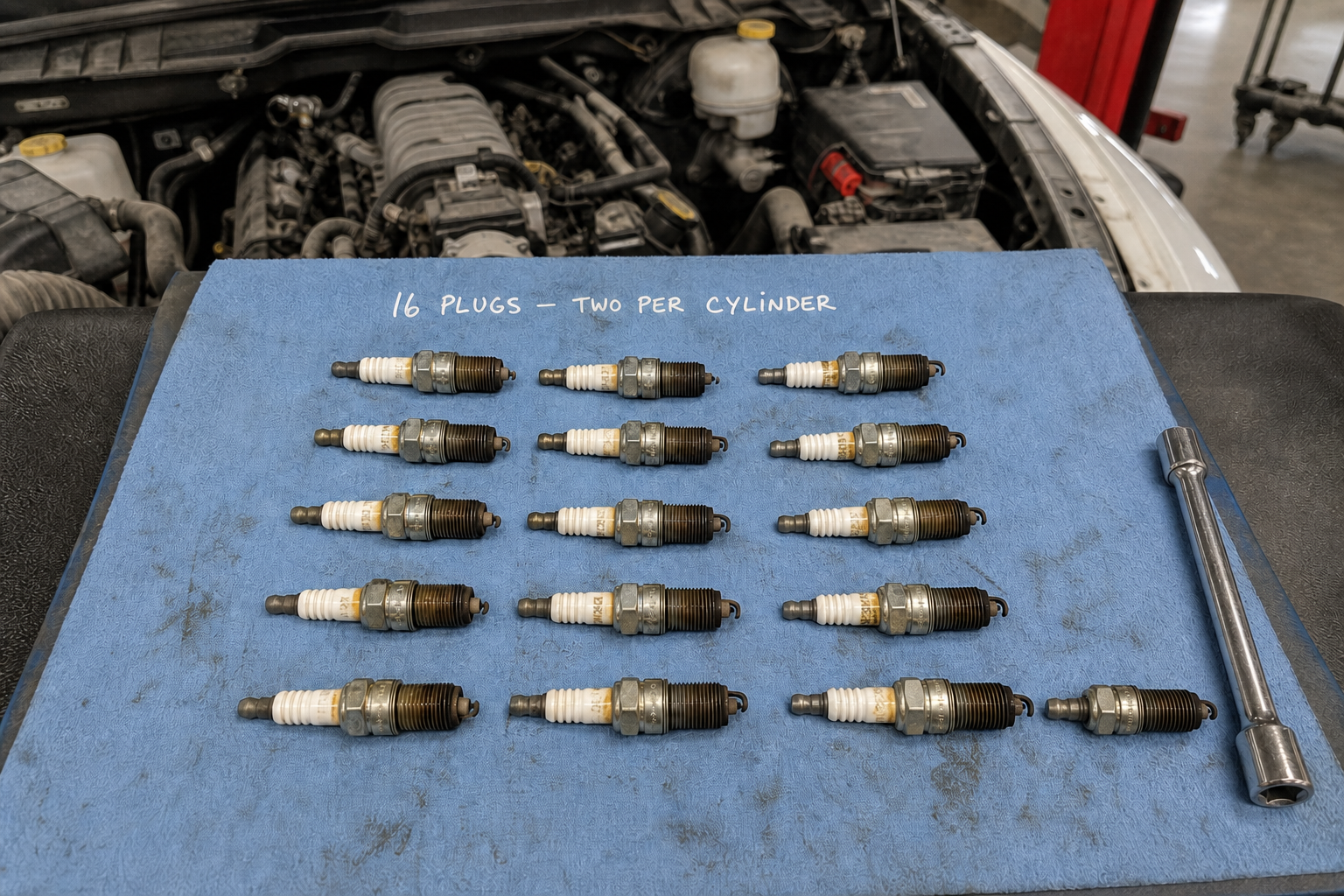
Sixteen plugs document the two-plugs-per-cylinder arrangement used by the 5.7 HEMI.
A parts counter receives an order for spark plugs for a 2015 Ram 1500 with the 5.7L HEMI. The customer requests a set of eight. The counter clerk double-checks the catalog: sixteen plugs required.
The customer insists there’s been a mistake. "It’s a V8. Eight cylinders, eight plugs."
The clerk pulls up the service bulletin. The 5.7 HEMI runs a dual-ignition system. Two spark plugs fire in each cylinder during every combustion cycle. Eight cylinders multiplied by two plugs per cylinder equals sixteen plugs total.
This isn’t a typo or an upsell. The modern 5.7 HEMI engine family uses two spark plugs per cylinder as a core design feature. Understanding which model years carry this configuration, why Chrysler engineered it this way, and how to handle replacement work matters for anyone ordering parts, scheduling service, or performing tune-ups on HEMI-powered vehicles.
Key Takeaways
|
Point |
Detail |
|
**Standard count** |
16 spark plugs in third-generation 5.7 HEMI engines (2009+) |
|
**System name** |
Dual ignition or twin-plug design |
|
**Cylinder layout** |
Two plugs per cylinder x 8 cylinders = 16 total |
|
**Primary benefit** |
Faster flame propagation, improved combustion efficiency, lower emissions |
|
**Replacement interval** |
Typically 30,000–100,000 miles depending on plug material and driving conditions |
|
**Verification method** |
Check service manual or VIN decoder for engine code; look for "MDS" or "VVT" designation |
Why the 5.7 HEMI Uses 16 Spark Plugs
The Chrysler HEMI engine (https://en.wikipedia.org/wiki/Chrysler_Hemi_engine) family gained its name from hemispherical combustion chambers. This chamber shape delivers excellent airflow and high compression ratios but creates a large surface area. A single spark plug positioned at one edge of the chamber must ignite a flame front that travels farther to consume all the air-fuel mixture.
Chrysler introduced dual ignition on the third-generation 5.7L HEMI (internally designated Eagle) starting in the 2009 model year. Two plugs fire simultaneously near opposite sides of each chamber. This creates two flame fronts that meet in the middle, cutting the flame travel distance roughly in half.
Performance gains from dual ignition:
- **Faster combustion**: The mixture burns more completely within the available time window, especially at higher RPM.
- **Better fuel economy**: More thorough combustion extracts more energy from each fuel charge.
- **Lower emissions**: Reduced unburned hydrocarbons and improved catalyst light-off.
- **Power increase**: Third-gen HEMI engines gained 15–20 horsepower over the prior single-plug design without displacement changes.
The system also supports variable valve timing (VVT) and cylinder deactivation (Multi-Displacement System, or MDS). These technologies require precise ignition timing control. Dual plugs provide redundancy and finer control over the combustion event.
Which 5.7 HEMI Models Have Dual Ignition
Not every 5.7L HEMI uses 16 spark plugs. The first two generations used a single plug per cylinder, for a total of eight.
Single-plug 5.7 HEMI (2003–2008):
- Second-generation HEMI introduced in 2003 Dodge Ram
- Used in Ram pickups, Dodge Durango, Jeep Grand Cherokee, Chrysler 300, Dodge Charger, Dodge Magnum through 2008
- Eight spark plugs total
- Typically produces 340–345 horsepower
Dual-plug 5.7 HEMI (2009–present):
- Third-generation Eagle engine introduced for 2009 model year
- Standard in Ram 1500, 2500 (gasoline), Dodge Durango, Jeep Grand Cherokee, Chrysler 300, Dodge Charger, Dodge Challenger
- 16 spark plugs total
- Base output 360–395 horsepower depending on year and tune
How to verify your engine:
- **Check the build date**: Model year 2009 and newer almost certainly have dual ignition.
- **Look for the VVT badge or MDS label**: Variable valve timing and cylinder deactivation were introduced alongside dual ignition.
- **Open the hood**: Third-gen HEMIs have two coil packs visible on each valve cover—16 coil-on-plug assemblies total.
- **Read the service manual**: The manual will list plug count and part numbers.
Marine and industrial 5.7 HEMI variants may differ. Always cross-reference the specific application.
How the Two-Plug-Per-Cylinder System Works
Dual ignition (https://en.wikipedia.org/wiki/Dual_ignition) is not unique to the HEMI. Aircraft piston engines have used twin plugs for decades to improve reliability and combustion efficiency. Chrysler adapted the concept for automotive use with specific tuning for fuel economy and emissions compliance.
Ignition sequence in a dual-plug HEMI:
- The engine control module (ECM) monitors crankshaft position, camshaft position, throttle angle, and knock sensors.
- At the calculated ignition timing point, the ECM triggers both coils for a given cylinder simultaneously.
- Two sparks jump across two gaps in the combustion chamber at nearly the same instant (within microseconds).
- Two flame fronts propagate toward each other, consuming the air-fuel mixture from multiple initiation points.
- Combustion completes faster than a single-plug arrangement, especially under lean or high-load conditions.
Plug positioning:
Each cylinder has one plug on the intake-valve side and one on the exhaust-valve side of the hemispherical chamber. This placement maximizes the separation between ignition points, ensuring the flame fronts cover the chamber volume efficiently.
The system does not provide redundancy in the sense that one plug can carry the load if the other fails. Both plugs must fire for optimal combustion. A single dead plug causes rough idle, misfires, and reduced power. The ECM will log a misfire code for the affected cylinder.
Replacement Workflow and Part Selection
Replacing 16 spark plugs instead of eight changes the labor time and parts cost. A typical tune-up on a dual-ignition HEMI takes 1.5 to 2.5 hours depending on accessibility and whether the intake manifold must be removed.
Step-by-step replacement:
- **Verify plug type and gap**: The 5.7 HEMI uses specific heat-range plugs. Do not substitute without consulting the service manual. Common OEM part numbers include Mopar 68269140AA (iridium) and Champion RE16WYPB5.
- **Remove coil packs**: Each plug has an individual coil mounted directly on top. Disconnect the electrical connector, remove the mounting bolt, and pull the coil straight up. Inspect the coil boot for cracks or carbon tracking.
- **Extract old plugs**: Use a 5/8-inch spark plug socket with a swivel joint. Some plugs are recessed and require a long extension. Apply anti-seize compound to the threads of the new plugs (lightly—excess can interfere with heat transfer).
- **Torque to specification**: The 5.7 HEMI calls for 13 lb-ft (156 in-lb) torque. Over-torquing can strip the aluminum threads in the cylinder head. Under-torquing allows plugs to work loose or overheat.
- **Reinstall coils and connectors**: Press each coil down until it seats fully on the plug insulator. A partial connection causes arcing and coil failure.
- **Clear fault codes and test-drive**: After replacement, clear any stored misfire codes with a scan tool. Drive the vehicle through various load conditions to confirm smooth operation.
Plug material options:
|
Material |
Lifespan |
Cost per Plug |
Notes |
|
Copper-core |
20,000–30,000 mi |
$2–4 |
Cheapest; requires frequent replacement |
|
Platinum |
60,000–100,000 mi |
$5–10 |
Good balance of cost and longevity |
|
Iridium |
80,000–120,000 mi |
$8–15 |
OEM choice for most 2009+ HEMIs; best durability |
Chrysler recommends iridium plugs for the third-generation 5.7 HEMI. Downgrading to copper can save money initially but increases maintenance frequency. The cost difference becomes negligible when labor is factored in.
Common replacement triggers:
- Hard starting or extended cranking
- Rough idle or engine stumble
- Reduced fuel economy (2+ MPG drop)
- Check engine light with P0300-series misfire codes
- Visual inspection showing eroded electrodes or heavy carbon deposits
If multiple plugs show identical wear patterns, the replacement interval is probably appropriate. If one or two plugs fail early while others look new, investigate coil pack quality, fuel injector spray patterns, or valve sealing issues.
FAQs
Do all HEMI engines use 16 spark plugs?
No. The 5.7L HEMI used 8 plugs from 2003 to 2008. The 6.1L, 6.4L, and supercharged 6.2L HEMIs also use dual ignition (16 plugs for the V8s). The older 426 HEMI from the 1960s used 8 plugs. Always verify by model year and engine code.
Can I replace only 8 plugs instead of all 16?
You can, but you shouldn’t. Spark plugs wear at similar rates. Replacing half the set leaves old plugs that will fail soon, requiring another round of labor. Mixing old and new plugs can also create slight differences in flame propagation, potentially causing drivability issues or triggering knock sensors.
What happens if one plug fails?
The cylinder will misfire. The ECM detects incomplete combustion and logs a fault code. Fuel economy drops, power decreases, and unburned fuel may damage the catalytic converter over time. The vehicle remains drivable but should be repaired promptly.
Can I use hotter or colder heat-range plugs for performance?
Heat range changes should only be made with a clear understanding of combustion chamber temperatures and fuel octane. A plug that’s too cold fouls with carbon. A plug that’s too hot causes pre-ignition. For street-driven vehicles, stick with the OEM heat range. Modified engines with forced induction or compression increases require consultation with a calibration specialist.
Why does the dual-ignition system improve fuel economy?
More complete combustion means more energy extracted from each fuel charge. The ECM can also run leaner air-fuel ratios under light load without misfires, since the twin flame fronts reliably ignite lean mixtures. The combination yields 5–10% better fuel economy compared to the earlier single-plug design, all else being equal.
Do I need to replace the coil packs when I replace the plugs?
Not unless they show signs of failure (cracks, carbon tracking, intermittent misfires). Coil packs typically outlast two or three sets of spark plugs. However, if a coil has been arcing due to a worn plug, it may have internal damage. Test each coil’s primary and secondary resistance with a multimeter before reinstalling.
Conclusion
The 5.7 HEMI’s 16-plug dual-ignition system separates it from most V8 engines. Two plugs per cylinder burn the mixture faster, boost efficiency, and support advanced valve timing strategies. This design became standard in 2009 and continues in current production.
For parts buyers, the plug count doubles the line-item quantity but also extends service intervals when iridium plugs are used. For mechanics, the added complexity requires attention to coil pack seating and proper torque specs. For vehicle owners, understanding the system explains why a tune-up costs more than expected—and why skipping plugs to save money undermines the engine’s design intent.
Verify your specific engine configuration before ordering parts. The 2003–2008 models use eight plugs. The 2009-and-later models use sixteen. Check the build date, look for the MDS or VVT badge, or count the coil packs under the hood. The system works only when all components are present and functioning.