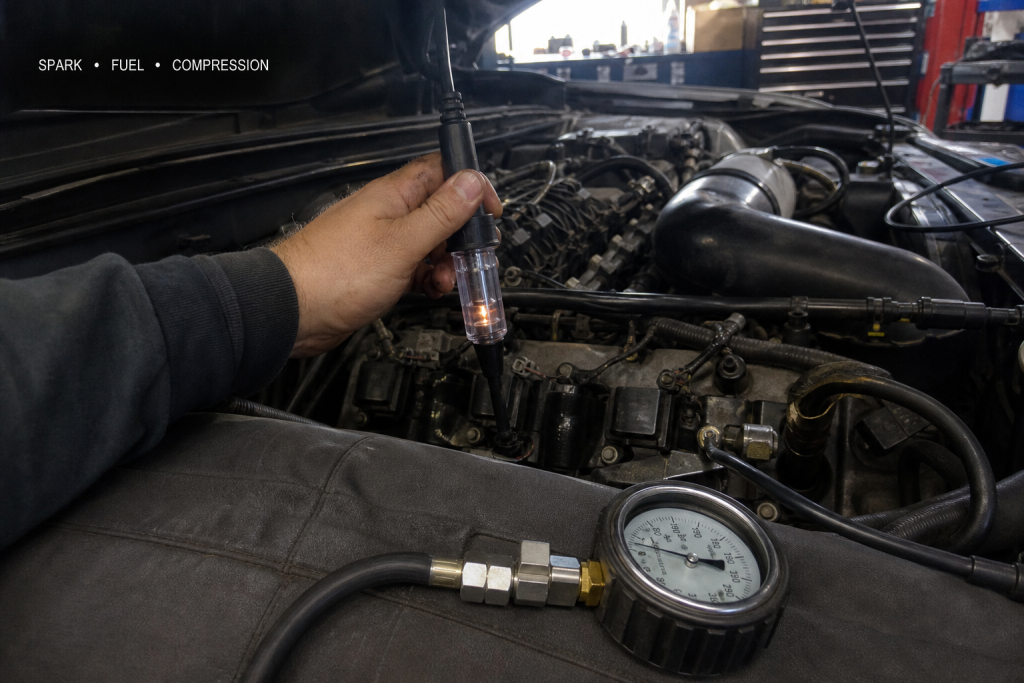
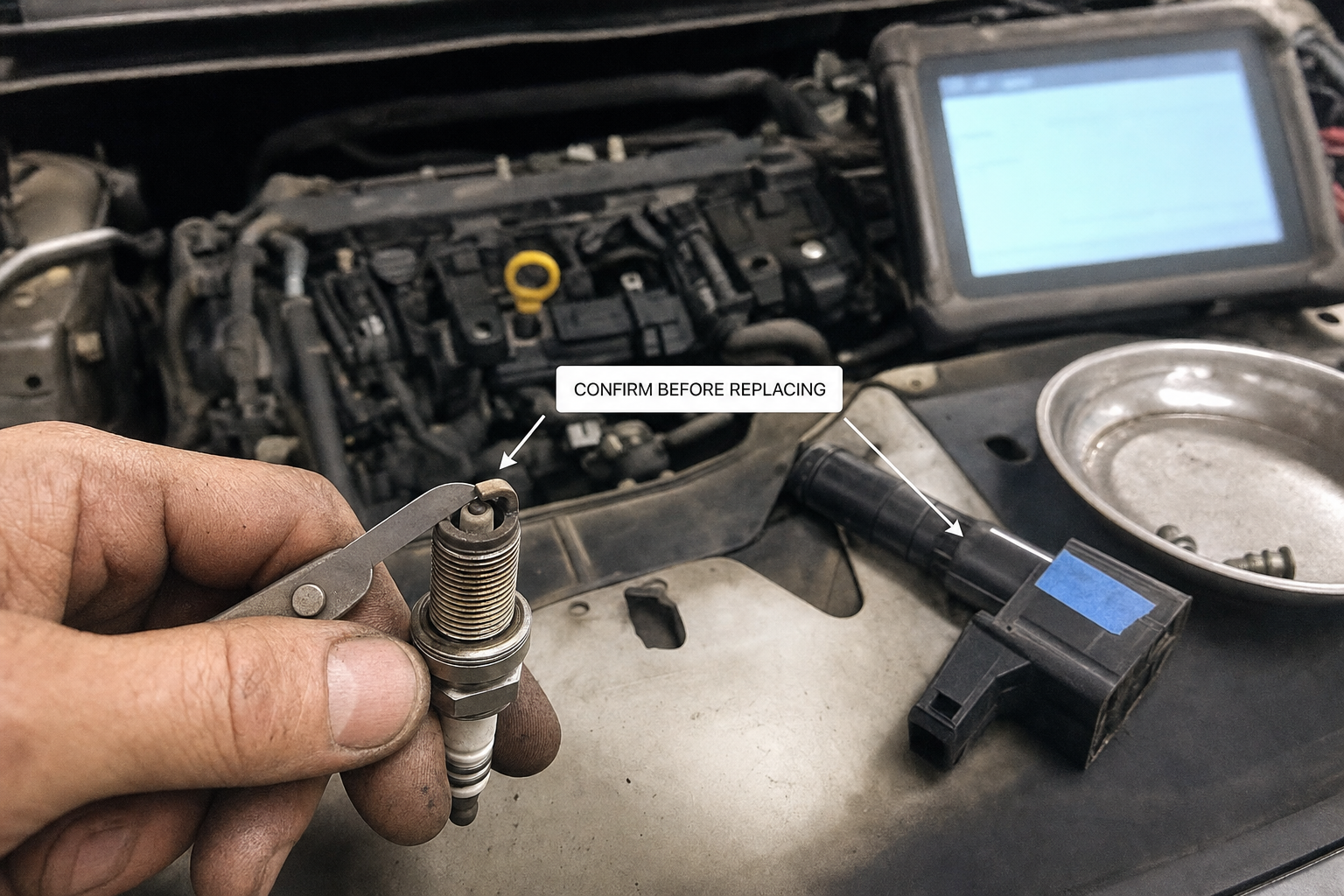
Inspect the plug, verify the gap and confirm the fault pattern before replacing parts.
Introduction
Walk into any parts counter and you’ll hear the same story: check engine light came on, someone suggested spark plugs, customer bought a set, installed them, and the light came back two days later. The question isn’t whether spark plugs can cause a check engine light—they absolutely can—but whether they’re actually the problem in your specific case.
Yes, worn or fouled spark plugs trigger check engine lights by causing misfires that the OBD-II system (https://en.wikipedia.org/wiki/OBD-II_PIDs) detects and logs as trouble codes. But dozens of other failures produce identical symptoms: coil packs, injectors, vacuum leaks, compression loss, fuel pressure problems. Replacing plugs without confirming they’re the root cause wastes time and money while the real issue continues.
This article walks through the diagnostic workflow that separates plug-related misfires from everything else that lights up your dashboard. If you’re holding a code reader and wondering whether to buy spark plugs, start here.
Key Takeaways
- **P0300-P0308 codes** (random or cylinder-specific misfires) are the primary codes caused by spark plug failure
- **Freeze-frame data** shows exact conditions when the misfire occurred—RPM, load, temperature, and fuel trim values matter
- **Physical plug inspection** reveals electrode wear, carbon fouling, oil contamination, and gap erosion that confirm spark delivery problems
- **Cylinder-specific patterns** help distinguish plug issues from coil, injector, or mechanical failures
- **Swap tests** move suspected components to different cylinders to verify whether the problem follows the part or stays with the cylinder
- **Replacement intervals** vary by plug type: copper 20-30k miles, platinum 60-80k, iridium 100k+
What Codes Do Bad Spark Plugs Actually Trigger?
The check engine light (https://en.wikipedia.org/wiki/Check_engine_light) illuminates when the powertrain control module (PCM) detects a problem that affects emissions or drivability. For spark plugs, that means misfire detection.
Primary misfire codes:
|
Code |
Description |
What It Means |
|
P0300 |
Random/Multiple Cylinder Misfire |
Misfires across multiple cylinders or no clear pattern |
|
P0301-P0308 |
Cylinder-Specific Misfire |
Misfire detected in specific cylinder (1-8) |
|
P0316 |
Misfire Detected on Startup |
Misfire during first 1000 engine revolutions |
Secondary codes that may appear:
- **P0171/P0174** (fuel trim lean): Misfires can skew oxygen sensor readings
- **P0420/P0430** (catalyst efficiency): Unburned fuel from misfires damages catalysts
- **P0128** (coolant temp): Extended misfires prevent proper warm-up
A single P030X code doesn’t prove the spark plug failed—it only confirms that cylinder isn’t firing correctly. The plug is one possible cause among several.
Read the Freeze-Frame Data First
Every stored trouble code includes freeze-frame data: a snapshot of engine conditions at the moment the PCM logged the fault. This data separates spark plug problems from other failures.
What to check in freeze-frame:
Engine load and RPM: Plug-related misfires often appear under load (acceleration, climbing grades) when spark demand is highest. Misfires at idle or low load suggest vacuum leaks, low compression, or injector problems.
Engine coolant temperature: Cold misfires (below 160°F) can indicate fouled plugs or weak ignition, but also point to cold-start injector enrichment issues or carbon buildup.
Fuel trim values: Long-term fuel trim above +15% means the PCM is adding fuel to compensate for a lean condition. If misfires occur with high positive trim, check for vacuum leaks or fuel delivery problems before blaming plugs.
Misfire counter: Some scan tools show misfire counts per cylinder over the last 200 crankshaft revolutions. High counts on one cylinder with low counts elsewhere suggest a cylinder-specific issue—plug, coil, or injector.
If freeze-frame shows misfires only during cold starts with high fuel trim, fouled plugs are possible. If misfires occur at steady cruise with normal fuel trim, look at coil packs or injectors first.
Physical Spark Plug Inspection
Pull the plugs and read them. Electrode condition, gap measurement, and insulator color reveal whether the plug failed or something else damaged it.
Electrode wear patterns:
- **Rounded center electrode with 0.055"+ gap:** Normal wear after extended service. Replace on interval.
- **Eroded ground electrode with asymmetric wear:** High combustion temperatures, possibly from lean mixtures or pre-ignition.
- **Carbon-fouled black deposits:** Rich fuel mixture, weak spark, or excessive idling. Fix fuel delivery before installing new plugs.
- **Oil-fouled wet deposits:** Valve seals, piston rings, or PCV system failure. New plugs will foul immediately without mechanical repair.
- **White chalky deposits with blistered insulator:** Severe overheating from pre-ignition, wrong heat range, or detonation.
Gap measurement: Use a wire feeler gauge, not a coin-style tool. Gaps wear over time as electrode material erodes. Factory spec is typically 0.028"-0.050" depending on ignition system voltage. Gaps exceeding 0.060" on conventional systems cause weak spark and misfires.
Thread and seat condition: Cross-threaded plugs or damaged seats prevent proper heat transfer and compression sealing. If threads stripped during removal, the plug wasn’t the problem—installation technique was.
Normal wear with correct gap and clean insulators supports plug replacement. Carbon fouling or oil contamination means the plugs are symptoms, not the cause.
Cylinder-Specific Diagnostics: Isolate the Component
When you have a single-cylinder misfire code, determine whether the problem is the plug, the coil, the injector, or the cylinder itself.
Swap test procedure:
- Note which cylinder shows the misfire code
- Swap the spark plug from the misfiring cylinder with one from a known-good cylinder
- Clear codes and run the engine until the check engine light returns
- Re-scan for codes
Results interpretation:
- **Misfire moves to the new cylinder:** The spark plug was faulty. Replace it.
- **Misfire stays on the original cylinder:** The plug is fine. Check coil pack, injector, compression, valve train.
Repeat the swap test with the coil pack if the plug test was inconclusive. Modern coil-on-plug systems make swapping easy—move the coil from cylinder 3 to cylinder 5, clear codes, and see if the misfire follows.
When swap tests aren’t conclusive:
If the misfire appears randomly across multiple cylinders (P0300), you may have:
- Weak ignition coil driver circuits in the PCM
- Low fuel pressure affecting all cylinders intermittently
- Vacuum leaks creating lean conditions across the bank
- Worn distributor components (older vehicles)
Multiple-cylinder random misfires rarely result from spark plugs alone unless the entire set is severely worn or contaminated.
Replacement Intervals by Plug Type
Spark plug (https://en.wikipedia.org/wiki/Spark_plug) service life depends on electrode material and engine operating conditions.
Standard replacement intervals:
|
Plug Type |
Material |
Typical Interval |
Notes |
|
Copper core |
Copper/nickel alloy |
20,000-30,000 miles |
Lowest cost, fastest wear, high conductivity |
|
Platinum single |
Platinum center electrode |
60,000-80,000 miles |
Better wear resistance than copper |
|
Platinum double |
Platinum center and ground |
80,000-100,000 miles |
Slower gap erosion |
|
Iridium |
Iridium center electrode |
100,000-120,000 miles |
Hardest material, finest electrode |
Factors that shorten service life:
- **Severe duty cycles:** Frequent cold starts, extended idling (police, taxi, delivery vehicles)
- **Forced induction:** Turbo and supercharged engines run higher cylinder pressures and temperatures
- **Direct injection:** GDI engines expose plugs to fuel spray and carbon deposits
- **Fuel quality:** Low-octane fuel in high-compression engines causes detonation and electrode erosion
If you’re diagnosing misfires on plugs with 80,000 miles that are rated for 100,000, and inspection shows excessive gap or electrode wear, they’ve reached end-of-life regardless of the interval claim.
When Spark Plugs Are Not the Problem
Installing new plugs without addressing the underlying cause results in repeated failures and wasted money.
Situations where plugs are symptoms:
Oil consumption: Blue smoke, high oil usage, or oil-fouled plugs indicate worn rings, valve seals, or PCV system problems. New plugs will foul within a few hundred miles.
Carbon buildup: Direct-injection engines accumulate carbon on intake valves and in the combustion chamber. This carbon breaks loose and fouls plugs. Chemical cleaning or walnut blasting solves the root issue.
Ignition system voltage: Weak coils, high-resistance plug wires, or failing ignition modules produce insufficient spark energy. The plug can’t compensate for voltage problems upstream.
Lean conditions: Vacuum leaks, failed mass airflow sensors, or low fuel pressure create lean mixtures that misfire regardless of plug condition. Fix fuel delivery and metering first.
Mechanical failures: Low compression from worn rings, burnt valves, or jumped timing chains prevents proper combustion even with new plugs.
If you replace plugs and the check engine light returns within 500 miles, you fixed the wrong component.
FAQ
Can I just replace one spark plug if only one cylinder misfires?
You can, but it’s not recommended. Plugs wear at similar rates across cylinders under normal conditions. If one failed early, the others are close behind. Mismatched wear between old and new plugs can cause slight timing and combustion differences. Replace the full set unless the failed plug was damaged by a unique event (oil fouling on one cylinder, cross-threading during prior service).
Will a check engine light for spark plugs cause a failed emissions test?
Yes. Any stored trouble code related to misfires will fail an OBD-II emissions inspection before the dynamometer test begins. Some jurisdictions allow a single non-misfire-related code, but P0300-series codes are automatic failures. Clear the code, verify the repair with a drive cycle, and ensure readiness monitors complete before testing.
How long can I drive with a misfire code before it causes damage?
Driving on a misfiring cylinder sends unburned fuel into the exhaust system. This fuel ignites in the catalytic converter, raising temperatures above design limits. Sustained misfires melt catalyst substrates within a few hundred miles. If you see a flashing check engine light (indicating severe misfire), stop driving immediately. A solid light allows limited driving to reach a repair facility, but don’t delay.
Do I need to replace ignition coils when I replace spark plugs?
Not unless the coils failed or show signs of carbon tracking, oil contamination, or physical damage. Coils have longer service lives than plugs—typically 100,000-150,000 miles. Inspect coils during plug replacement and replace if the rubber boot is torn, the connector is corroded, or you see evidence of spark arcing on the coil tower.
Conclusion
Spark plugs cause check engine lights when electrode wear, fouling, or gap erosion prevents proper combustion and triggers misfire codes. Confirming they’re the actual problem requires reading freeze-frame data, inspecting plug condition, and performing cylinder-specific swap tests. Skipping these steps and replacing plugs based only on a code wastes time when the real failure is a coil pack, injector, or mechanical issue.
Pull the diagnostic data first. Match the plug condition to the freeze-frame evidence. Isolate the failed component with targeted swaps. Address root causes like oil consumption or carbon buildup before installing new parts. This workflow confirms the diagnosis before you spend money, and it prevents the same light from returning a week later because you fixed the symptom instead of the cause.