The engine block is a precision-machined casting that forms the structural datum for the entire engine. It locates the cylinder bores, crankshaft centerline, deck surface, coolant passages, and oil galleries in a single rigid assembly. Combustion pressure pushes against the cylinder walls, transfers through the deck surface into the head bolts, and travels down through the main bearing webs into the engine mounts. Understanding how the block carries these loads—and what happens when casting quality, machining tolerance, or material condition fails—determines whether a worn or damaged block can be repaired, resurfaced, or must be replaced.
Key Takeaways
- The engine block is the primary structural datum that locates cylinders, crankshaft, head, and accessory mounts in fixed geometric relation.
- Combustion pressure travels from cylinder walls through deck fasteners and main bearing caps into the crankcase structure and engine mounts.
- Coolant jackets and oil galleries are cast or drilled passages that remove heat and deliver lubrication without compromising structural webs.
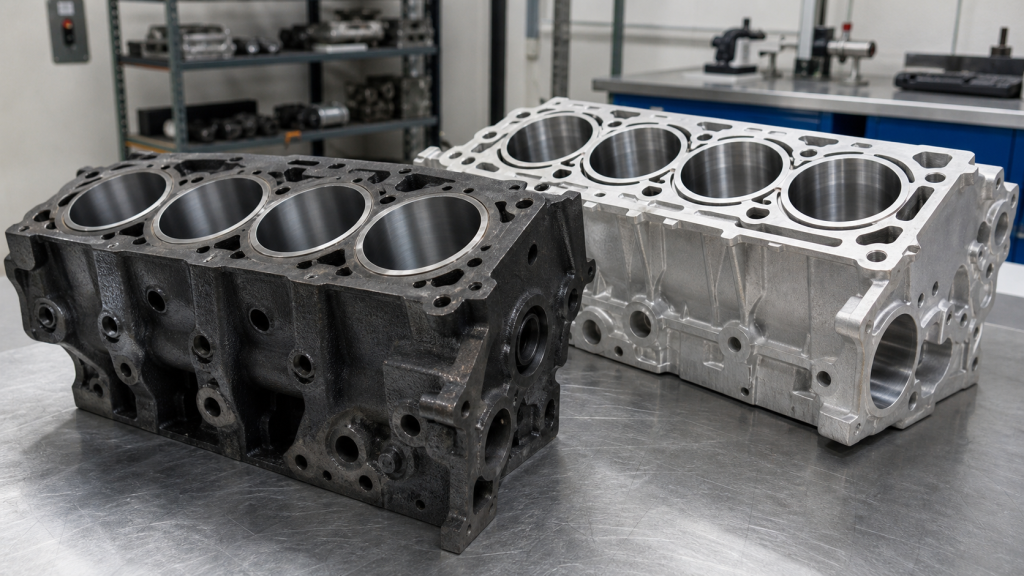
- Cast iron blocks offer stiffness and wear resistance; aluminum blocks reduce weight but require liners or thermal coatings in high-load applications.
- Block geometry—deck flatness, bore roundness, main bearing bore alignment—controls whether a rebuild meets compression, oil pressure, and sealing targets.
The Engine Block Is the Main Structural Datum
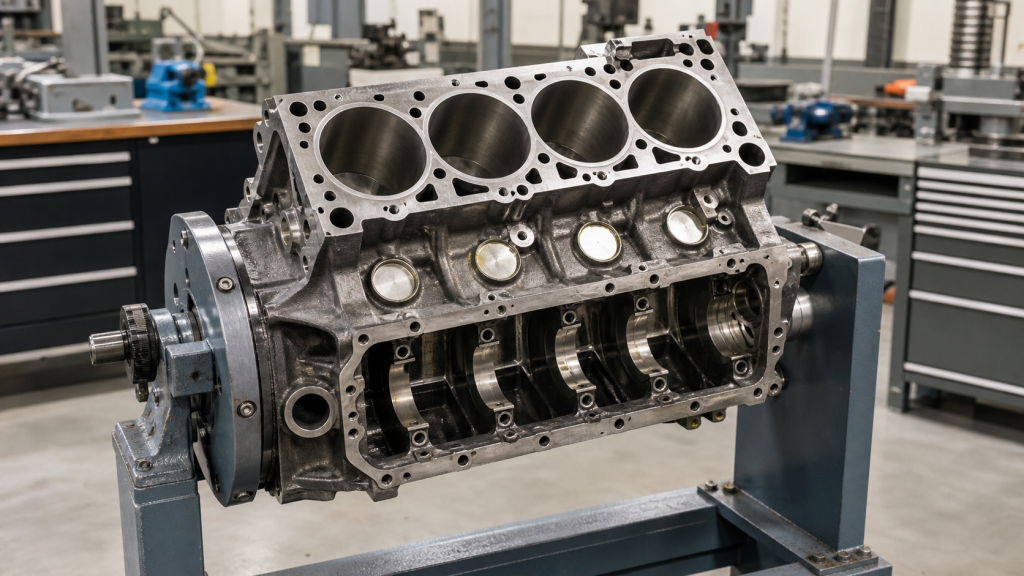
The engine block establishes the coordinate system for every other engine component. Cylinder bores are machined parallel to one another and perpendicular to the deck surface. The crankshaft centerline is located by a series of main bearing bores machined in a single operation, ensuring alignment within a few thousandths of an inch. The deck surface—where the cylinder head bolts down—is machined flat and parallel to the crankshaft axis so that head gasket compression remains uniform across all cylinders.
This datum-based design means that machining errors, casting porosity, or distortion in the block compromise every downstream assembly. A warped deck prevents head gasket sealing. Misaligned main bearing bores bind the crankshaft or accelerate bearing wear. Out-of-round cylinder bores cause uneven piston ring contact, increasing oil consumption and blowby. Engine block repair and resurfacing procedures exist to restore these datums, but only within material and structural limits.
The block also houses the mounting bosses that attach the engine to the vehicle. These bosses transfer combustion loads, rotating inertia, and accessory drive forces into the chassis. A crack in a mounting boss or main bearing web can propagate during operation, eventually causing catastrophic failure.
Cylinder Bores, Deck, Crankcase, and Main Bearing Structure
The cylinder bore is a precision-ground hole that guides the piston and seals combustion pressure through the piston rings. Bore diameter, surface finish, and roundness directly affect ring seal, oil control, and piston-to-wall clearance. Most production blocks use a cast-in bore for iron blocks or a pressed-in liner for aluminum blocks. The bore surface must resist wear from piston side loads while maintaining the cross-hatch finish that retains oil film.
The deck is the flat surface at the top of the block where the cylinder head seals. Deck flatness is measured in thousandths of an inch across the entire sealing surface. If the deck warps from overheating or loosened head bolts, coolant or combustion gas leaks between cylinders or into the coolant passages. Resurfacing removes material to restore flatness, but excessive removal changes piston-to-deck clearance and compression ratio.
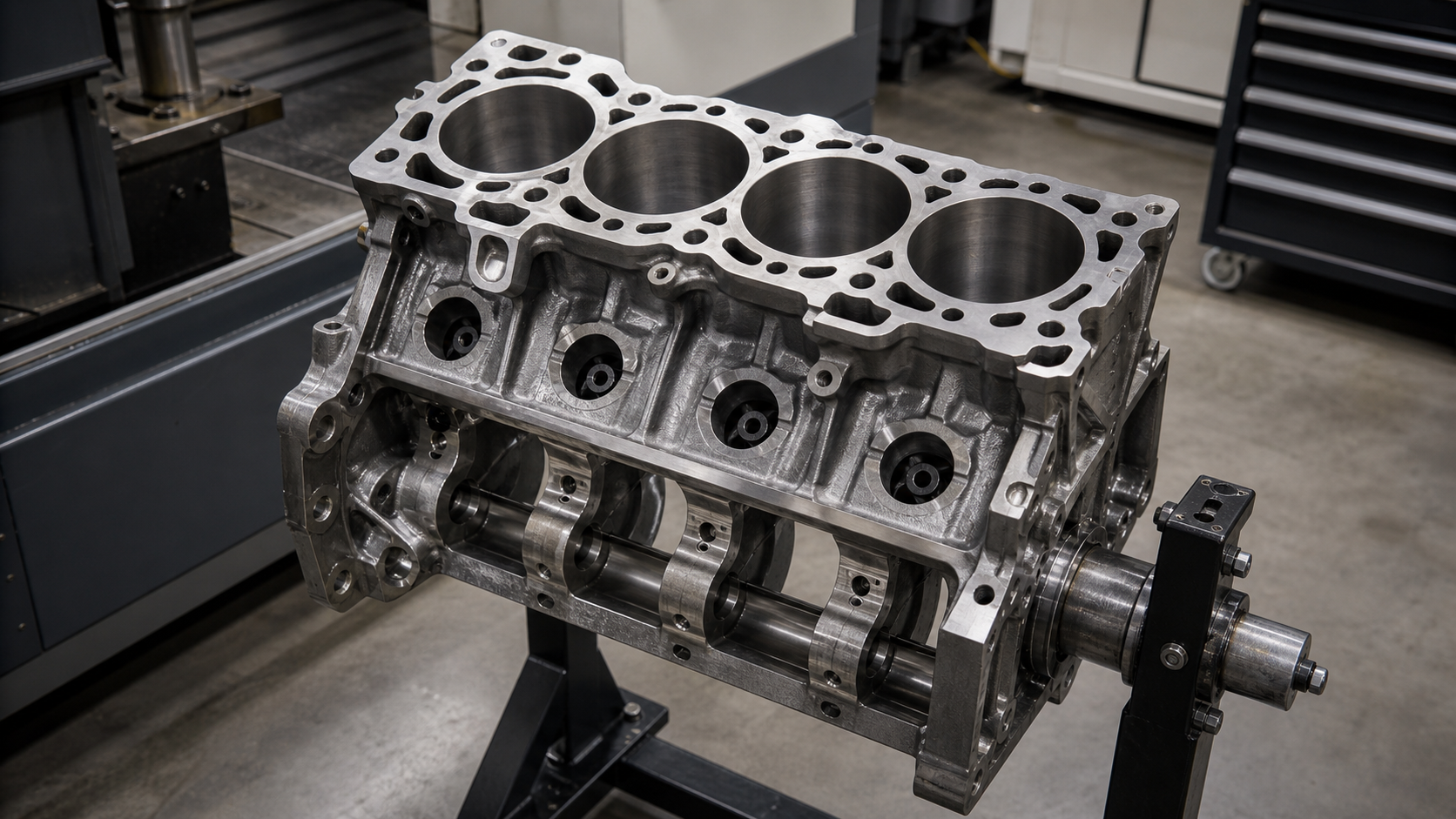
The crankcase is the lower structure that surrounds the crankshaft and contains the main bearing caps. In most designs, the main bearing bores are split between the block and separate bearing caps, which are torqued in place to clamp the bearing shells around the crankshaft journals. Some heavy-duty and performance blocks use a bedplate—a separate structural grid bolted to the bottom of the block—to increase main bearing stiffness and distribute loads over a larger area.
Main bearing webs are the vertical walls between each main bearing bore. These webs carry the full rotating load of the crankshaft, including combustion impulses and reciprocating inertia. Aluminum and cast iron blocks differ significantly in web design: aluminum requires thicker sections or additional reinforcement to match the stiffness of iron.
Coolant Jackets and Oil Galleries
Coolant jackets are cast passages that surround the cylinder bores and combustion chambers. Coolant flows through these jackets to remove heat from the cylinder walls, valve seats, and exhaust ports. The jacket design must balance cooling effectiveness against structural stiffness—too much material removal weakens the casting, while insufficient cooling causes hot spots that lead to detonation or head gasket failure.
Oil galleries are drilled or cast passages that distribute pressurized oil from the pump to the main bearings, camshaft bearings, and cylinder head. Gallery plugs seal the ends of drilled passages and must remain leak-tight under full oil pressure. A leak in an oil gallery or a missing plug drops oil pressure to downstream bearings, causing accelerated wear or seizure.
Coolant and oil passages are verified during block inspection using pressure tests. A coolant pressure test applies pressure—typically matching the system’s rated cooling system pressure—to the sealed block and checks for leaks at core plugs, gallery plugs, or through cracks in the casting. An oil gallery pressure test uses a similar method to confirm that all passages seal and that oil reaches every bearing surface. These tests detect porosity, cracks, or plug failures that visual inspection misses. Without measured confirmation, a rebuilt engine may lose coolant internally, overheat, or starve bearings of oil.
How the Block Carries Combustion and Rotating Loads
Combustion pressure in a typical gasoline engine reaches high peak cylinder pressure values during combustion. This force pushes down on the piston crown, through the piston pin into the connecting rod, and into the crankshaft journal. The crankshaft converts linear piston motion into rotation, but the force vector changes direction with every stroke. The block absorbs these reversing loads through the main bearing caps and webs.
At the top of the block, combustion pressure also acts radially against the cylinder wall and upward against the deck surface. The cylinder head is clamped to the deck with head bolts or studs torqued to a specified preload. This preload must exceed peak cylinder pressure to prevent head gasket blowout. The deck surface distributes this clamping force evenly across the gasket, while the head bolts thread into reinforced bosses cast into the block structure.
The main bearing caps and webs carry the full rotating assembly load. Each main bearing supports a portion of the crankshaft’s weight and the alternating combustion forces transmitted through the connecting rods. The bearing cap bolts are torqued to specifications defined in the engine service manual to prevent cap movement under load. If a cap shifts or fretting occurs between the cap and block, bearing clearance increases and oil pressure drops.
Engine mounts bolt to reinforced bosses on the block exterior. These mounts isolate the engine’s vibration from the chassis while preventing excessive movement during acceleration, braking, or cornering. A cracked mounting boss allows the engine to shift position, misaligning drivetrain components and potentially breaking exhaust or cooling system connections.
Cast Iron, Aluminum, Liners, and Bedplates
Cast iron blocks offer high stiffness, excellent wear resistance, and thermal stability. Gray cast iron is the traditional material for production engines because it machines easily, dampens vibration, and allows direct cylinder bore machining without liners. The graphite flakes in gray iron provide inherent lubricity and reduce piston ring wear. However, cast iron is heavy, and modern fuel economy targets have driven many manufacturers toward aluminum.
Aluminum blocks can reduce engine mass substantially compared with equivalent iron designs, but the result depends on section thickness, reinforcement, liners, and the lower structure. Because the bore surface must resist ring and piston wear, many aluminum blocks use cast-iron or steel liners, while others use an engineered bore surface or thermal-spray coating. The exact construction must be identified before honing, boring, or selecting replacement pistons.
Liner replacement is a common rebuild procedure for aluminum blocks, but it requires precision. The liner must be press-fit with controlled interference to ensure heat transfer from the liner into the surrounding coolant jacket. Service specifications define the required interference fit for each engine design. Insufficient interference allows the liner to shift or vibrate, causing fretting wear and eventual coolant leaks. Excessive interference distorts the bore, creating an out-of-round condition that increases ring wear.
Bedplate designs appeared in heavy-duty diesel and high-performance engines to increase main bearing stiffness. A bedplate is a separate casting or fabricated steel grid that bolts to the bottom of the block, tying all main bearing caps together into a single rigid structure. This design reduces main bearing deflection under load and allows higher cylinder pressures. The tradeoff is increased weight, cost, and assembly complexity. Bedplate engines require careful torque sequences and often use angle-torque specifications to achieve proper cap preload.
When a block reaches the end of its service life, the decision between repair and replacement depends on material condition, available machining limits, and the cost of related components. Cast iron blocks tolerate multiple bore oversize operations—typically up to 0.060 inches total in many designs—before wall thickness becomes marginal. Aluminum blocks with liners can often be restored by installing the next oversize liner, but only if the surrounding aluminum structure remains sound. Porosity, cracks, or erosion in the coolant jacket limit repairability regardless of material. A block with a cracked main bearing web or through-crack in a cylinder wall is scrap.
What Attaches to the Block
The cylinder head bolts to the deck surface and seals the combustion chambers. The head contains the valves, ports, and combustion chamber shape that control airflow and flame propagation. Head studs or bolts thread into the block, and their torque and sequence determine head gasket sealing and deck stress distribution.
The oil pan bolts to the bottom of the crankcase and serves as the engine’s oil reservoir. Pan gasket sealing depends on a flat, undistorted rail around the perimeter of the block. A warped pan rail causes oil leaks that contaminate the engine bay and reduce oil capacity.
The timing cover bolts to the front of the block and encloses the timing chain or belt drive. The timing cover often incorporates the front main seal, oil pump mounting, and crankshaft position sensor. Misalignment between the timing cover and crankshaft nose causes front seal leaks and sensor signal errors.
Accessory brackets bolt to reinforced bosses on the block sides. These brackets support the alternator, power steering pump, air conditioning compressor, and other belt-driven accessories. A cracked bracket boss drops the accessory into the drive belt, causing immediate engine shutdown.
The engine mounts thread into bosses cast into the block sides or bottom. These mounts isolate vibration and position the engine in the vehicle chassis. Mount failure allows excessive engine movement, which can break exhaust connections, radiator hoses, or wiring harnesses.
Why Block Geometry Controls Rebuild Quality
Rebuilding an engine requires restoring block geometry to specifications that support proper sealing, bearing clearance, and component alignment. Three measurements determine whether a used or worn block is rebuildable:
Deck flatness is measured with a precision straightedge and feeler gauges or on a calibrated surface plate across the axes specified by the engine maker. The acceptable distortion and minimum deck height depend on the block, head gasket, and measurement span. Resurfacing removes material between the crankshaft centerline and deck, so the shop must verify piston-to-deck clearance, compression geometry, timing relationships, and the maker’s minimum-height limit before cutting.
Cylinder bore condition is assessed by measuring diameter at multiple depths and orientations with a dial bore gauge referenced to a micrometer. Compare taper, out-of-round, diameter, and surface damage with the exact service limit and the piston and ring supplier’s finish specification. A bore that exceeds those limits may require honing, boring to an approved oversize, or installing a liner; visual crosshatch appearance alone does not establish suitability.
Main bearing bore alignment is checked with the specified caps or bedplate installed at the correct fastener condition. Misalignment can bind the crankshaft or concentrate bearing load. Whether line boring or line honing is permissible depends on measured bore size, alignment, cap registers, bearing crush, and the engine maker’s repair procedure; machining without that complete measurement set can create a new bearing-fit problem.
These inspection steps must precede any parts ordering or machining work. A block that fails multiple checks may exceed economical repair limits, particularly if replacement short blocks or used blocks are available. Sourcing a replacement block requires matching the engine family, casting number, and year range to ensure that bore spacing, deck height, main bearing journal diameter, and bolt patterns align with existing components. Cylinder head bolt patterns and coolant passage locations often change within the same engine family, making some blocks incompatible with existing heads or accessories.
FAQs
Can a cracked engine block be repaired?
Minor surface cracks in non-structural areas can sometimes be repaired using cold-stitch methods or specialized welding techniques, but cracks in cylinder walls, main bearing webs, coolant jackets, or combustion chambers usually require block replacement. The repair cost, risk of re-cracking, and availability of replacement blocks determine whether repair is practical. Always pressure-test a repaired block before assembly.
How do I know if my engine block is aluminum or cast iron?
Use a magnet. Cast iron is ferromagnetic and attracts a magnet strongly. Aluminum is non-magnetic. You can also check the engine code or casting number stamped on the block and cross-reference it with manufacturer specifications. Weight is another indicator—aluminum blocks are noticeably lighter than iron blocks of the same displacement.
What causes engine block porosity?
Porosity occurs during casting when gas pockets become trapped in the molten metal as it solidifies. These voids create pathways for coolant or oil to leak through the casting wall. Porosity is a manufacturing defect, not a wear or maintenance issue. Pressure testing during inspection detects porosity that is not visible externally. Severe porosity makes a block unrepairable.
Do all aluminum blocks use cylinder liners?
No. Some aluminum blocks use pressed or cast-in iron or steel liners, while others use thermal spray coatings applied directly to the aluminum bore. A few high-silicon aluminum alloys are hard enough to run without liners in low-load applications. The engine’s design, intended power output, and manufacturer’s cost targets determine which approach is used.
How much does engine block resurfacing cost?
Block resurfacing cost varies by region, block size, access, cleaning and disassembly needs, crack testing, fixturing, machining route, and required inspection. A deck-only price is not comparable with a reconditioning quote that also includes boring, honing, main-bore work, pressure testing, threaded-hole repair, and final washing. Request a written scope listing each operation, the measurements reported before and after machining, and the specification used for acceptance.
Conclusion
The engine block is the structural foundation that locates every major engine component and carries combustion loads from the cylinder walls through the deck, main bearings, and engine mounts. Understanding how the block functions as a machined datum—and how casting quality, material choice, and geometric accuracy determine rebuild feasibility—helps you make informed decisions about repair, replacement, or sourcing. Before committing to a rebuild, measure deck flatness, bore condition, and main bearing alignment against the engine manufacturer’s specifications. Use pressure tests to confirm that coolant jackets and oil galleries seal properly. If you are sourcing a replacement block, verify the casting number, bore spacing, and deck height to ensure compatibility with your existing cylinder head, crankshaft, and accessory brackets. For assistance matching engine block specifications to your application, consult your engine builder or parts supplier with the complete engine code and vehicle identification information.