White exhaust smoke points to coolant entering the combustion chamber, but that path can start at a cracked cylinder head, a warped head deck, a failed head gasket, or a cracked engine block. Each failure creates overlapping symptoms—coolant loss, rough idle, overheating—yet each requires a different repair scope and cost. This guide sorts cracked cylinder head symptoms by leak path, then explains the tests that confirm whether the head itself is damaged or whether the problem lies in the gasket or block.
Key Takeaways
- White exhaust smoke, coolant loss, and rough idle are shared by cracked heads, warped heads, and gasket failures; use pressure tests and flatness measurements to separate them.
- Combustion-to-coolant leaks cause bubbles in the overflow tank and exhaust pressure in the cooling system, while coolant-to-oil mixing produces milky oil and raised oil-pan levels.
- External coolant or oil leaks along the head deck suggest either head-bolt clamp failure or casting porosity rather than a through-crack.
- Compression and leak-down tests reveal valve-sealing loss or combustion leaks, but cannot distinguish between head cracks, gasket failure, and piston-ring issues without teardown.
- Pressure testing the head and measuring deck flatness on a surface plate are the only confirmation methods that isolate head damage from gasket or block faults.
Cracked, Warped, and Generally Bad Are Different Diagnoses
The term bad cylinder head symptoms covers three distinct mechanical failures: a crack through the casting, warpage of the head deck surface, and valve-sealing loss from worn guides or burned seats. A cracked cylinder head develops a leak path through the casting material, usually between a coolant passage and a combustion chamber, or between two coolant passages. A warped cylinder head has a distorted deck surface that prevents the head gasket from sealing properly, but the casting itself remains intact. Valve-train damage—worn guides, burned seats, failed seals—creates compression loss and oil consumption without affecting the head casting or deck.
These failures produce overlapping symptoms because all three compromise sealing between the combustion chamber, cooling system, and lubrication system. The diagnostic job is to separate the leak paths and confirm which part failed before ordering replacement heads, gaskets, or machining services.
A crack requires head replacement or specialized welding repair. Warpage requires resurfacing on a milling machine or surface grinder, with a cut depth that must stay within the engine-maker’s service limit. Valve-train damage requires seat machining, guide replacement, or valve replacement, all of which can be done without replacing the head casting.
Combustion-to-Coolant and Coolant-to-Oil Symptoms
Combustion-to-coolant leaks create the most visible and measurable symptoms. Hot combustion gas enters the cooling system during the power stroke, raising system pressure and forcing coolant into the overflow tank. The overflow tank shows bubbles during engine operation, and coolant level drops without visible external leaks. The exhaust carries a sweet smell from vaporized coolant, and white steam exits the tailpipe continuously rather than only during cold startup. The engine overheats because combustion gas displaces coolant in the passages around the combustion chamber.
A combustion-to-coolant leak can originate from a crack in the head, a crack in the block, or gasket failure at the fire ring. The head gasket is the most common failure point, especially after overheating or incorrect head-bolt torque. A crack in the head typically runs between the valve seats or from a valve seat to a coolant passage, particularly on engines with thin casting sections between the valves and the coolant jacket. Cast-iron heads crack less frequently than aluminum heads because iron has higher tensile strength, but iron heads are more susceptible to warpage from thermal stress.
Coolant-to-oil mixing produces milky or tan-colored oil on the dipstick and under the oil-filler cap. The oil level rises above the full mark because coolant volume adds to the sump. This leak path usually runs from a coolant passage to an oil-return passage in the head, or from the coolant jacket to the valve-cover area. The head gasket can also fail between a coolant passage and an oil-return hole.
Coolant in the oil reduces lubrication effectiveness and can cause bearing damage if the engine continues to run. The oil pressure may drop because the coolant dilutes the oil and lowers its viscosity. Coolant-to-oil leaks are less common than combustion-to-coolant leaks because the pressure differential between the cooling and lubrication systems is smaller, but they indicate serious head or gasket damage that requires immediate shutdown.
Compression, Misfire, and Valve-Sealing Signs
Low compression in one or more cylinders indicates a leak path from the combustion chamber, but the leak can exit to the cooling system, crankcase, intake port, or exhaust port. A compression test measures cranking pressure, and the result must be compared with the engine maker’s procedure, minimum value, and cylinder-to-cylinder balance rule. A low reading narrows the fault to sealing loss; it does not by itself distinguish a valve, ring, gasket, head, or block problem.
A leak-down test provides more diagnostic information than a compression test. Compressed air enters the cylinder through the spark-plug hole with the piston at top dead center on the compression stroke, and the technician measures how much air leaks past the sealing surfaces. Higher leak rates indicate problems, with the leak path identified by listening for air escaping at the tailpipe (exhaust valve), the intake (intake valve), the oil-filler cap (piston rings), or the coolant overflow (head or gasket). According to measurement practices documented by automotive repair sources, leak-down testing isolates the failed component more reliably than compression testing alone.
Engine misfires occur when compression loss prevents complete combustion. The engine runs rough at idle, hesitates during acceleration, and may trigger a misfire code in the engine-control module. A single-cylinder misfire usually indicates a valve or ignition problem rather than a head crack, while multiple adjacent cylinders misfiring together suggest head-gasket failure or a crack between cylinders. Diesel engines lose power and produce excessive smoke when compression drops below the ignition threshold.
Valve-sealing loss from worn guides, damaged seals, or carbon buildup creates oil consumption and blue smoke, which is distinct from the white steam caused by coolant leaks. Valve-train noise—ticking or clattering—indicates loose clearance or worn cam lobes, not head casting failure.
External Leak and Overheating Patterns
External coolant leaks from the head appear at the head-to-block parting line, around freeze plugs, or at coolant-passage connections. A crack that reaches the outside of the casting will leak coolant when the system is pressurized, leaving stains on the block or head surface. These leaks are easier to locate than internal leaks because the coolant path is visible, but they can be confused with weeping from a loose head bolt or a deteriorated head gasket.
Oil leaks from the valve-cover gasket, cam-tower seals, or head-to-block joint appear as dark stains on the side of the engine. A cracked head can leak oil from the camshaft journals or oil-return passages, but external oil leaks more commonly originate from gasket failure or loose fasteners. Porosity in the casting—small voids left during the casting process—can also cause slow seepage without a visible crack line.
Persistent overheating after head-gasket replacement or cooling-system service suggests either a crack in the head or block, or warpage that prevents proper gasket sealing. The cooling system pressurizes beyond the radiator-cap rating, forcing coolant into the overflow bottle and creating hot spots around the combustion chambers. Overheating can cause additional damage, including further cracking or warpage, so diagnosis must happen before the engine is restarted.
Tests for Cracks, Warpage, and Gasket Failure
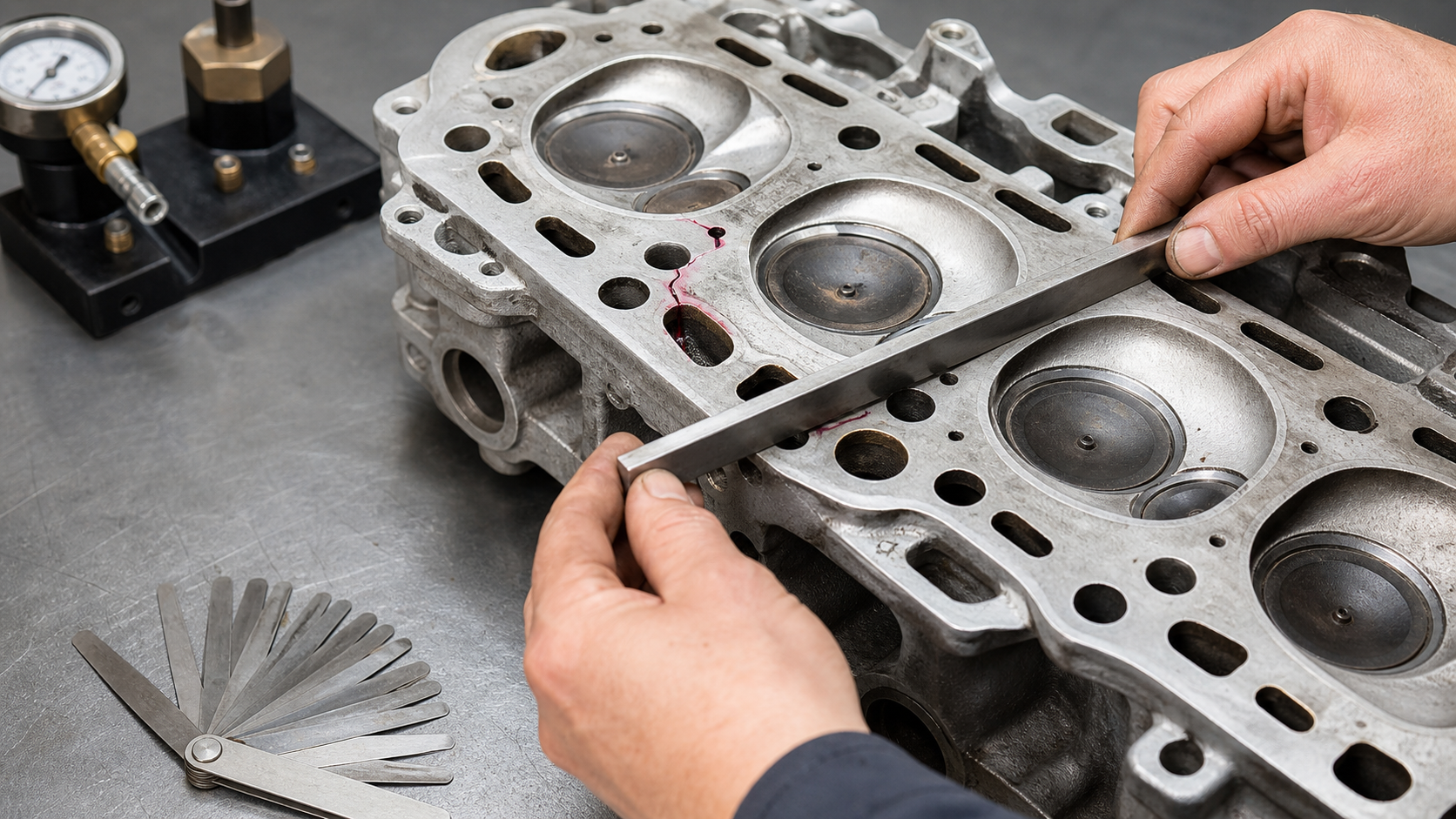
Pressure testing the head off the engine confirms whether a crack penetrates the cooling passages or combustion chambers. The head is placed on a test stand with all passages sealed except the coolant inlet and outlet, then pressurized with air or water. A crack will leak fluid or show bubbles in a water bath. Dye-penetrant or magnetic-particle inspection reveals surface cracks that do not penetrate all the way through the casting. Professional inspection methods include fluorescent dye and ultraviolet light to highlight fine cracks.
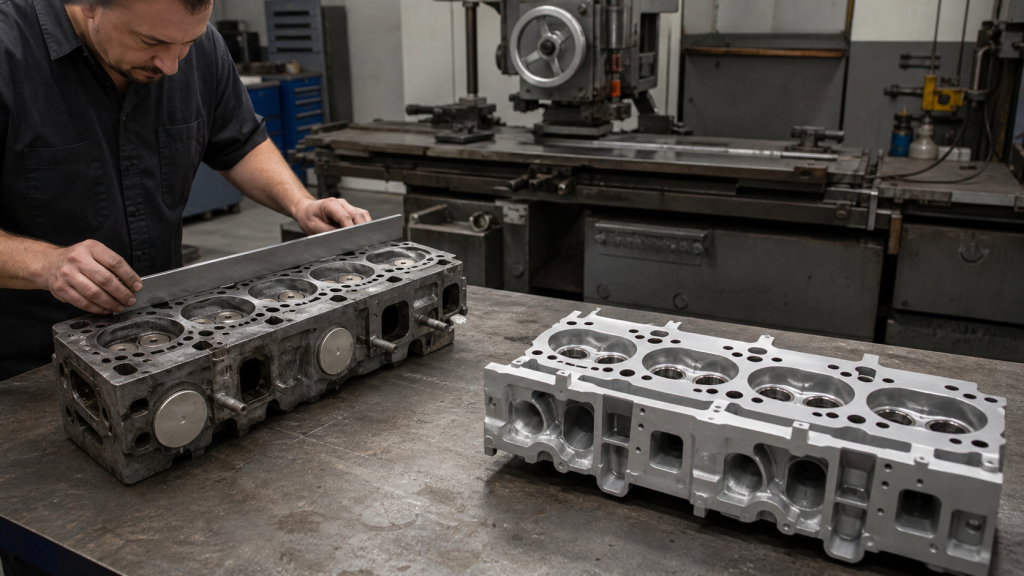
Flatness measurement determines whether the head deck is warped. The head sits on a precision surface plate, and a feeler gauge or dial indicator measures the gap between the deck and the plate. Flatness specifications vary by engine and must come from the service manual or gasket manufacturer. Warpage beyond the limit requires resurfacing, but the machining cut must stay within the total material-removal limit specified for that engine, or the head must be replaced.
Visual inspection of the removed head reveals cracks around valve seats, between cylinders, or near bolt holes. A crack may appear as a dark line in the casting, or as a stained area where coolant or oil has leaked through. The gasket surface shows compression marks where the fire rings sealed, and these marks should be uniform. Uneven marks or missing compression areas indicate warpage or incorrect bolt torque.
A combustion-leak test on the assembled engine uses a chemical detector that changes color when exposed to combustion gas. The test tool sits in the radiator filler neck, and the engine runs at idle. If combustion gas enters the cooling system, the detector fluid changes color. This test confirms a combustion-to-coolant leak but does not distinguish between head, block, or gasket failure.
|
Test Method |
What It Confirms |
What It Cannot Confirm |
|---|---|---|
|
Compression test |
Low cylinder pressure |
Leak location (valves, rings, gasket, crack) |
|
Leak-down test |
Leak path direction |
Exact crack location before teardown |
|
Pressure test (head off) |
Crack penetration in head casting |
Block cracks or gasket-surface condition |
|
Flatness measurement |
Deck warpage |
Internal cracks or valve-train wear |
|
Combustion-leak detector |
Combustion-to-coolant path exists |
Which component failed (head, block, gasket) |
Damage Locations and Repairability
Cracks typically form in high-stress areas of the cylinder head: between valve seats, between the valve seat and the spark-plug hole, between adjacent cylinders, and around head-bolt bosses. Aluminum heads crack more readily than cast-iron heads because aluminum has lower fatigue resistance and higher thermal expansion. Overheating, detonation, and incorrect head-bolt torque are the primary causes.
A crack between valve seats or from a valve seat to a coolant passage can sometimes be welded, but the repair requires preheating the entire casting, welding with compatible filler material, and stress-relieving afterward. Most aluminum-head cracks are considered non-repairable because the welding distorts the deck surface and the heat-affected zone remains brittle. Cast-iron heads can be welded more successfully, but the repair still requires subsequent machining and pressure testing.
Warpage can be corrected by resurfacing if the total material removal stays within the service limit. The machine shop mills or grinds the deck flat, then measures the remaining deck height. If the deck height falls below the minimum specified in the service manual, the head must be replaced. Excessive material removal raises the compression ratio, advances valve timing, and may cause piston-to-valve interference.
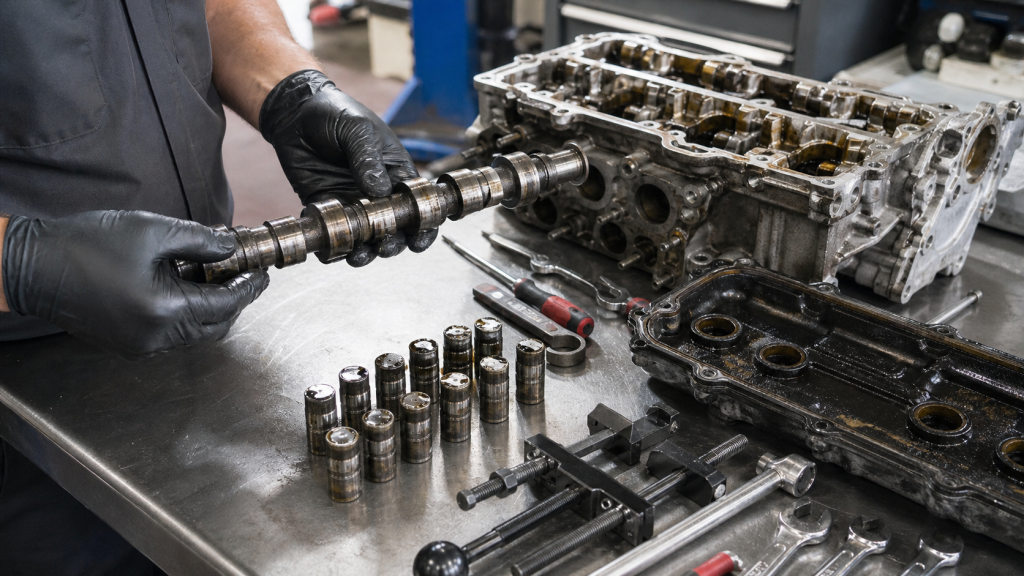
Valve-train damage—worn guides, burned seats, cracked valves—is repairable through machining and component replacement. The machine shop installs new valve guides, cuts the valve seats to the correct angles and widths, and laps the valves to the seats. This work requires confirming that the head casting and deck surface are undamaged.
What Evidence to Collect before Disassembly
Before removing the cylinder head, document the symptoms and test results to guide the inspection. Record the exact coolant-loss rate, whether the loss is gradual or sudden, and whether coolant appears in the oil or exhaust. Note which cylinders show low compression or high leak-down, and where the leaking air exits. Photograph any external leaks, stains, or damage to the head, block, or gasket.
Run a combustion-leak test and record the result. Check the cooling-system pressure with the engine cold and hot, and compare it to the radiator-cap rating. Measure the coolant temperature at the thermostat housing and radiator outlet to confirm that the thermostat and water pump are functioning.
After disassembly, inspect the head gasket for failure patterns. A blown gasket shows a breach in the fire ring, missing material, or carbon tracking between cylinders or to a coolant passage. The gasket condition reveals whether the failure started from overpressure, overheating, or insufficient bolt clamp. Inspect the head-bolt holes in the block for thread damage, cracks, or coolant contamination. Measure the head-bolt lengths to check for stretching, which indicates the bolts must be replaced.
Deliver the head to a machine shop with a clear description of the failure symptoms and test results. Request pressure testing, flatness measurement, valve-guide and seat inspection, and crack inspection. Ask for a written report with measured values rather than a pass/fail statement, so you can compare the results to service-manual limits. If the head is repairable, request a quote for resurfacing, valve-train work, and pressure testing after machining. If the head is not repairable, request confirmation of the crack location and recommendations for replacement-head selection.
FAQs
Can a small crack in a cylinder head be left alone if the engine still runs?
No. A crack that allows combustion gas or coolant to leak will grow larger from thermal cycling and pressure stress. The engine will overheat, lose coolant continuously, and risk further damage to the block, gaskets, and bearings. Coolant in the oil destroys lubrication and can seize the engine. Even a slow external leak wastes coolant and creates a fire risk if coolant contacts hot exhaust components. Continued operation accelerates the damage and increases the final repair cost.
How do you distinguish between a cracked head and a blown head gasket without teardown?
You cannot confirm the exact failed component without removing the head. A combustion-leak test proves that combustion gas enters the cooling system, but the leak path can originate from the head, block, or gasket. Pressure testing and flatness measurement after disassembly isolate the failed part. However, external leaks that appear only at the head-to-block joint, combined with a gasket that shows localized burning or missing material, suggest gasket failure. Internal leaks with no gasket damage point to a crack in the head or block.
What causes a cylinder head to warp instead of crack?
Warpage results from uneven thermal expansion when one area of the head reaches a higher temperature than another. Severe overheating, coolant loss, or a stuck thermostat create hot spots that expand more than the surrounding casting. When the engine cools, the material contracts unevenly and leaves permanent distortion. Aluminum heads warp more easily than cast-iron heads because aluminum has higher thermal expansion. Repeated overheating cycles increase the warpage, and incorrect head-bolt torque or sequence can also distort the deck by creating uneven clamping force.
Is it worth repairing a cracked aluminum cylinder head or should it be replaced?
Replacement is usually more reliable and cost-effective than welding an aluminum head. Welding requires specialized equipment, preheating, and stress-relieving, and the repair area remains weaker than the original casting. The welding process can distort the deck surface, requiring additional machining that may exceed the material-removal limit. Cast-iron heads have better welding success rates, but even then, replacement is often chosen for critical applications.
Do all engines with white exhaust smoke have cylinder-head problems?
No. White smoke during cold startup is normal condensation in the exhaust system and clears within a few minutes. Continuous white smoke indicates coolant entering the combustion chamber, but the leak path can originate from the head, head gasket, block, or intake-manifold gasket on engines with coolant-heated intakes. A combustion-leak test confirms whether exhaust gas enters the cooling system, which rules out intake-manifold leaks. Pressure testing and flatness measurement after teardown identify the failed component.
Conclusion
Cracked cylinder head symptoms overlap with warped-head and blown-gasket symptoms because all three failures compromise sealing between the combustion, cooling, and lubrication systems. White exhaust smoke, coolant loss, rough idle, and overheating point to a leak path, but only pressure testing the head, measuring deck flatness, and inspecting the gasket after disassembly confirm which part failed. Before removing the cylinder head, run a leak-down test, combustion-leak test, and cooling-system pressure check to document the failure mode. After disassembly, request a machine-shop inspection with written measurements for flatness, cracks, and valve-train condition. Compare those measurements to the service-manual limits before approving repair or ordering a replacement head.