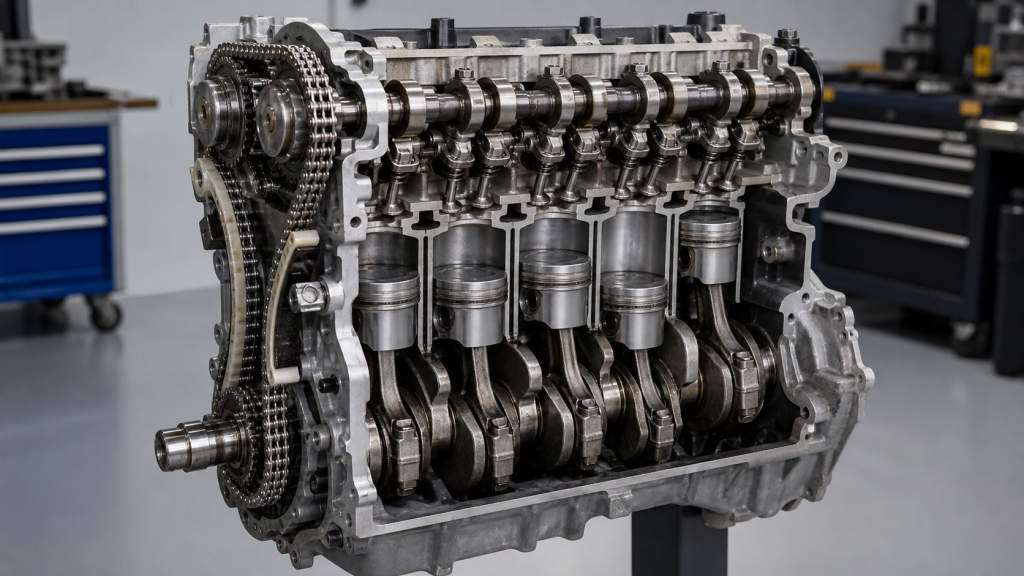
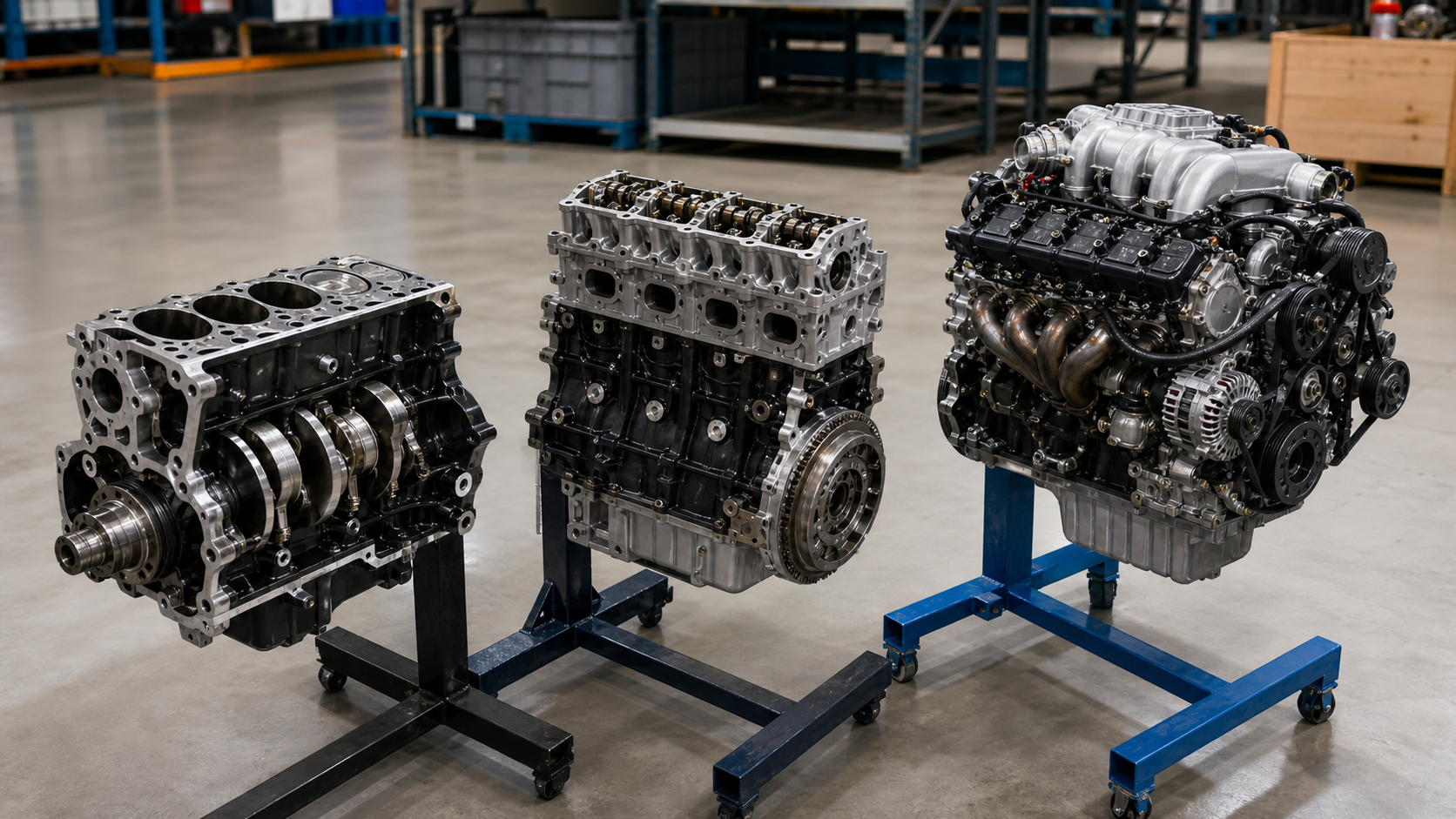
When comparing a short block vs long block, the label alone is not a specification. A short block typically includes the engine block, crankshaft, pistons, connecting rods, and main bearings—the rotating assembly—while a long block adds the cylinder head, camshaft, and valve train. But three suppliers can use the same term for three different packing lists: one long block may include an oil pump and water pump, another may not, and a third may arrive as a dressed assembly with accessories. Before ordering any replacement engine assembly, request the complete parts list, verify which gaskets and hardware are included, and confirm whether the unit has been pressure-tested and includes an inspection record.
Key Takeaways
- A short block usually includes the block, crankshaft, pistons, rods, and main bearings; a long block adds the cylinder head, camshaft, and valve train, but supplier definitions vary widely.
- Verify the actual packing list before ordering—some "long blocks" exclude oil pumps, water pumps, timing covers, or external sensors that others include.
- Choose a short block when your cylinder head, camshaft, and valve train are reusable and within service limits; choose a long block when top-end wear, damage, or unknown history makes reuse risky.
- A crate engine or complete engine typically includes front covers, oil pans, intake manifolds, and sometimes accessories, reducing assembly time but increasing cost.
- Request compression test data, surface finish reports, and pressure test results for any assembly—delivered condition determines warranty validity and installation success.
The Fast Answer: Assembly Names Are Not Universal Packing Lists
What is a short block engine, and what is a long block engine? The answer depends on the supplier. In the aftermarket, "short block" and "long block" are commercial labels, not engineering specifications. One remanufacturer may define a short block as block, crank, pistons, and rods; another may include the oil pump and timing chain; a third may add the camshaft but leave out the cylinder head. The same inconsistency affects long blocks: some arrive with all internal parts installed but no external accessories; others include oil pumps, water pumps, and timing covers; a few are shipped as complete dressed engines with intake manifolds and sensors.
This variation creates three risks. First, you may order a long block expecting an oil pump and water pump, then discover they are not included and must be purchased separately. Second, installation labor estimates depend on the actual assembly scope—if the cylinder head must still be disassembled, inspected, cleaned, and reassembled, the "long block" label saved no time. Third, warranty terms often hinge on which parts were supplied by the seller and which were reused from the old engine, so unclear boundaries lead to rejected claims.
Before comparing cost or lead time, request the complete packing list. Verify which gaskets, fasteners, seals, and sensors are included. Ask whether the assembly has been pressure-tested, whether compression or leak-down data is available, and whether the cylinder head has been resurfaced. A detailed parts list and inspection record define the actual product, not the label.
What a Short Block Usually Includes
A typical short block contains the engine’s rotating assembly and the lower structure that supports it. The engine block casting forms the cylinder bores, coolant passages, oil galleries, and mounting surfaces for external components. The crankshaft, held by main bearings in the block’s main bearing saddles, converts the reciprocating motion of the pistons into rotary motion. Pistons fit inside the cylinder bores, connected to the crankshaft by connecting rods and rod bearings. Piston rings seal combustion pressure and control oil film on the cylinder walls.
What is included in a short block varies, but most assemblies include:
- Engine block, cleaned and inspected, with cylinder bores honed or rebored to the specified finish and oversize if needed
- Crankshaft, ground to standard or undersize journals depending on wear
- Main bearings, sized to match crankshaft journal diameter and block saddle bore
- Pistons, matched to cylinder bore diameter and compression ratio specification
- Piston rings, gapped for the bore size and ring groove condition
- Connecting rods, resized and fitted with new rod bearings
- Camshaft bearings, pressed into block cam bores
- Core plugs (freeze plugs), installed in block casting holes
Some suppliers include the oil pump, camshaft, and timing components with a short block; others exclude them. The camshaft may or may not be installed. Timing chains or belts, sprockets, tensioners, and guides are sometimes packaged separately. External parts such as oil pans, timing covers, valve covers, intake manifolds, and exhaust manifolds are rarely included. Gaskets and hardware may be supplied as a separate kit or not at all.
Short blocks are sold with different levels of machine work. A "bare" short block includes only the assembled rotating components, with no additional machining beyond basic cleaning. A "machined" short block has been bored, honed, and decked to restore flatness and surface finish. A "balanced" short block has had the rotating assembly dynamically balanced to reduce vibration. Verify which machining operations have been completed and request surface finish measurements for cylinder bores and deck surfaces.
What a Long Block Usually Adds
A long block builds on the short block foundation by adding the cylinder head, camshaft (if not already included), valve train, and associated timing components. The cylinder head contains the combustion chambers, intake and exhaust ports, valve seats, and valve guides. Valves, valve springs, retainers, and keepers are assembled into the head, along with rocker arms or cam followers depending on engine design. The camshaft drives the valve train, opening and closing the valves in coordination with crankshaft rotation.
Long block assemblies typically include:
- Cylinder head, resurfaced to restore flatness and finish, with valve seats and guides reconditioned or replaced
- Valves, refaced or replaced, with new seals installed
- Valve springs, retainers, keepers, and associated hardware
- Camshaft, installed in block cam bores or overhead cam carriers depending on engine family
- Timing chain or belt, with sprockets, tensioners, guides, and gears
- Head gasket, supplied separately or pre-installed
Some long blocks also include the oil pump, water pump, timing cover, and oil pan; others exclude these parts. Front covers, rear seals, and accessory brackets are inconsistently included. The distinction between a long block and a complete or dressed engine depends on whether external accessories, sensors, and manifolds are installed.
Long blocks are supplied with varying levels of preparation. A "remanufactured" long block has been disassembled, cleaned, measured, machined as needed, and reassembled with new wear parts. A "rebuilt" long block has been reassembled with replaced wear items but may not have been fully machined. A "used" or "tested" long block has been removed from a donor vehicle and tested for basic function. Request compression test results, leak-down percentages, and cylinder head surface finish measurements. A properly prepared long block should show consistent compression across cylinders, acceptable leak-down on each cylinder, and deck surface flatness within the engine manufacturer’s specification.
Long Block vs Complete or Dressed Engine
The boundary between a long block and a complete engine depends on which external components are installed. A long block stops at the core assembly: block, crankshaft, pistons, rods, cylinder head, camshaft, and valve train. A complete engine or dressed engine adds the oil pan, timing cover, valve covers, water pump, oil pump (if not already included), intake manifold, exhaust manifolds, sensors, wiring harnesses, and sometimes accessories like the alternator, power steering pump, and air conditioning compressor.
The term "crate engine" is often used for complete, ready-to-install assemblies that include all necessary external components and have been run on a test stand. Crate engines are shipped on pallets in protective packaging, ready for installation with minimal additional parts. Some crate engines include engine mounts, flywheels, and clutch or flexplate assemblies; others require these parts from the original engine.
Choosing long block vs complete engine depends on the condition and compatibility of your existing external parts. If the oil pan, timing cover, intake manifold, and sensors are in good condition and match the replacement engine family, a long block saves cost. If external parts are worn, damaged, or incompatible—common when upgrading engine families or when the original failure was caused by contaminated oil or coolant—a complete engine avoids mixing old parts with a new assembly and reduces the risk of early failure or warranty rejection.
Crate Engine vs Long Block
Comparing a crate engine vs long block comes down to labor time, parts reuse risk, and warranty coverage. A crate engine arrives as a complete, tested assembly with all internal and most external components installed, reducing installation labor to removing the old engine, transferring necessary brackets and accessories, and installing the new unit. A long block requires disassembly of the old engine to recover oil pans, timing covers, water pumps, manifolds, sensors, and wiring, inspection and cleaning of these parts, then reassembly onto the new long block.
Labor cost tips the decision. The time required to install a long block versus a crate engine depends on engine family, chassis layout, access constraints, and the number of external parts that must be transferred. Compare local labor rates against the price difference between assembly grades to determine the most economical choice.
Parts condition determines whether reuse is practical. If the original failure was a spun bearing or broken piston but external parts show normal wear, reusing the oil pan, timing cover, and manifolds is reasonable. If the failure involved coolant contamination, overheating, or catastrophic damage that scattered debris, external parts may be scored, warped, or contaminated beyond cleaning. In these cases, a crate engine eliminates the reuse decision and the risk of introducing worn parts into a new assembly.
Warranty terms differ between assembly grades. Long block warranties typically cover only the parts included in that assembly—block, rotating components, cylinder head, camshaft, and valve train. If a reused oil pump fails and starves the new engine of oil, the warranty may not cover the resulting damage because the oil pump was not supplied by the seller. Crate engine warranties typically cover all supplied components, reducing disputes about what caused a failure. Review warranty terms carefully and document the condition of all reused parts before installation.
Choose by Reusable Parts, Labor, Downtime, and Warranty
Four factors control whether to choose a short block, long block, or complete crate engine: the measured condition of reusable parts, local labor capability and cost, acceptable downtime, and warranty scope.
Measure reusable parts before deciding. For a short block, the cylinder head, camshaft, and valve train must be within service limits. Perform a compression test and leak-down test on all cylinders. Compression should be consistent across cylinders and meet the engine manufacturer’s specification. Leak-down should be within acceptable limits for the engine family; excessive leak-down indicates worn rings, valve seats, or head gasket damage. Check the cylinder head surface for flatness using a precision straightedge and feeler gauges; out-of-flat surfaces beyond specification require resurfacing. Inspect the camshaft lobes for pitting, scoring, or wear into the hardened surface; any visible base metal exposure requires camshaft replacement.
If the cylinder head, camshaft, or valve train shows wear or damage beyond limits, a long block is required regardless of its higher cost, because machining and parts for the head may exceed the price difference. If compression, leak-down, and surface measurements are within specification and cam lobes show normal wear patterns, a short block allows reuse of known-good top-end parts.
Evaluate local labor capability. Installing a short block requires disassembling the cylinder head, cleaning and inspecting all parts, replacing gaskets and seals, and reassembling the valve train with correct timing. This work demands experience with valve train setup, torque sequences, and timing alignment. If in-house labor lacks this experience or tooling, a long block or crate engine shifts complexity to the supplier and reduces installation risk. If experienced technicians and proper tools are available, a short block may offer better cost control.
Consider downtime. A short block installation may require several days for disassembly, inspection, parts ordering, machining (if needed), and reassembly. A long block reduces that to one or two days for parts transfer and installation. A crate engine may allow same-day or next-day installation if the engine is in stock and external parts are compatible. In fleet or commercial applications, downtime cost often exceeds parts cost, making crate engines the better economic choice.
Purchase Specification and Receiving Checklist
Request the following information with any short block, long block, or crate engine quote:
Assembly scope: Complete parts list, including whether oil pump, water pump, timing cover, oil pan, valve covers, intake manifold, exhaust manifolds, sensors, wiring, and accessories are included. Identify any parts that must be supplied by the buyer or transferred from the old engine.
Machining and preparation: List of completed machining operations, including cylinder bore diameter and finish, crankshaft journal diameter, deck surface flatness and finish, and cylinder head flatness and finish. Request surface finish measurements or specifications used.
Testing and inspection: Compression test results for all cylinders, leak-down test percentages, and pressure test confirmation for coolant and oil passages. Request photos of bearing surfaces, cam lobes, and valve seats if available.
Warranty terms: Coverage period, mileage limit, covered components, exclusions for reused parts or installation defects, required installation procedures, and break-in instructions. Verify whether warranty is parts-only or covers labor, and whether diagnosis and teardown are included.
Fitment and compatibility: Confirm engine family, displacement, VIN range, and model year compatibility. Identify any differences in sensors, mounts, or accessories that require modification or additional parts.
On delivery, inspect the assembly before signing for receipt:
- Verify all packaged parts against the packing list
- Check for shipping damage, loose parts, or leaking fluids
- Confirm that rotating components turn freely without binding or excessive drag
- Inspect machined surfaces for rust, contamination, or damage
- Verify that protective plugs or caps are installed on all ports and openings
- Photograph the as-delivered condition and any discrepancies for warranty documentation
Do not install an assembly that shows shipping damage, incorrect parts, or missing components. Contact the supplier immediately and document the condition before moving or opening protective packaging.
FAQs
Can I mix short block and long block parts from different suppliers?
Mixing parts from different suppliers introduces dimensional and material compatibility risks. Crankshaft and camshaft timing must match; piston-to-valve clearance depends on camshaft profile, piston dome height, and deck height; bearing clearances depend on journal diameter and housing bore. If you must mix parts, verify all critical dimensions against the engine manufacturer’s service manual and measure clearances before assembly. Using parts from a single remanufacturer ensures compatibility and preserves warranty coverage.
How do I verify that a used long block is actually tested and not just pulled from a salvage yard?
Request documentation: compression test results with cylinder numbers and pressures, leak-down test percentages, and any pressure test or run stand data. A tested long block should include a tag or label with test date, technician signature, and recorded values. If the seller cannot provide test data, assume the assembly has not been tested and plan for full inspection and testing before installation. Used assemblies without test records should be priced accordingly and may not include any warranty.
What assembly grade should I choose for a high-mileage engine with unknown maintenance history?
For engines with unknown history, a long block or crate engine reduces risk. Unknown maintenance may mean worn camshafts, damaged valve seats, scored cylinder walls, or contaminated oil galleries that will not be revealed until disassembly. A short block requires reusing the cylinder head and valve train, which may fail shortly after installation if wear or damage was not detected. A long block replaces all high-wear internal parts and allows inspection of external components during transfer. If the vehicle is worth rebuilding, the higher cost of a long block is justified by lower failure risk and better warranty coverage.
Is a remanufactured engine better than a rebuilt engine, and how do I tell the difference?
A remanufactured engine has been fully disassembled, cleaned, measured, and machined to restore dimensions and surface finish to within original specifications. Worn or damaged parts are replaced, and the assembly is tested before shipping. A rebuilt engine has been repaired by replacing failed parts but may not have been fully machined or tested. "Remanufactured" typically indicates a higher standard of preparation, but verify by requesting machining records and test data rather than relying on the label. Some sellers use "rebuilt" and "remanufactured" interchangeably, so documentation is the only reliable proof of work performed.
Can I upgrade to a higher-performance camshaft or different compression ratio when ordering a long block?
Many remanufacturers offer custom specifications for long blocks and crate engines, including upgraded camshafts, higher compression pistons, and performance valve train components. Specify the intended application, required power output, and any constraints like fuel type or emissions compliance. Performance modifications may void original equipment warranties and affect emissions certification, so verify local regulations before ordering. Custom assemblies typically require longer lead times and may not be returnable, so confirm all specifications and compatibility before ordering.
Conclusion
Choosing between a short block vs long block depends on measured evidence, not labels. Perform compression and leak-down tests on your existing engine, inspect cylinder head flatness and camshaft condition, and compare the cost of machining and parts against the price difference between assembly grades. Request a complete packing list and test data from any supplier before ordering, and verify fitment, warranty terms, and required installation procedures. The right assembly balances reusable parts, labor capability, downtime cost, and warranty coverage for your specific engine and application. Before installation, photograph the as-delivered condition, confirm all parts against the packing list, and inspect for shipping damage or missing components.