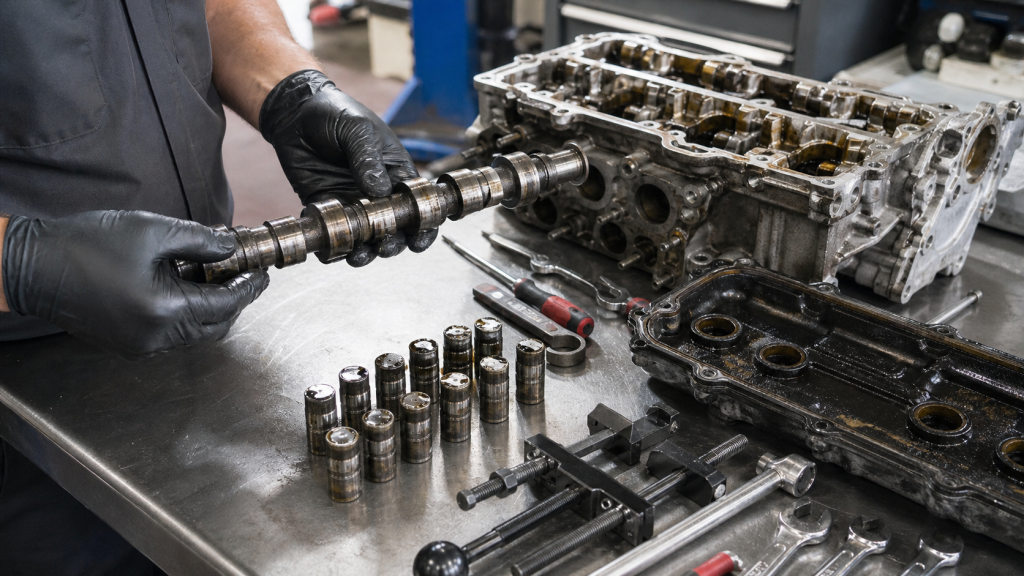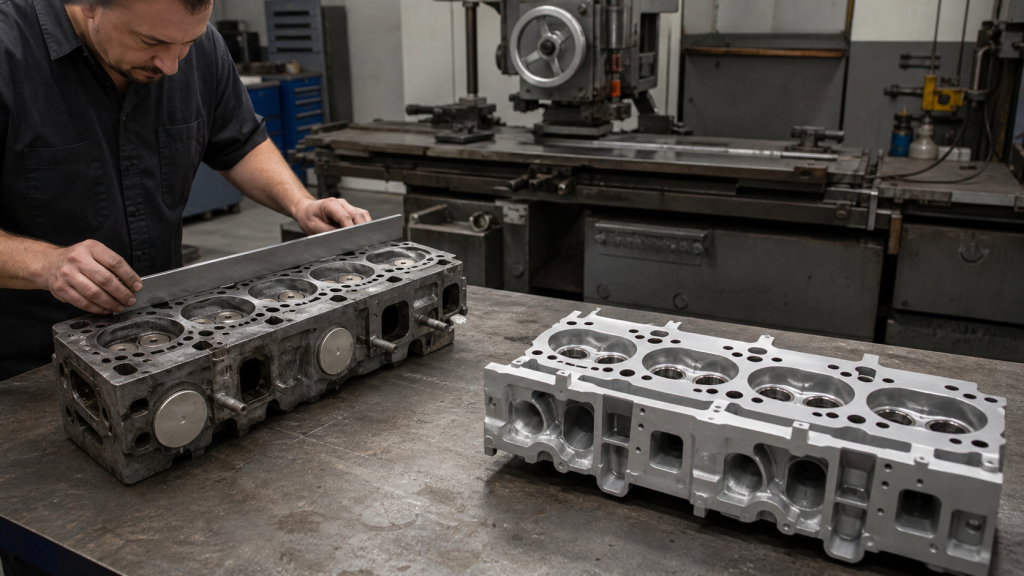
A misfire that remains after replacing spark plugs, checking fuel injectors, and confirming ignition timing points to a mechanical fault inside the valvetrain. When the engine runs rough at idle, loses power under load, or produces loud ticking from the valve cover, a worn or failed camshaft becomes the likely cause. Confirming the diagnosis means measuring valve lift with a dial indicator and inspecting oil-filter debris under magnification, not relying on performance symptoms alone.
Key Takeaways
- Worn camshaft lobes reduce valve lift, causing misfires, rough idle, reduced power, and persistent valvetrain noise after ignition and fuel checks eliminate other causes.
- Journal and cam-bearing wear drop oil pressure, create knocking sounds, and deposit bronze or aluminum particles in the oil filter.
- Timing-drive faults, phaser seizure, or sensor-target damage cause erratic timing, cam-position correlation codes, and sudden driveability changes.
- Broken camshafts produce immediate catastrophic noise, complete valve-function loss, and metal debris throughout the oil system.
- Causes include oil starvation, incompatible lifters or followers, installation errors, improper break-in, and sustained high-load operation beyond design limits.
- Confirmation requires dial-indicator measurement of valve lift at each lobe, oil-filter inspection under magnification, and comparison to service-manual specifications before ordering replacement parts.
Bad Camshaft Is a Failure Category, Not One Symptom
Camshaft failure takes four primary forms: lobe wear that reduces valve lift, journal or bearing distress that compromises lubrication and shaft support, timing-system faults that move cam position relative to crank position, and fracture that breaks the shaft. Each failure mode creates a different symptom pattern. Lobe wear causes progressive performance loss and valvetrain noise. Journal damage produces oil-pressure warnings and knocking sounds. Timing faults trigger sensor codes and sudden driveability changes. Shaft breakage creates immediate catastrophic failure with metal debris flooding the oil system.
Misdiagnosis occurs when technicians assume a single symptom—a check-engine light or rough idle—proves camshaft failure without measuring actual valve motion or inspecting bearing surfaces. A sticky lifter, worn rocker arm, collapsed hydraulic adjuster, or broken valve spring produces similar symptoms but requires a different repair. The diagnosis must identify which component failed and which failure mechanism caused the damage before selecting replacement parts or calculating repair scope.
Service manuals specify valve-lift measurements at each lobe and bearing-clearance limits for the journals. A camshaft with one heavily worn lobe and seven good lobes points to localized lubrication failure or a defective lifter, not uniform material fatigue. A shaft with scored journals but intact lobes indicates bearing failure or oil-supply blockage. Matching the symptom pattern to the failure mode determines whether the repair requires camshaft replacement alone, a complete valvetrain overhaul, or correction of an upstream oiling or timing-system fault.
Lobe Wear and Lost Valve Lift
Camshaft lobe wear appears as a flat spot on the lobe profile where the hardened surface has broken through and the base material has worn away. The worn lobe no longer lifts the valve to the specified height, reducing airflow through that cylinder. Symptoms include rough idle, misfires on specific cylinders, reduced power, and ticking or tapping noises from the valve cover that match engine speed. The misfire persists after replacing spark plugs and fuel injectors because the valve is not opening far enough to fill the cylinder with fresh charge or expel exhaust gases completely.
Measuring valve lift with a dial indicator confirms lobe wear. Remove the valve cover, install the dial indicator on the valve retainer or rocker arm, and rotate the crankshaft through one complete cycle while recording peak lift. Compare the measured lift to the service-manual specification for that lobe. A worn intake lobe shows reduced lift compared to specification, with severity varying by wear depth and duration. Exhaust lobes wear faster in engines with high exhaust-gas temperatures or insufficient oil supply to the cam-lobe contact zone.
Oil analysis and filter inspection reveal the wear mechanism. Ferrous metal particles in the oil or filter indicate the cam-lobe hardened surface has worn through, allowing steel-on-steel contact between the lobe and lifter. Engines with flat-tappet camshafts show more rapid lobe wear than roller-cam designs because the flat tappet slides across the lobe under high contact stress, while a roller follower rotates on the lobe with lower friction and heat generation.
Journal and Cam-Bearing Distress
Camshaft journals rotate inside cam bearings pressed into the cylinder head or engine block. Journal wear creates excessive clearance between the journal and bearing, allowing pressurized oil to escape instead of flowing to downstream components. Symptoms include low oil-pressure warnings, knocking or rumbling noises from the cam-bearing area, and metallic debris in the oil filter. The oil-pressure gauge reads lower than specification at idle and under load. Unlike lobe wear, which affects specific cylinders, journal damage produces system-wide oil-pressure loss and noise that does not correlate with valve events.
Measuring bearing clearance requires removing the camshaft and using Plastigage or a bore gauge to measure the bearing inside diameter and a micrometer to measure the journal outside diameter. Clearance exceeding the service-manual limit confirms bearing wear. Scored or grooved journals show lubrication failure or contamination damage. Bearing material embedded in the journal surface or journal material deposited on the bearing indicates seizure or near-seizure conditions.
Oil-filter inspection under magnification identifies bearing material. Aluminum-bronze particles from cam bearings appear as soft, brass-colored flakes distinct from the harder, darker steel particles from lobe wear. Some engines use aluminum or babbitt cam bearings that produce bright aluminum particles. The quantity and size of particles indicate wear severity. A few small flakes suggest early-stage wear; large chunks or continuous debris flow confirm catastrophic bearing failure requiring immediate shutdown to prevent crankshaft or block damage.
Timing Drive, Phaser, and Sensor-Target Problems
Camshaft timing faults occur when the cam-to-crank relationship changes from the design value. Stretched timing chains, worn chain guides, failed hydraulic phasers, or damaged reluctor rings cause timing errors that the engine control module detects through the camshaft position sensor. Symptoms include illuminated check-engine lights with cam-position correlation codes (P0016, P0017, P0018, P0019 are common examples), rough idle, hard starting, reduced power, and sudden changes in engine behavior. Unlike lobe wear, timing faults affect all cylinders simultaneously because the entire camshaft has moved relative to the crankshaft.
The camshaft position sensor monitors a reluctor ring, toothed wheel, or target pattern on the camshaft. When the physical timing changes or the target becomes damaged, the sensor signal no longer matches the crankshaft position sensor signal. The control module stores a diagnostic trouble code and may activate limp mode to prevent engine damage. Timing chains stretch over time, allowing the camshaft to lag behind the crankshaft. Variable valve timing systems use hydraulic phasers that can seize in the advanced or retarded position, freeze due to sludge buildup, or fail internally from wear or contamination.
Diagnosing timing faults requires a scan tool to read sensor signals and correlation codes, followed by physical inspection of the timing chain, guides, tensioner, and phaser. Measuring chain stretch involves marking the chain and sprockets at the aligned position, then measuring how far the marks separate after rotation. Phaser function testing uses the scan tool to command phaser movement while monitoring cam-position sensor response. A stuck phaser, broken chain guide, or worn chain tensioner requires replacement before the timing fault damages valves, pistons, or the camshaft itself through valve-to-piston contact.
Broken Camshaft Symptoms
Camshaft fracture produces immediate catastrophic failure distinct from progressive wear. The shaft breaks at a journal, lobe, or drive gear, instantly stopping valve motion on all cylinders downstream of the fracture. Symptoms include sudden loss of power, complete engine stall, loud crashing or grinding noises, and rapid oil-pressure loss. The engine may continue running on the cylinders upstream of the break but with severe vibration and noise. Metal debris from the broken shaft contaminates the entire oil system, requiring complete disassembly, cleaning, and inspection of all bearings, journals, and oil passages.
A broken camshaft cannot be diagnosed incrementally. The engine must be shut down immediately to prevent secondary damage to the crankshaft, cylinder head, block, oil pump, and bearings. Attempting to restart the engine circulates metal debris throughout the system, scoring bearing surfaces and blocking oil passages. The repair scope expands from camshaft replacement to complete engine overhaul or replacement.
Fracture mechanisms include fatigue from cyclic loading, stress concentration at design transitions, material defects, and sudden overload from timing-component failure. Overhead-cam engines that lose timing-chain tension allow the camshaft to stop rotating while the crankshaft continues, creating valve-to-piston contact and shock-loading the cam lobes and journals. The fracture typically occurs at the narrowest cross-section—often at a journal or between lobes where the shaft diameter is smallest. Metallurgical examination of the fracture surface reveals whether the break resulted from fatigue, brittle fracture, or ductile overload.
Causes: Lubrication, Compatibility, Installation, and Load
Camshaft failure originates from five primary causes: oil starvation, incompatible lifters or followers, improper installation procedures, inadequate break-in, and operation beyond design limits. Oil starvation occurs when oil pressure drops below the minimum required to maintain a hydrodynamic film between the lobe and lifter or between the journal and bearing. Causes include low oil level, failed oil pump, blocked oil passages, wrong oil viscosity, or extended oil-change intervals that allow sludge formation. The cam-lobe hardened surface breaks down rapidly under boundary-lubrication conditions, initiating wear that progresses to complete lobe failure.
Lifter or follower incompatibility creates mismatched contact geometry or material hardness. Flat-tappet camshafts require lifters with specific crown radius and surface finish. Roller camshafts require matched roller diameter and needle-bearing preload. Installing a new camshaft with used lifters or mixing lifter types causes accelerated lobe wear because the contact pattern and break-in surface have already been established on the old components. The service manual specifies whether lifters must be replaced with the camshaft and whether lifters must be installed in their original positions.
Installation errors include insufficient assembly lube, incorrect bearing clearance, improper torque sequence on cam-bearing caps, and contamination during assembly. Camshafts require molybdenum-disulfide assembly lube on lobes and journals to prevent metal-to-metal contact during initial start-up before the oil pump establishes full system pressure. Bearing caps torqued out of sequence or to incorrect specifications distort the bearing bores, creating high spots that score the journals during rotation.
Break-in procedures for flat-tappet camshafts require sustained elevated RPM operation to transfer material between the lobe and lifter faces and establish the wear pattern. Inadequate break-in RPM, premature idle operation, or insufficient oil pressure during break-in prevents proper lobe-lifter mating and leads to rapid wear failure. Roller camshafts do not require break-in but demand clean oil and proper preload on the roller-follower bearings.
Sustained operation beyond design limits—such as extended high-RPM use, nitrous-oxide injection, or forced induction on a naturally aspirated cam design—overloads the cam lobes and journals through increased valve-spring forces, higher combustion pressures, and greater inertial loads. The camshaft must be matched to the valve-spring rate, lifter mass, and power output. According to 2CarPros’ camshaft symptom article, identifying failure causes prevents repeat failures when installing replacement components.
Tests That Confirm the Camshaft before Replacement
Confirming camshaft failure requires three verification steps: valve-lift measurement, oil-filter debris inspection, and service-manual comparison. Valve-lift measurement uses a dial indicator mounted on the valve retainer or rocker arm while manually rotating the crankshaft through two complete revolutions. Record peak lift for each valve and compare to the service-manual specification. Lift measurements below specification indicate worn lobes. Uneven lift across cylinders points to isolated lobe damage rather than uniform wear.
Oil-filter inspection under magnification identifies wear debris and bearing material. Cut open the filter canister and examine the pleats for metallic particles. Steel particles from cam lobes appear as dark, magnetic flakes. Bronze or aluminum particles from cam bearings are softer, non-magnetic, and lighter in color. Large chunks of bearing material or continuous debris indicate catastrophic bearing failure. Clean oil with no debris does not rule out lobe wear but eliminates bearing failure and shaft breakage as causes.
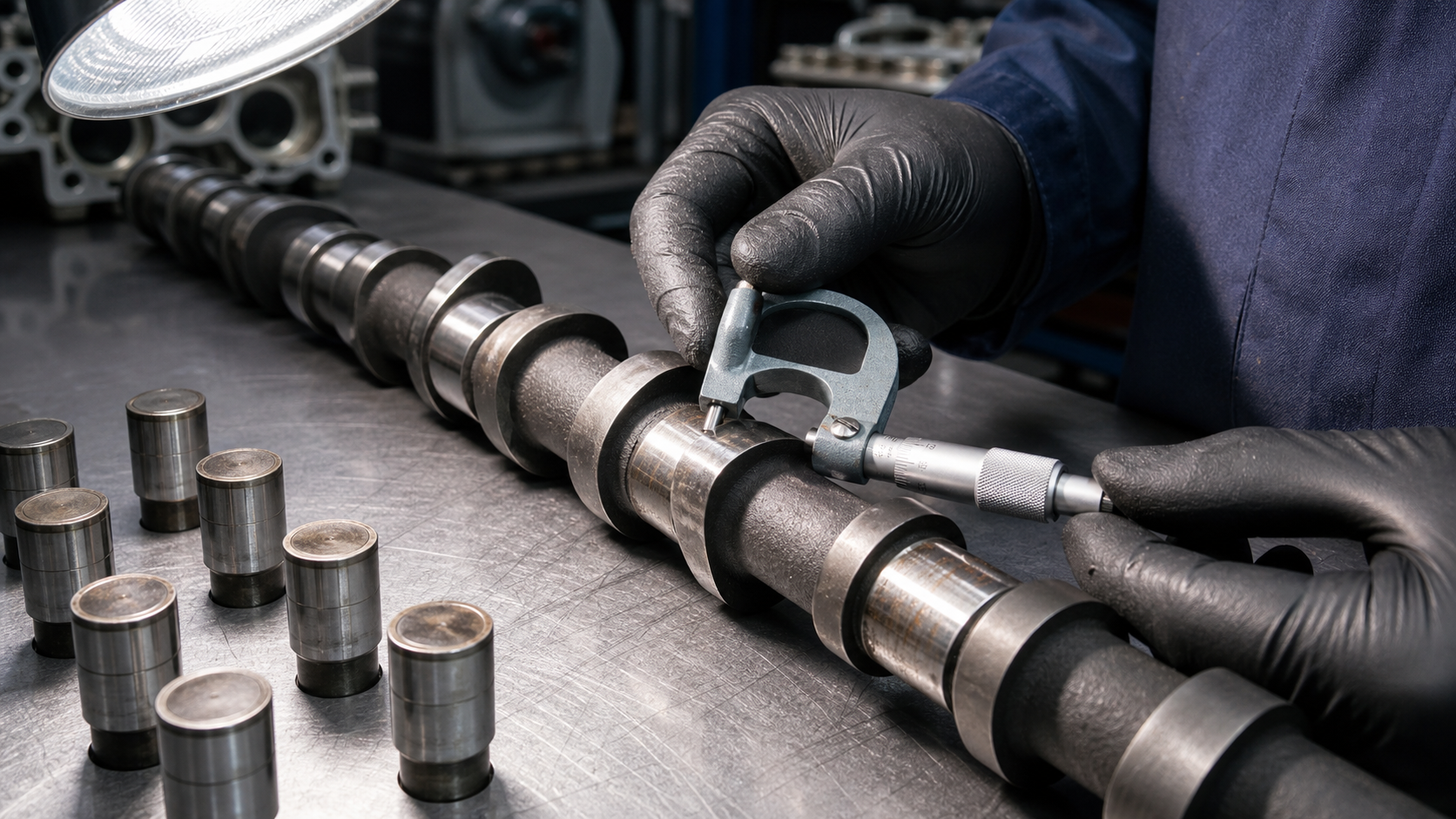
Camshaft journal inspection requires removal and measurement with a micrometer at multiple points along each journal. Out-of-round or tapered journals indicate bearing-clearance problems. Scoring, grooves, or discoloration on the journal surface confirms lubrication failure. Lobe inspection under magnification reveals pitting, spalling, or complete surface loss. The lobe base-circle diameter measurement compared to specification quantifies wear depth.
Once measurements confirm which failure mode caused the symptoms, cross-reference the engine family, production year, and build code to identify the correct replacement camshaft. Overhead-cam engines require cam-bearing replacement as part of the cylinder-head service. Pushrod engines with cam-in-block designs require checking crankshaft and lifter condition before installing a new camshaft. The replacement scope includes all components that contact the damaged camshaft: lifters, rocker arms, valve-spring retainers, timing components, and oil pump if debris has circulated through the system.
FAQs
Can a bad camshaft cause low oil pressure?
Yes, worn camshaft journals and cam bearings increase bearing clearance, allowing pressurized oil to escape instead of flowing to downstream components. The oil-pressure gauge reads lower than specification, and oil-pressure warning lights illuminate at idle. Measuring journal-to-bearing clearance with Plastigage or precision gauges confirms whether excessive clearance is causing the pressure loss.
Will a worn camshaft damage the cylinder head?
A worn camshaft lobe does not directly damage the cylinder head, but secondary effects can cause head damage. Excessive valvetrain noise from worn lobes indicates metal-to-metal contact that produces debris. If debris circulates through the oil system, it scores cam bearings pressed into the head, requiring bearing replacement or head machining. A broken camshaft allows valve-to-piston contact in interference engines, bending valves and damaging valve seats.
How long can you drive with a worn camshaft?
Driving duration depends on failure severity and progression rate. A slightly worn lobe causing minor roughness may persist for extended periods before complete failure. A heavily worn lobe or damaged journal progresses rapidly once the hardened surface breaks through, causing catastrophic failure within a short timeframe. Oil-pressure loss from bearing wear requires immediate shutdown to prevent crankshaft and block damage. Monitor oil pressure, listen for noise changes, and measure valve lift rather than estimating remaining service life.
Do you have to replace lifters when replacing the camshaft?
Flat-tappet camshafts require new lifters because the wear pattern established between the old cam and lifters does not match the new cam lobe geometry. Installing a new flat-tappet cam with used lifters causes rapid lobe wear and premature failure. Roller camshafts can reuse lifters if inspection shows no wear, damage, or debris contamination. Hydraulic roller lifters with internal wear or collapsed plungers must be replaced regardless of camshaft condition. The service manual specifies replacement requirements for each engine family.
What is the difference between camshaft position sensor failure and camshaft failure?
The camshaft position sensor is an electronic component that monitors camshaft rotation and sends signals to the engine control module. Sensor failure causes electrical faults, sensor codes, and loss of timing information but does not affect mechanical valve motion. Camshaft failure is physical wear or breakage of the shaft itself, reducing valve lift or stopping valve motion entirely. A bad sensor can be replaced quickly without engine disassembly. A bad camshaft requires teardown, measurement, and mechanical replacement of worn components.
Conclusion
Confirming bad camshaft symptoms requires moving past generic performance complaints to specific measurements: dial-indicator valve-lift readings at each lobe compared to service-manual specifications, and oil-filter inspection under magnification for bearing debris or lobe-wear particles. Match the symptom pattern—rough idle and specific-cylinder misfires suggest lobe wear, while oil-pressure loss and knocking indicate journal damage. Cross-reference the failure mode to the replacement scope: isolated lobe wear may allow reusing journals and bearings, but bearing failure or shaft breakage requires complete teardown, cleaning, and inspection of all oil-system components. When requesting quotes for camshaft replacement, specify the engine family, production year, measured wear locations, and whether the repair includes lifters, bearings, timing components, and oil-system cleaning. Suppliers need teardown findings and service-manual data to quote the correct replacement assembly and confirm compatibility with existing valvetrain components.