A blue puff of exhaust smoke after overnight parking points directly to oil pooling above intake-valve heads while the engine sits. Gravity pulls crankcase oil past worn or hardened valve-stem seals, and the next cold start burns that oil in a visible plume. This pattern—smoke at start-up that clears after a few seconds—is the signature of valve-seal leakage, distinct from piston-ring wear or head-gasket failure. Recognizing when smoke appears, not just its color, lets you trace oil movement past the valve stem and separate valvetrain faults from lookalike conditions in the rings, guides, positive crankcase ventilation system, turbocharger seals, or head gasket.
Key Takeaways
- Cold-start blue smoke that disappears within seconds indicates oil pooling above intake valves during shutdown, a hallmark of failing valve-stem seals.
- Deceleration smoke—blue haze during engine braking or coasting—results from high manifold vacuum pulling oil past worn seals when throttle closes.
- Rising oil consumption without external leaks, fouled spark plugs on specific cylinders, and rough idle or misfire codes confirm oil entering the combustion chamber.
- Compression and leak-down tests isolate valve-seal leakage from piston-ring blowby, and inspection of PCV flow, turbo seals, and coolant passages rules out common lookalikes.
- Worn valve guides compromise new seal performance; measure guide clearance against the engine’s service specification before authorizing seal replacement to avoid repeat failure.
- Labor dominates repair cost because cylinder-head removal or specialized on-car tooling is required, and machine shops must verify guide condition before installing new seals.
Valve-Stem Seals Control Oil at a Moving Interface
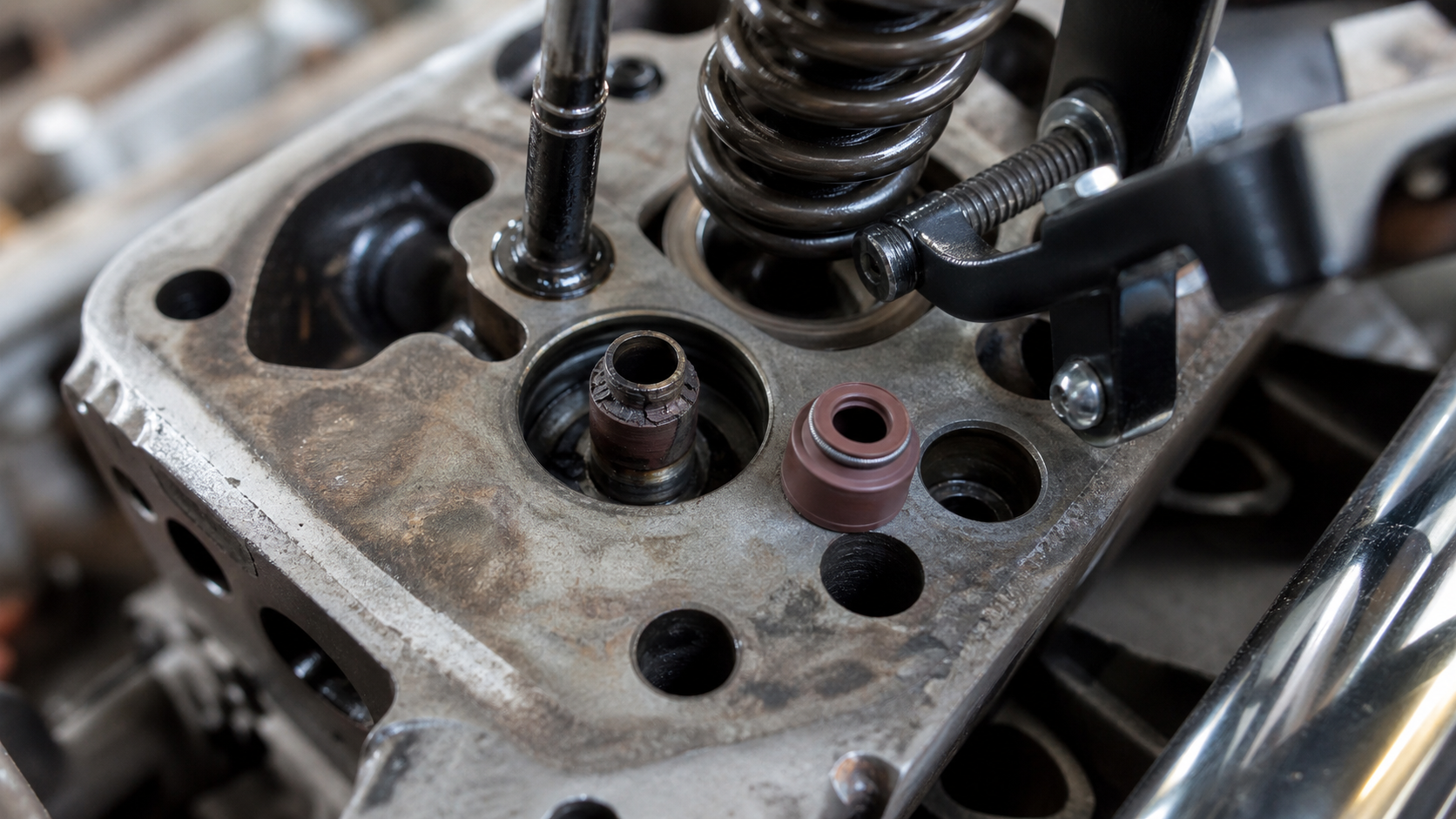
Valve-stem seals sit at the top of each valve guide, surrounding the valve stem as it slides through the guide during opening and closing cycles. The seal’s primary job is to meter a controlled oil film onto the stem for lubrication while blocking excess crankcase oil from following the stem down into the combustion chamber. Intake valves face the highest risk because manifold vacuum pulls oil toward the chamber during deceleration and idle, while exhaust valves operate in hotter conditions that accelerate seal hardening.
Seals fail through age-related hardening, heat cycling, carbon buildup on the stem, or contaminated oil that carries abrasive particles. A hardened seal loses its flexibility and can no longer conform to the stem, allowing oil to slip past. Excessive guide wear expands the clearance between stem and guide, forcing the seal to stretch beyond its design range and breaking its ability to maintain a consistent wiper edge. Valve-spring pressure, oil viscosity, engine temperature, and crankcase vacuum all influence leakage rate once the seal begins to fail.
Smoke Patterns That Point toward the Valvetrain
Exhaust smoke timing reveals the leakage path. Cold-start smoke appears when oil that pooled above the intake valves during shutdown burns off in the first combustion cycles. If the plume clears quickly and does not return until the next cold start, the fault is almost certainly valve seals rather than rings. Piston rings produce continuous smoke under load because blowby pressure forces oil past the rings whenever combustion pressure is high.
Deceleration smoke occurs during engine braking or coasting with a closed throttle. Manifold vacuum peaks under these conditions, pulling oil past intake-valve seals and into the cylinder. Mechanics often see blue haze trailing a vehicle during off-throttle descents or when the driver lifts abruptly after highway cruising. Acceleration smoke, by contrast, points toward rings because combustion pressure drives oil upward past worn or stuck rings when the engine is under load.
Idle smoke is less diagnostic because both valve seals and rings can leak at idle. However, if the smoke worsens when you blip the throttle and then release it—creating a vacuum spike—the cause is more likely intake-valve seals. Steady smoke at idle that does not vary with throttle position suggests ring blowby, a stuck PCV valve creating crankcase pressure, or turbocharger seal failure feeding oil into the intake tract.
Oil Consumption, Plug Fouling, and Misfire Signs
Measurable oil consumption without an external leak suggests oil is entering the intake, combustion chamber, exhaust, or forced-induction system, but the consumption rate does not identify the path. Valve-seal leakage is more credible when oil use appears with the characteristic operating-condition smoke pattern and the competing PCV, guide, ring, and turbocharger paths have been checked. Track consumption consistently, then combine that record with plug condition, borescope evidence, compression or leak-down results, and cylinder-head inspection.
Spark-plug condition isolates which cylinders are affected. Remove the plugs and inspect the insulator nose and ground electrode. Oil-fouled plugs appear wet or coated with black, sooty deposits that resist burning off. If only one or two cylinders show fouling, the problem is localized—possibly a single failed seal or a bent valve stem that broke the seal’s contact. If all plugs are fouled, suspect widespread seal failure, severe guide wear, or a PCV fault that is pressurizing the crankcase and forcing oil past multiple seals simultaneously.
Misfire codes and rough idle follow when oil fouls the plugs enough to prevent reliable ignition. The engine may idle unevenly, stumble during light acceleration, or trigger check-engine codes for random or cylinder-specific misfires. Fuel trims may run rich as the engine control module tries to compensate for incomplete combustion caused by oil-soaked electrodes.
Rings, Guides, PCV, Turbo, and Head-Gasket Lookalikes
Piston rings produce smoke under load rather than during deceleration or cold start. If blue smoke appears during hard acceleration, uphill climbs, or highway merging, the rings are the primary suspect. A compression test will show reduced pressure in affected cylinders, and a leak-down test will reveal air escaping past the rings into the crankcase. Ring wear is often uniform across all cylinders in high-mileage engines, whereas valve-seal wear may affect only a few cylinders.
Worn valve guides allow the valve to wobble in the bore, breaking the seal’s contact with the stem even when the seal itself is new. Measure guide-to-stem clearance with a dial indicator and compare the result to the service-manual specification. If clearance exceeds the manual’s wear limit, new seals will not solve the problem. The guide must be reamed and fitted with an oversize valve stem, or replaced with a bronze or cast-iron insert before installing new seals.
A stuck or restricted PCV valve creates crankcase pressure that forces oil past rings, seals, and gaskets. Remove the PCV valve, shake it to verify the internal check ball moves freely, and inspect the hose and intake port for sludge or carbon buildup. Test crankcase vacuum with the engine running; a healthy system pulls vacuum at idle according to the service manual’s specification. Positive pressure or zero vacuum indicates PCV blockage or excessive blowby overwhelming the system.
Turbocharger seal failure feeds oil into the compressor housing and intake tract, producing white or blue smoke that increases with boost. Remove the intake pipe and check for oil pooling in the cold side of the turbo or the intercooler. Shaft play in the turbo’s center section—measured by pushing the shaft radially and axially—reveals bearing wear that allows the seals to leak. Turbo-fed oil smoke is continuous under boost, not limited to deceleration or cold start.
Head-gasket leakage between an oil passage and a combustion chamber can mimic valve-seal smoke, though it is rare. A leak-down test with air introduced through the spark-plug hole will reveal bubbles in the coolant or oil, and a compression test may show uneven pressure between adjacent cylinders. Coolant consumption, white exhaust smoke, or oil contaminated with coolant confirms head-gasket involvement rather than valve seals.
Diagnosis before Cylinder-Head Disassembly
A compression test provides the baseline. Warm the engine to operating temperature, disable the ignition and fuel systems, remove all spark plugs, and thread the compression gauge into each cylinder in turn. Crank the engine through several compression strokes and record the pressure. Compare results to the service-manual specification and calculate the variation between cylinders. Uniform pressure within the manual’s acceptable range across all cylinders, combined with normal absolute values, rules out severe ring or valve-seating problems and narrows the fault to seals or guides.
A leak-down test isolates the leakage path. Connect regulated shop air through an adapter in the spark-plug hole with the piston at top dead center on the compression stroke. Listen and feel for escaping air at the intake, exhaust, crankcase breather, and coolant passages. Air hissing from the intake or exhaust port when the valves are closed confirms valve-sealing problems, though it does not distinguish between worn seats, bent valves, and failed seals. Air escaping into the crankcase through the oil filler or dipstick tube points toward rings. Compare leak-down percentages to the manual’s acceptable range.
Inspect the PCV system, turbocharger, and external oil leaks before committing to cylinder-head work. A PCV valve is inexpensive and quick to replace; a turbocharger seal repair is expensive but avoids unnecessary head removal. If the compression and leak-down results are acceptable, the PCV system flows correctly, and no external leaks exist, the smoke pattern and oil consumption point to valve-stem seals as the remaining likely cause.
Seal Replacement with the Head On or Off
Valve-seal replacement without removing the cylinder head is possible on some engines using compressed air to hold the valves in place while the keepers, retainers, springs, and seals are removed and replaced. This method requires a special spring compressor that works through the spark-plug hole and an air-hold adapter that pressurizes the cylinder to prevent the valve from dropping into the combustion chamber. On-car seal replacement saves labor time and preserves the head gasket, but access is limited and the method cannot address worn guides or valve-seating issues.
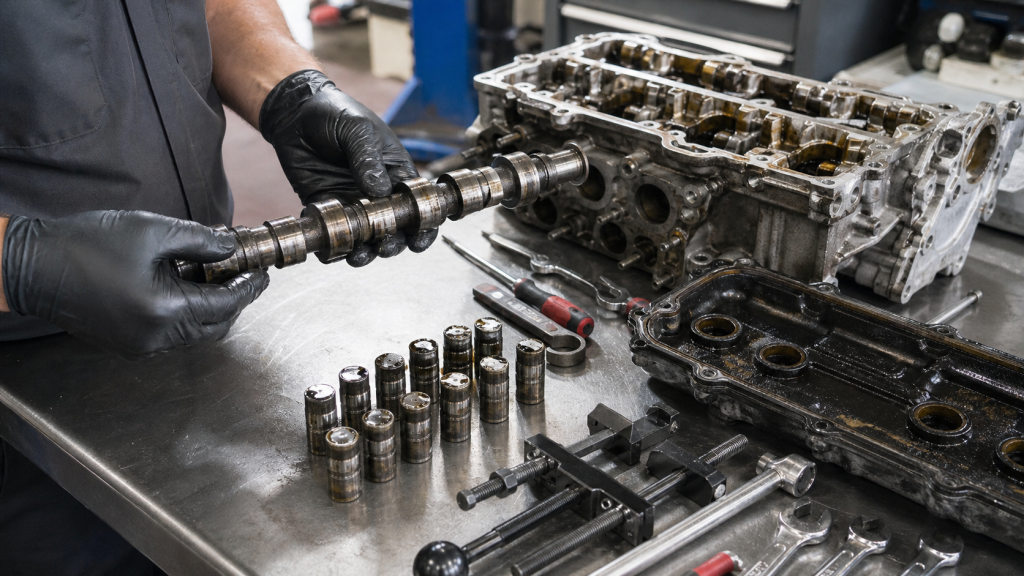
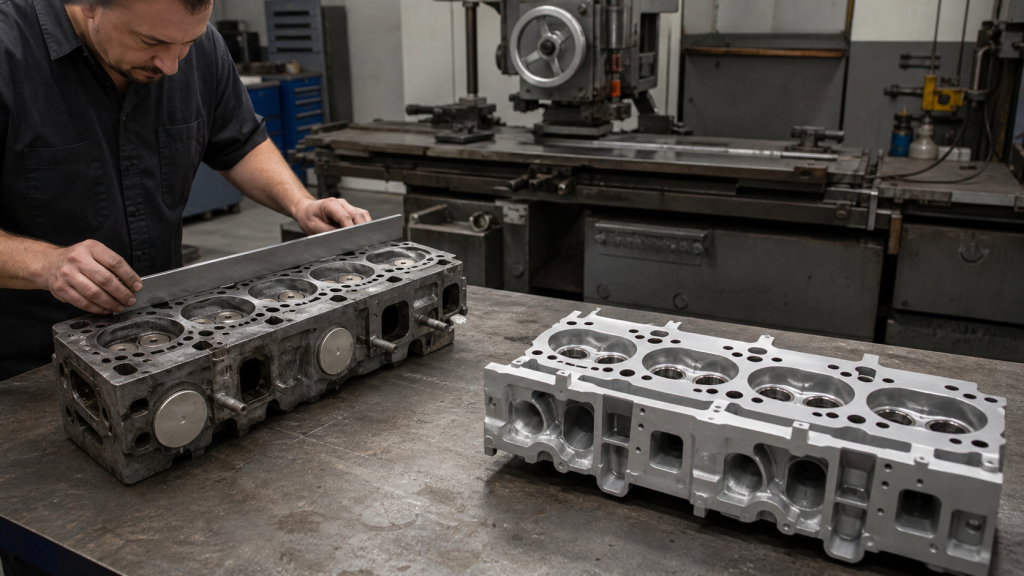
Cylinder-head removal provides complete access and allows inspection of guides, seats, valve faces, springs, and the combustion-chamber condition. The machine shop can measure guide wear, resurface the valve seats, replace or repair guides, test spring tension, and verify valve stem straightness before installing new seals. This approach is necessary when compression or leak-down tests reveal seating problems, when guide wear exceeds specification, or when the engine’s mileage and condition justify a complete valvetrain overhaul rather than a temporary seal replacement.
Labor dominates the cost in either case. Parts—seals, gaskets, and associated hardware—represent a smaller fraction. Overhead-cam engines with timing belts or chains add timing-system labor, and engines with variable valve timing require careful camshaft-phaser alignment during reassembly. Always request a written estimate that specifies which inspection and machining steps are included, so you can compare quotes accurately. Repair costs vary by region, engine configuration, valve count, and whether the head is removed; obtain at least two estimates from shops that detail their diagnostic and machining procedures.
When Worn Guides Make New Seals Insufficient
New valve-stem seals installed over worn guides fail quickly because the excessive guide clearance allows the valve to tilt and move laterally, breaking the seal’s contact with the stem. The seal cannot maintain its wiper edge when the stem’s axis shifts during each opening and closing cycle. Measure intake and exhaust guide-to-stem clearance before approving seal replacement. The service manual specifies the new clearance and the wear limit; consult the manual for your specific engine.
If clearance exceeds the wear limit, the guide must be repaired before new seals are installed. Bronze or cast-iron guide liners can be pressed into the worn guide bore and reamed to the correct stem clearance. Thin-wall bronze inserts are common in aluminum heads because they conduct heat away from the valve stem and resist galling. Alternatively, the guide can be reamed oversize and fitted with a valve that has an oversize stem, restoring the correct clearance without adding a liner. Knurling—a process that displaces metal inward to reduce the guide’s inside diameter—is a lower-cost option for mild wear but is less durable than liners or oversize valves.
Valve-spring condition also affects seal life. Weak or collapsed springs reduce valve acceleration and may allow the valve to float at high rpm, hammering the seal and guide. Measure installed spring height and free length, and test seat pressure and open pressure with a spring tester. Replace springs that fall below the service manual’s specification, and verify that shims or different-thickness retainers are not needed to restore correct installed height after machining the seats.
FAQs
Can I drive with bad valve seals until I can afford repairs?
You can continue driving, but oil consumption will worsen and fouled spark plugs may cause misfires that damage the catalytic converter. Monitor oil level weekly and top off as needed to prevent running the engine low on oil, which accelerates wear on bearings and camshaft lobes. Driving in this condition is not immediately dangerous but becomes expensive if converter replacement is added to the repair.
Do valve-seal additives or thicker oil stop the smoke?
Oil additives that swell seals or thicken the oil film may reduce smoke temporarily but do not restore the seal’s ability to control oil flow. Switching to a higher-viscosity oil can slow leakage past worn seals but also reduces flow to other engine parts and may trigger low-pressure warnings in engines with tight bearing clearances. Additives and thicker oil are short-term measures, not substitutes for mechanical repair.
How long do valve-stem seals last?
Service life depends on engine design, operating conditions, oil-change intervals, and oil quality. Seals in engines that see frequent cold starts, short trips, or prolonged idling may harden and fail earlier. Engines operated at steady highway speeds with synthetic oil and regular service intervals often last longer without seal replacement. High-temperature exhaust-valve seals degrade faster than intake-valve seals in engines with lean mixtures or turbocharging. Consult your service manual for maintenance recommendations specific to your engine.
Will replacing valve seals fix a cylinder with low compression?
No. Low compression indicates that the valve or seat is not sealing combustion pressure, a problem caused by a worn or burned valve face, a recessed or eroded seat, or a bent valve stem. Valve-seal replacement addresses oil control, not compression loss. The cylinder head must be removed, the valves and seats inspected and machined, and damaged components replaced before compression returns to specification.
Can I replace just the seals on the affected cylinders?
Replacing seals on only a few cylinders saves parts cost but not labor if the cylinder head must be removed. Once the head is off and disassembled, the incremental cost of replacing all seals is small compared to the risk of returning later to address additional seal failures. On-car seal replacement with an air-hold tool makes selective replacement more practical, but the method does not allow guide inspection or valve-seating checks.
Conclusion
Identifying bad valve seal symptoms begins with reading the exhaust smoke pattern—cold-start puffs and deceleration haze point to the valvetrain, while smoke under load suggests rings. Confirm the fault with compression and leak-down tests, inspect the PCV system and turbocharger seals, and measure valve-guide clearance against your engine’s service specification before committing to repair. Request a written estimate that includes guide inspection, seat machining if needed, and the scope of gasket and timing-system work, so you can compare machine-shop and mechanic quotes on equal terms. If guide wear is within specification and no valve-seating problems exist, seal replacement restores oil control and eliminates the smoke; if guides are worn, repair or replacement of the guides must precede new seals to prevent early failure.