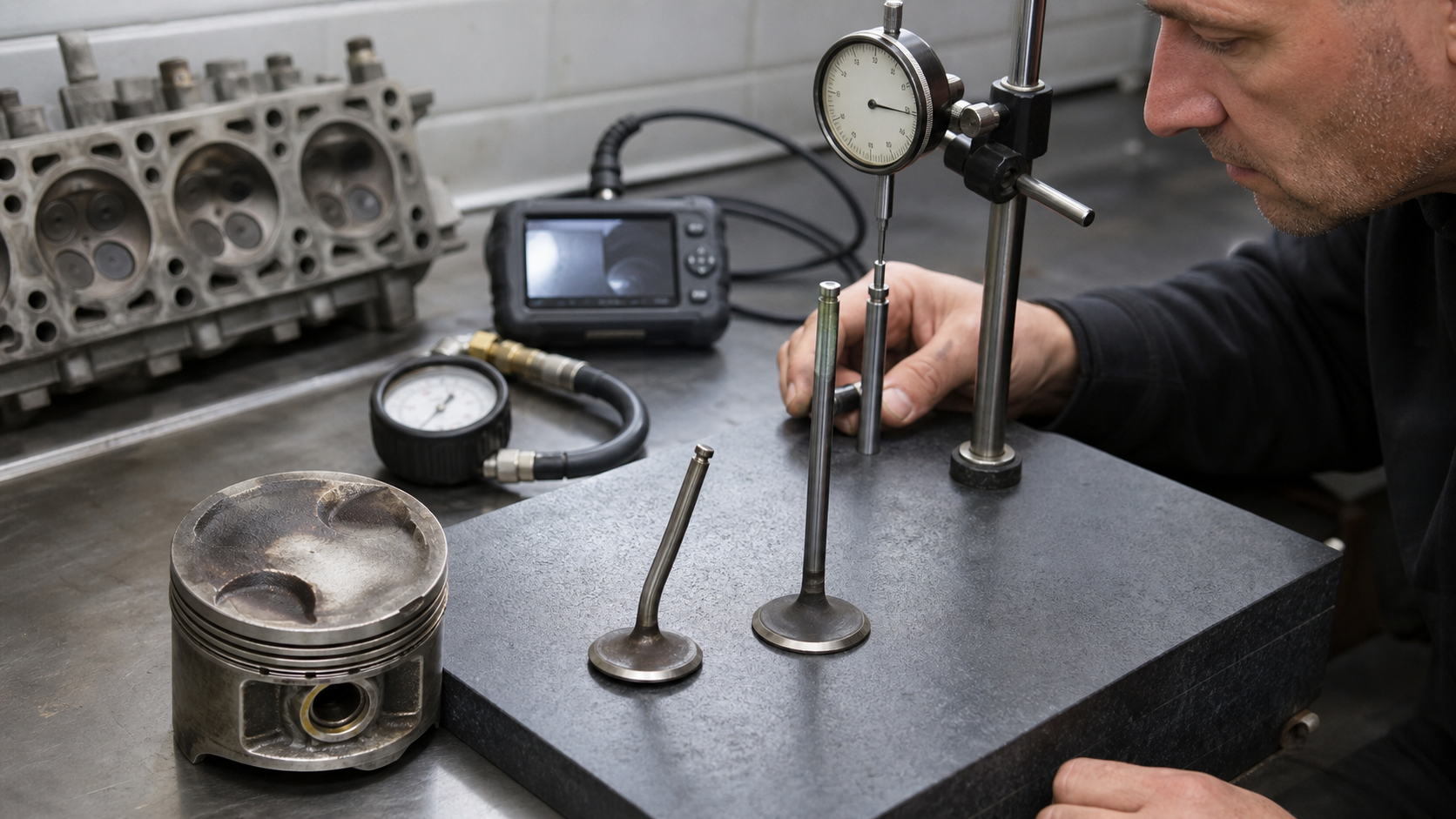
A bent valve loses its ability to seal the combustion chamber, producing measurable pressure loss during compression or power strokes. Most bent valves occur after timing-belt or timing-chain failure in interference engines, where piston travel overlaps valve lift. The diagnostic approach combines leak-down testing—which locates escaping air at the intake, exhaust, crankcase, or cooling system—with timing service history and borescope confirmation of stem or face deformation. Compression tests reveal the affected cylinder, leak-down isolates which valve is leaking, and borescope inspection confirms physical damage before teardown.
Key Takeaways
- Bent valves create sealing loss, detected by low compression in one or more cylinders and air escaping through the intake or exhaust during leak-down testing.
- Timing-belt or timing-chain failure in interference engines is the most common cause, allowing pistons to strike open valves.
- Leak-down testing narrows the fault to intake or exhaust valves by routing compressed air through the cylinder and listening at the throttle body, tailpipe, crankcase, or coolant reservoir.
- Borescope inspection through the spark-plug or injector bore confirms stem bending, face deformation, or piston crown damage without removing the cylinder head.
- Replacing only the bent valve often leaves debris, damaged guides, worn cam lobes, or weakened springs that cause repeat failure.
- Preventing recurrence requires verified timing marks, correct belt or chain tension, scheduled replacement intervals, and eliminating over-rev or foreign-object ingestion.
A Bent Valve Usually Produces a Sealing Problem
Engine valves seal the combustion chamber during compression and power strokes, then open to admit fresh charge or expel exhaust. A bent valve no longer matches its seat geometry, allowing combustion pressure to escape. This leakage reduces cylinder pressure, misfires the affected cylinder, and may push air or exhaust gases into the intake manifold, crankcase, or cooling passages depending on whether the intake or exhaust valve is bent.
The diagnostic approach for bent valve symptoms uses leak-down testing to locate escaping air and timing service history to identify the triggering event. Compression testing shows which cylinder has lost pressure, but leak-down testing isolates whether the leak occurs at the intake valve (air heard at the throttle body), exhaust valve (air at the tailpipe), piston rings (air at the oil filler), or head gasket (air at the coolant reservoir). Combining this measurement with knowledge of recent timing-belt replacement, over-rev events, or sudden engine stops narrows the cause to piston-to-valve contact, valve float, or foreign-object damage.
Borescope inspection through the spark-plug or injector bore provides visual confirmation of stem bending, face deformation, or piston crown contact marks before removing the cylinder head. Together, these checks separate a bent valve from ignition misfires, injector faults, ring wear, or head-gasket leaks that produce similar rough running or no-start symptoms.
Symptoms during Cranking, Idle, and Load
Bent valve symptoms vary with engine speed and load, but all trace back to incomplete sealing in one or more cylinders.
During cranking, an engine with bent valves may refuse to start or crank more easily than normal. The affected cylinder produces no compression, so the starter motor rotates the crankshaft with less resistance. If multiple valves are bent, the engine may turn freely but fail to build enough pressure in any cylinder to ignite the air-fuel mixture. Backfiring through the intake or exhaust during cranking indicates that combustion gases are escaping past the bent intake valve into the intake manifold or past the bent exhaust valve into the exhaust system at the wrong point in the cycle.
At idle, a bent valve causes a steady misfire in the affected cylinder. The engine runs rough, shakes on its mounts, and may stall when load is applied by the alternator, air conditioning compressor, or power steering pump. The check engine light illuminates, and diagnostic trouble codes point to cylinder-specific misfires. Because the bent valve cannot seal, unburned fuel passes through the cylinder and exits into the exhaust, where it may ignite in the catalytic converter and produce popping sounds or exhaust smoke.
Under load, power loss becomes the dominant symptom. Acceleration is sluggish, and the engine hesitates or stumbles when the throttle is opened. Each dead cylinder reduces total output proportional to its displacement—a four-cylinder engine loses roughly one-quarter of its power with one bent valve, while a six-cylinder loses approximately one-sixth. Higher exhaust temperatures in the working cylinders may trigger knock or pre-ignition if the engine control unit cannot reduce timing or enrichment fast enough. Increased oil consumption may also occur if combustion pressure forces oil past the rings in the remaining cylinders working at higher loads.
Timing Failure and Piston-to-Valve Contact
Piston-to-valve contact is the most common cause of bent valves, and it occurs almost exclusively in interference engines. In an interference engine, the piston travels into the space that the fully open valve occupies during normal operation. Precise timing-belt or timing-chain synchronization keeps the valves closed when the piston reaches top dead center. If the belt breaks or the chain skips, the camshaft stops or shifts position while the crankshaft continues rotating, and open valves remain in the piston’s path.
The collision happens at engine speed, bending the stem, cracking the face, or both. Multiple valves may bend simultaneously if the failure occurs while several valves are open. Exhaust valves, which operate at higher temperatures and are often made from harder alloys, may crack rather than bend. Intake valves, typically softer and cooler, bend more readily but may also fracture if the material is brittle or the impact is severe.
Timing belt failure in interference engines is the trigger reported in most bent-valve cases. Belts wear, stretch, and eventually break if not replaced at the manufacturer’s interval. Chains can skip teeth if the tensioner fails or if debris jams the guides. Even a correctly timed engine can suffer valve contact if the belt is installed one tooth off, a common assembly error during timing-belt replacement.
Non-interference engines avoid this problem by design. The piston never enters the valve’s swept volume, so timing failure causes a no-start condition but no physical damage. However, non-interference designs often sacrifice compression ratio, power density, or package space, which is why most modern engines use interference timing.
Over-Rev, Foreign Objects, Sticking, and Assembly Errors
Beyond timing failure, four additional mechanisms can bend valves.
Over-revving occurs when engine speed exceeds the valve spring’s ability to control valve motion. At very high rpm, the spring cannot close the valve fast enough, and the valve bounces or floats. If the valve floats open during the compression stroke, the rising piston strikes it. Manual-transmission downshifts, missed shifts, or failed engine-speed limiters are typical causes. Racing engines use stiffer springs, titanium retainers, and aggressive cam profiles to delay valve float, but street engines operating beyond redline will bend valves if spring control is lost.
Foreign-object ingestion through the intake can jam a valve open or strike the valve face directly. Broken intake-manifold gaskets, failed turbocharger compressor wheels, or loose hardware dropped during service are common sources. Even small fragments can wedge between the valve and seat, holding the valve partially open until piston contact bends the stem.
Valve sticking due to carbon buildup, insufficient lubrication, or coolant contamination can prevent a valve from closing. Direct-injection engines accumulate intake-valve deposits because fuel no longer washes the valve face. If deposits build up enough to restrict stem motion in the guide, the valve may hang open momentarily and be struck by the piston. Loss of oil supply to the valve guide or use of incorrect-viscosity oil increases friction and can cause similar sticking, especially on cold starts.
Assembly errors during cylinder-head installation or valve adjustment can create interference. Installing the wrong-thickness head gasket reduces piston-to-valve clearance. Overtightening valve lash or using incorrect-length pushrods in pushrod engines holds the valve open. Failure to verify piston-to-valve clearance with clay or dial-indicator checks after installing performance camshafts or aftermarket pistons has bent many valves during the first start.
Compression, Leak-Down, Borescope, and Timing Checks
Confirming bent valve symptoms requires a methodical test sequence that isolates the fault before teardown.
Compression testing measures cranking pressure in each cylinder and identifies which cylinders have lost sealing. A bent valve typically produces significantly lower pressure than specification, though exact values depend on engine design and altitude. Testing all cylinders in sequence reveals whether the damage is isolated to one cylinder or affects multiple cylinders, which indicates catastrophic timing failure. Record the results and compare against the service manual’s specification and acceptable variation between cylinders.
Leak-down testing narrows the fault to intake valve, exhaust valve, rings, or head gasket by pressurizing the cylinder with compressed air and listening for leaks. Set the piston at top dead center on the compression stroke, remove the spark plug, and apply regulated shop air through a leak-down tester adapter. The tester measures how much pressure is retained. A bent intake valve sends air up through the throttle body or intake manifold, producing an audible hiss. A bent exhaust valve directs air out the tailpipe. Rings leak into the crankcase, heard at the oil filler or dipstick tube. Head gaskets leak into the cooling system, creating bubbles in the coolant reservoir.
Leak-down results isolate the valve but do not measure the severity of the bend. A valve with a small bend or face deformation may still show moderate leakage, while a severely bent valve loses nearly all pressure. The location of the leak—intake or exhaust—guides borescope inspection and repair planning.
Borescope inspection through the spark-plug or injector bore confirms physical damage without removing the cylinder head. A modern USB borescope or articulating inspection camera allows viewing the valve face, piston crown, and cylinder wall. Look for bent valve stems visible near the valve guide, deformed or cracked valve faces, contact marks or dents on the piston crown, and metal fragments or debris in the combustion chamber. Rotate the crankshaft by hand while observing the valves to check for restricted motion or abnormal stem angle.
Timing verification checks whether the camshaft and crankshaft are correctly aligned. Remove the timing cover and inspect the timing marks on the crankshaft gear or pulley and the camshaft gear or sprocket. Compare against the service manual’s specification for top dead center on cylinder one. If the marks are off by one or more teeth, or if the timing belt or chain is broken, piston-to-valve contact is confirmed. Even if timing appears correct, inspect the belt or chain for wear, cracks, missing teeth, or stretched links that could allow the timing to slip.
The combination of leak-down location, borescope damage confirmation, and timing misalignment provides the evidence needed to plan repair scope.
Why Replacing Only the Bent Valve May Be Incomplete
Bent valve repair extends beyond the damaged valve itself. Piston-to-valve contact generates debris, damages related components, and often indicates that other valves, springs, or guides are near the end of their service life.
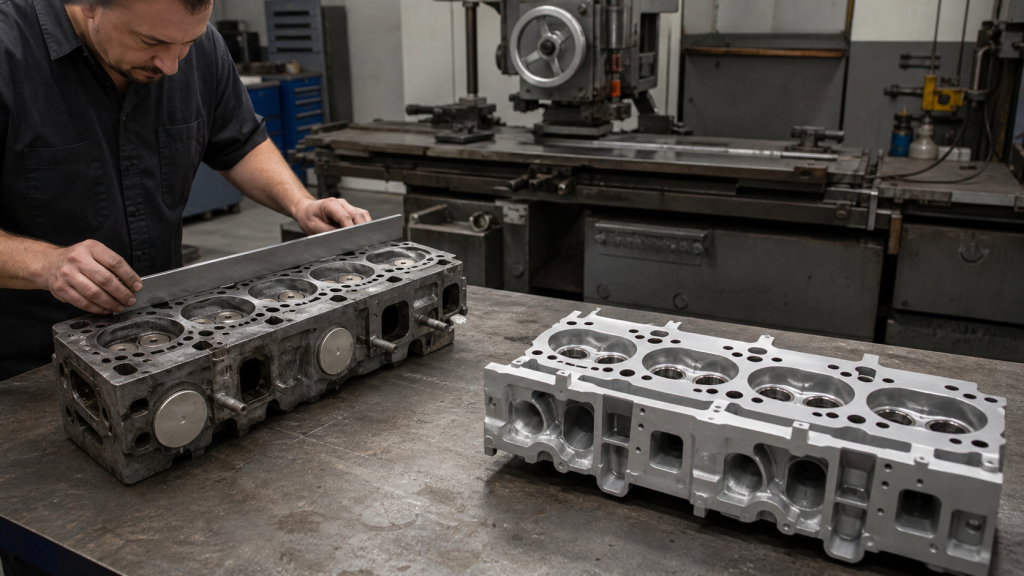
Debris contamination spreads metal fragments through the lubrication system and into the cylinder head oil passages. Bent valve stems shed particles, and piston crown impacts can dislodge aluminum or steel chips. This debris circulates through the oil pump, bearings, and camshaft lobes, causing accelerated wear. Machine shops performing cylinder-head work remove the head, disassemble it completely, and clean all passages with solvents and compressed air, but metal already in the crankcase requires an oil change and filter replacement immediately after reassembly.
Valve guides suffer impact loads when the stem bends. Even if the guide appears intact, internal wear or micro-cracks may allow excessive stem clearance, leading to oil consumption or valve sealing problems after the new valve is installed. Machine shops measure guide bore diameter and replace guides that exceed the service manual’s wear limit.
Valve springs lose tension or take a permanent set after timing failure. The sudden stop when the valve contacts the piston compresses the spring beyond its designed deflection. Reusing these springs risks valve float or insufficient closing force. Spring free length, installed height, and seat pressure must be measured and compared against specifications. Shops replace all springs as a set when reconditioning a head.
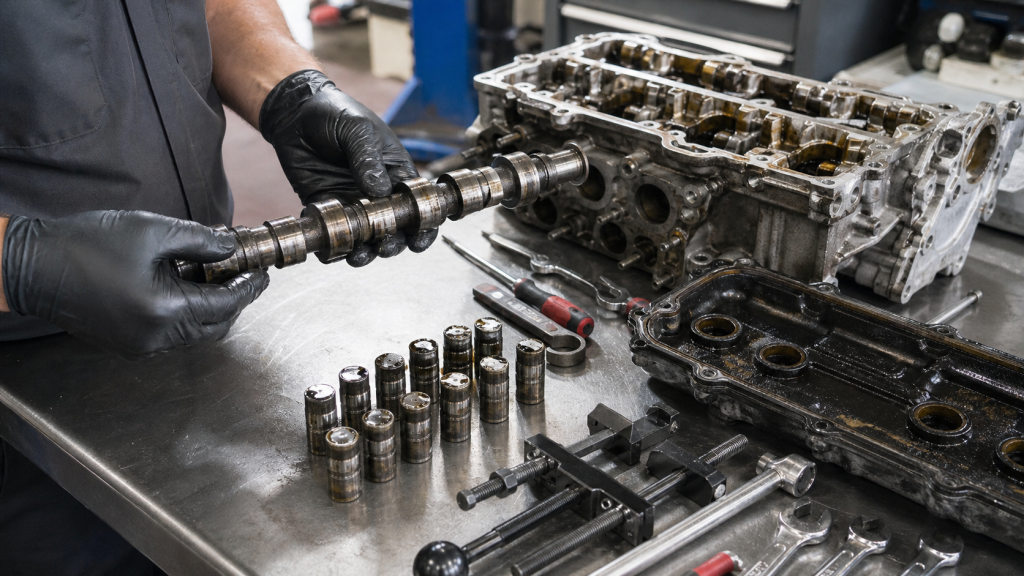
Camshaft lobes may show wear or damage if oil starvation contributed to valve sticking. Inspect the cam lobe that operates the bent valve for scoring, pitting, or irregular contact pattern. A worn lobe reduces valve lift and affects the rebuilt engine’s performance.
Pushrods in overhead-valve engines can bend during piston-to-valve contact. Roll each pushrod on a flat surface to check for straightness. Replace any that show visible runout.
Piston crown damage from valve contact may require piston replacement. Inspect the crown for dents, cracks, or embedded valve-face fragments. A dented crown changes compression ratio and creates a stress concentrator that can lead to piston failure.
Cylinder-head machine shops performing bent-valve repairs typically recommend a complete valve job—replacing all valves, guides, seals, and springs, refacing seats, and pressure-testing the head for cracks—rather than swapping just the bent valve. The labor to remove and reinstall the head dominates the job cost, so the incremental expense of full reconditioning is small compared to the risk of repeat failure.
Preventing Repeat Contact
Preventing bent valves requires adherence to timing-component service intervals, correct installation procedures, and operating discipline.
Timing-belt replacement must follow the engine manufacturer’s interval. Belts degrade with age even if mileage is low. Replace the water pump, tensioner, and idler pulleys at the same time, as these components share the same service life. Timing chains last longer but still require inspection and tensioner replacement per the service schedule. Engines that have exceeded the interval should have the belt or chain replaced immediately, regardless of apparent condition.
Installation verification after any timing service must include visual confirmation that all timing marks align at top dead center and that the belt or chain has correct tension per the service manual. Rotate the crankshaft two full revolutions by hand and recheck the marks. Incorrect tooth count or cam positioning by even one tooth can cause valve contact. Use a dial indicator or clay method to verify piston-to-valve clearance when installing aftermarket camshafts, high-compression pistons, or thinner head gaskets.
Rev-limit discipline in manual-transmission vehicles prevents over-rev damage. Train drivers to match engine speed during downshifts and to avoid forcing the shifter into a lower gear if resistance is felt. Automatic transmissions with electronic controls enforce shift timing, but failed speed sensors or control-module faults can allow unexpected downshifts. Address any transmission-control trouble codes immediately.
Intake-path cleanliness during service prevents foreign-object ingestion. Cover the intake manifold opening when the throttle body or air filter housing is removed. Inspect intake-manifold gaskets for cracking or delamination before reassembly. Use magnetic drain plugs and periodic oil analysis to detect metal contamination early.
Valve-guide lubrication in direct-injection engines benefits from periodic intake-valve cleaning or top-end cleaner additives. Carbon buildup reduces guide clearance and increases sticking risk. Some manufacturers recommend walnut-shell blasting or chemical cleaning at regular intervals on engines known for deposit accumulation.
Engines operating in severe service—frequent cold starts, short trips, dusty environments, or towing—should have timing components inspected more frequently than the standard interval. Visual inspection of belt condition, tensioner operation, and chain slack takes minimal time and can reveal impending failure before catastrophic damage occurs.
FAQs
Can a bent valve cause engine seizure or bearing damage?
A bent valve itself does not cause seizure or bearing damage. The valve bending occurs during a brief contact event, and the engine typically stops running immediately or continues with a misfire. However, if metal fragments from the bent valve, cracked piston, or damaged guide enter the oil system, they can score bearings or jam the oil pump. Always change the oil and filter after bent-valve repair and inspect the oil for metal particles before starting the engine.
How do you distinguish between a bent valve and a burnt valve?
Compression and leak-down tests produce similar results for both faults, but the cause and appearance differ. A bent valve follows a sudden mechanical event—timing failure, over-rev, or foreign-object ingestion—and creates a misfire immediately. A burnt valve develops gradually from hot spots, incorrect mixture, or exhaust-gas erosion and may start as an intermittent misfire that worsens over thousands of miles. Borescope inspection shows stem bending and piston contact marks for a bent valve, while a burnt valve displays a notched, eroded, or blackened valve face with no stem deformation.
Is it possible to straighten a bent valve instead of replacing it?
Straightening a bent valve is not a reliable repair. The bending process work-hardens the stem material unevenly, creates internal stress concentrations, and may introduce micro-cracks that will propagate under cyclic loading. Even if the stem appears straight after pressing, the valve face may no longer be concentric with the stem centerline, causing poor sealing and rapid seat wear. New valves cost less than the labor to attempt straightening and risk early failure.
Will a bent valve trigger a check engine light immediately?
A bent valve typically triggers a misfire code within seconds of starting the engine. The engine control unit monitors crankshaft acceleration during each cylinder’s power stroke and flags any cylinder that fails to contribute expected torque. Common trouble codes include P0300 (random misfire), P0301 through P0312 (cylinder-specific misfire), or P0420 (catalyst efficiency below threshold due to unburned fuel). However, if the timing failure occurs while the engine is off or if the bent valve allows enough compression for partial combustion, the light may not illuminate until the engine is cranked or driven.
Can you prevent bent valves in an interference engine by converting to non-interference timing?
Converting an interference engine to non-interference timing would require redesigning the cylinder head, pistons, or both to increase piston-to-valve clearance at all valve lift points. This is not practical for production engines. The only prevention is scheduled timing-component replacement and correct installation. Some engine builders install bronze or aluminum guardian pins between the camshaft and cylinder head that shear if the cam rotates unexpectedly, stopping valve motion, but these are custom racing solutions not applicable to street engines.
Conclusion
Bent valve symptoms begin with measurable sealing loss that leak-down testing locates at the intake or exhaust port. Timing failure in interference engines is the dominant cause, and borescope inspection confirms stem bending or face damage before committing to cylinder-head removal. Repair scope must include all valves, guides, springs, and inspection for debris contamination, not just replacement of the obviously bent component. Your next step is to perform compression and leak-down tests on the affected cylinders, document the timing service history, and request quotes from machine shops that specify the full reconditioning scope—valve replacement, guide and seat work, spring replacement, pressure testing, and cleaning—so you can compare both parts coverage and labor against the cost of a complete remanufactured cylinder head.