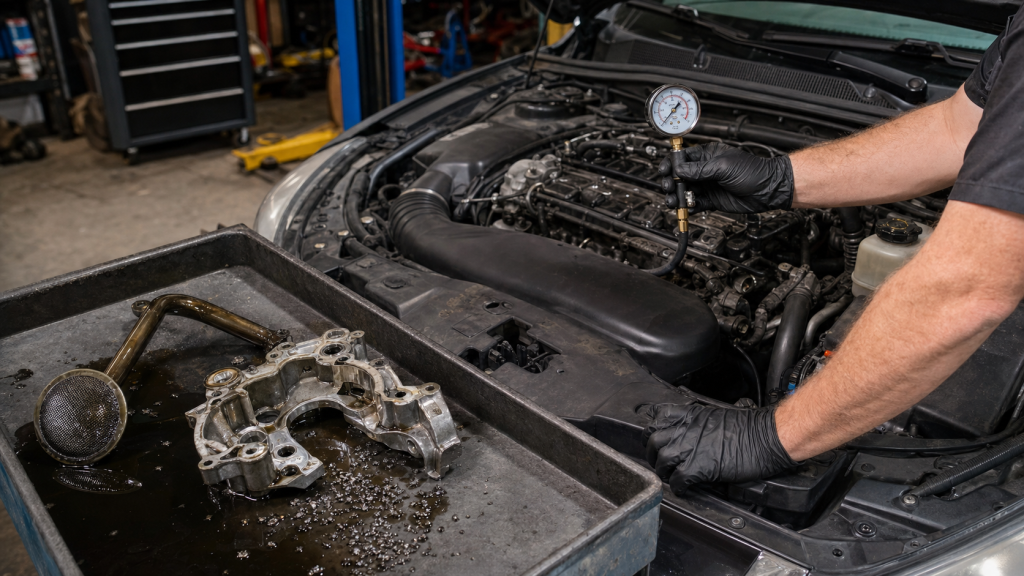
A low oil pressure warning light does not always mean the pump has failed. The light confirms only that measured pressure has dropped below the switch threshold—a condition that can result from diluted oil, a worn bearing, a clogged pickup screen, or a sending-unit fault. Before authorizing oil pump replacement, the shop must perform a mechanical pressure test at idle and higher engine speeds, inspect oil condition, and verify crankshaft bearing clearances. Once those tests isolate the pump as the root cause, the estimate must account for teardown access, the scope of parts included, collateral damage discovered during disassembly, and whether the engine requires further inspection before reassembly.
Oil pump replacement cost typically combines pump hardware, gaskets, seals, fresh oil and filter, and labor to remove the pan, front cover, or timing components required to reach the pump. Labor varies widely by engine layout: front-mounted pumps driven by the crankshaft snout may require only front-cover removal, while rear-mounted pumps inside the oil pan demand pan drop, pickup-tube service, and sometimes crankshaft or balancer repositioning. Estimates change further if the technician discovers worn bearings, damaged pickup screens, metal debris in the pan, or timing-chain stretch that must be corrected before the engine is safe to run.
Key Takeaways
- A warning light alone does not confirm pump failure; mechanical pressure testing at idle and rated speed isolates the fault before disassembly begins.
- Labor cost depends on pump location—front-cover pumps require timing-component access; pan-mounted pumps require pan removal and pickup inspection.
- The estimate must include the pump assembly, pan gasket or cover gasket, pickup O-ring or screen, oil, filter, and any collateral damage found during teardown.
- Worn main bearings, clogged screens, diluted oil, or timing-chain slack can mimic pump failure; pressure testing and oil analysis prevent misdiagnosis.
- Before approving the job, confirm whether the quote covers only the pump or includes bearing inspection, timing verification, and debris cleanup.
Confirm the Pump Is Actually the Cause
Low oil pressure can result from a failed pump, but it more commonly traces to worn crankshaft or camshaft bearings that leak pressurized oil back into the pan, contaminated oil that has lost viscosity, or a clogged pickup screen that starves the pump inlet. The warning light or gauge reflects only the pressure at the sending unit—it cannot distinguish between a pump that produces no flow and an engine that consumes all available pressure through excessive bearing clearance.
Shops confirm pump failure by installing a calibrated mechanical pressure gauge at the main oil gallery and recording pressure at idle and at the manufacturer’s specified test speeds. Service manuals publish minimum acceptable pressures for each engine family; a reading below specification at multiple speeds, combined with clean oil and normal bearing clearances, isolates the pump. If pressure meets specification at higher speeds but drops at idle, the root cause is often worn bearings rather than pump wear, because flow through enlarged clearances reduces pressure most at low shaft speed when pump output is minimal.
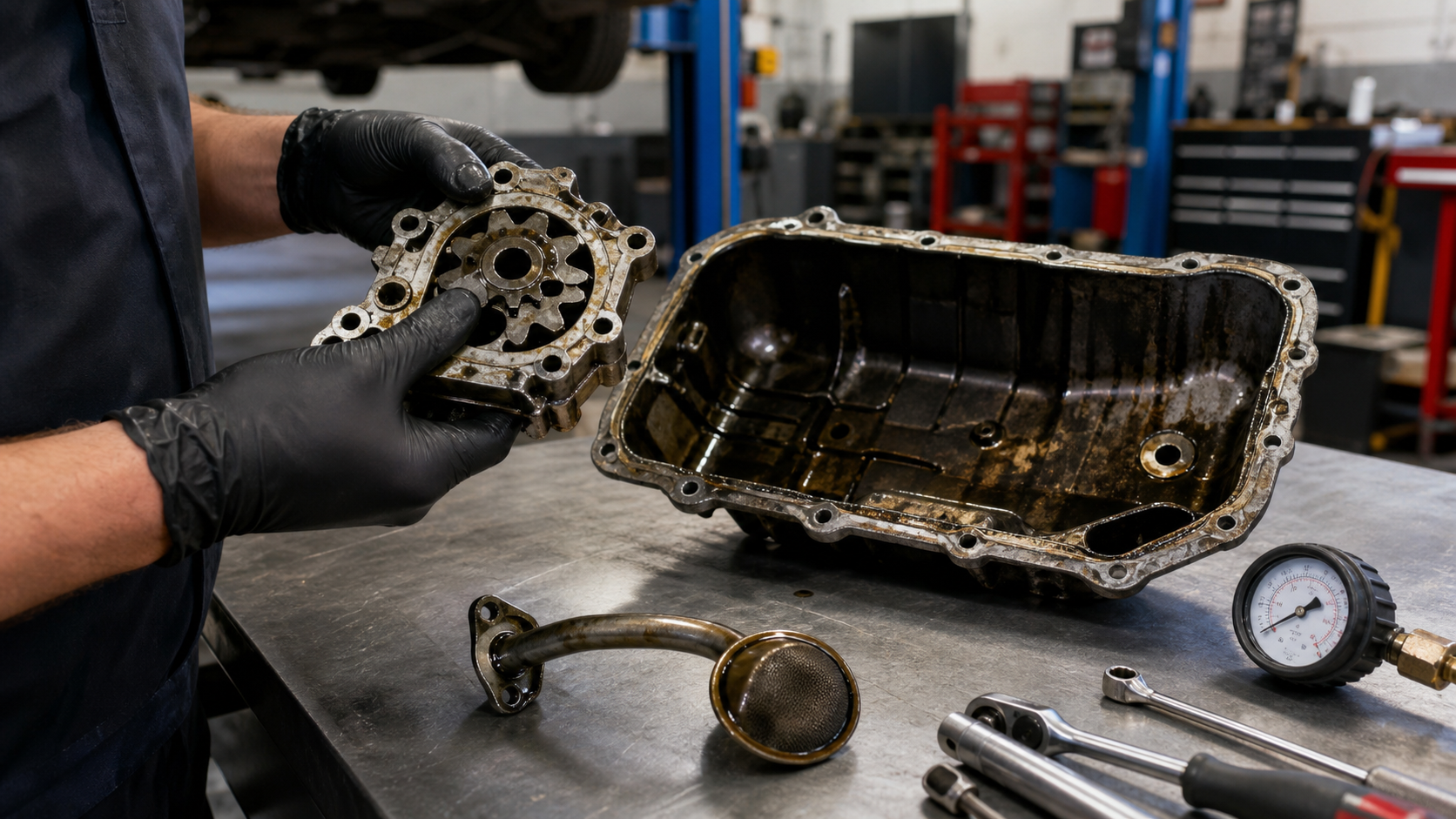
Before condemning the pump, the technician must verify oil level, check for fuel dilution or coolant contamination that thins the oil, inspect the pickup screen for blockage, and review maintenance records for oil-change intervals. A pump that has ingested debris from a spun bearing or failed timing component will show scoring on the gears or rotor, but that damage is secondary—the bearing or chain failure created the debris, and replacing the pump alone will not prevent recurrence.
What Is Included in an Oil Pump Replacement Estimate
A complete oil pump replacement includes the pump assembly, oil pan gasket or front cover gasket depending on pump location, pickup tube O-ring or gasket, oil filter, and enough engine oil to refill the system after draining. Many engines use a pressed steel or cast aluminum pan that can be resealed with formed silicone or a composite gasket; others use a structural pan that requires sealant application and torque-to-yield fasteners that must be replaced. The pump itself may be sold as a bare housing requiring transfer of the pickup tube and pressure relief valve, or as a complete assembly with these parts attached.
Labor begins with safely raising the vehicle, draining oil, and removing components that block pump access. Front-mounted pumps typically require removal of the accessory drive belt, crankshaft pulley, and front timing cover; the shop must inspect timing-chain or timing-belt condition while the cover is off and report excessive slack or tooth wear. Pan-mounted pumps require loosening engine mounts and lifting the engine slightly to clear the crossmember, then unbolting the oil pan. Once the pan is down, the technician inspects for metal shavings, sludge, or debris that indicate upstream wear.
The estimate should state whether it includes only pump replacement or whether the technician will measure crankshaft end play, inspect main and rod bearing surfaces, verify camshaft journal condition, and check for timing-component wear. If the quote does not include these inspections and the shop discovers damage after disassembly, a second authorization will be required before reassembly.
Why Labor Varies by Engine Layout
Oil pump location depends on engine architecture and determines the components that must be removed to reach it. Longitudinal rear-wheel-drive engines often mount the pump inside the oil pan, driven by the distributor shaft or a dedicated intermediate shaft that meshes with the camshaft. Accessing this pump requires pan removal, which on some designs also demands removal of the exhaust crossover pipe, steering linkage, or front subframe bolts. Transverse front-wheel-drive engines frequently place the pump at the front of the block, driven directly by the crankshaft snout or by the timing chain. These pumps require front-cover removal but leave the pan untouched.
V-configuration engines add complexity: the oil pan may be split into an upper sump cast into the block and a lower stamped-steel pan, with the pump bolted to the upper section. Removing the lower pan exposes the pickup tube but not the pump body, forcing a longer teardown. Overhead-cam engines with chain-driven pumps require timing-cover removal, chain tensioner release, and sometimes camshaft position verification before reassembly. Each additional system that must be disturbed adds labor hours to the baseline pump swap.
Labor time differences directly affect cost. A front-mounted pump on a four-cylinder engine with a single timing chain typically requires less labor than a pan-mounted pump on a V8 with a structural pan, crossmember interference, and dual exhaust. Shops multiply labor hours by their hourly rate, which varies by region, facility overhead, and technician certification level. An estimate that does not specify pump location and access path cannot be compared accurately against competing quotes.
Parts, Fluids, Gaskets, and Related Damage
The oil pump assembly itself ranges from simple two-gear designs in pushrod engines to multi-vane rotor assemblies in modern overhead-cam engines. Material and manufacturing method affect part cost: cast iron pump housings cost less than aluminum or sintered-metal designs, and pumps with integrated pressure regulation or variable displacement command higher prices. Aftermarket pumps are available for most engines, but quality varies—some use softer gear materials or looser internal clearances that reduce service life. Original-equipment pumps carry higher upfront cost but match factory tolerances and often include updated parts that address known failure modes.
In addition to the pump, the estimate must account for gaskets and seals that cannot be reused once disturbed. Oil pan gaskets range from simple cork-rubber composite strips to complex molded silicone designs with integrated steel carriers; front cover gaskets may be paper, composite, or formed-in-place silicone. The pickup tube connects to the pump with an O-ring or gasket that hardens over time and leaks if not replaced. Some engines require a new crankshaft front seal whenever the front cover is removed, because disturbing the seal lip causes leakage even if the seal appeared intact before disassembly.
Engine oil capacity varies by design—check the service manual or oil cap for the correct quantity. Synthetic oil costs more than conventional but offers better protection during the critical first start after pump replacement, when residual oil film on bearings has drained to the pan. A new filter is mandatory—reusing the old filter introduces debris and contaminants into the fresh oil.
Related damage discovered during teardown changes the estimate. Metal shavings in the pan indicate bearing wear; a clogged pickup screen suggests poor maintenance; timing-chain slack beyond specification means the chain and guides must be replaced to prevent valve-timing drift. The shop cannot predict these findings before disassembly, so estimates often include a clause allowing contact for additional authorization if inspection reveals further wear.
Warning Signs That Require Immediate Pressure Testing
The oil pressure warning light illuminates when pressure drops below the switch calibration threshold, which varies by engine design. This threshold is set below the pressure needed to maintain bearing film at idle and well below the pressure required at cruising speed. A light that flickers at idle but extinguishes at higher speeds often points to worn main bearings rather than pump failure, because slight increases in shaft speed restore enough pressure to satisfy the switch even though clearances are excessive.
Continuous low pressure at all speeds, combined with normal oil level and viscosity, justifies immediate mechanical pressure testing. The test requires threading a gauge into the oil pressure switch port or main gallery plug and running the engine at idle, mid-range speed, and maximum governed speed if safe to do so. Comparing the measured pressures against the service manual specification isolates the fault: if pressure is low at all speeds, the pump cannot generate flow; if pressure rises normally with speed but drops at idle, bearings are worn; if pressure is normal but the light stays on, the switch has failed.
Additional warning signs include valve-train noise that appears suddenly and worsens with engine speed, indicating loss of hydraulic lifter preload due to insufficient gallery pressure; rising coolant temperature caused by inadequate oil-cooler flow; and visible oil leakage at the pump mounting face or front cover gasket, which suggests internal damage or seal failure. These symptoms require measured pressure data to confirm the diagnosis.
Repair, Replace, or Inspect the Engine Further
Oil pump replacement restores lubrication only if the rest of the engine can hold pressure. Installing a new pump into an engine with worn main bearings, scored journals, or damaged bearing surfaces will not bring pressure into specification, because the clearances leak oil faster than the pump can supply it. Before approving pump replacement, the shop must verify that crankshaft and camshaft journals are within service limits, rod and main bearing clearances have not exceeded maximum specification, and no scoring or galling has occurred on load-bearing surfaces.
Measuring bearing clearance requires removing at least one main bearing cap and using Plastigage or a dial bore gauge to measure clearance between the journal and bearing. If clearance exceeds the maximum published in the service manual, the engine requires bearing replacement or journal machining. Light scoring on journals can sometimes be polished, but deep grooves or heat discoloration mandate crankshaft removal and regrinding or replacement.
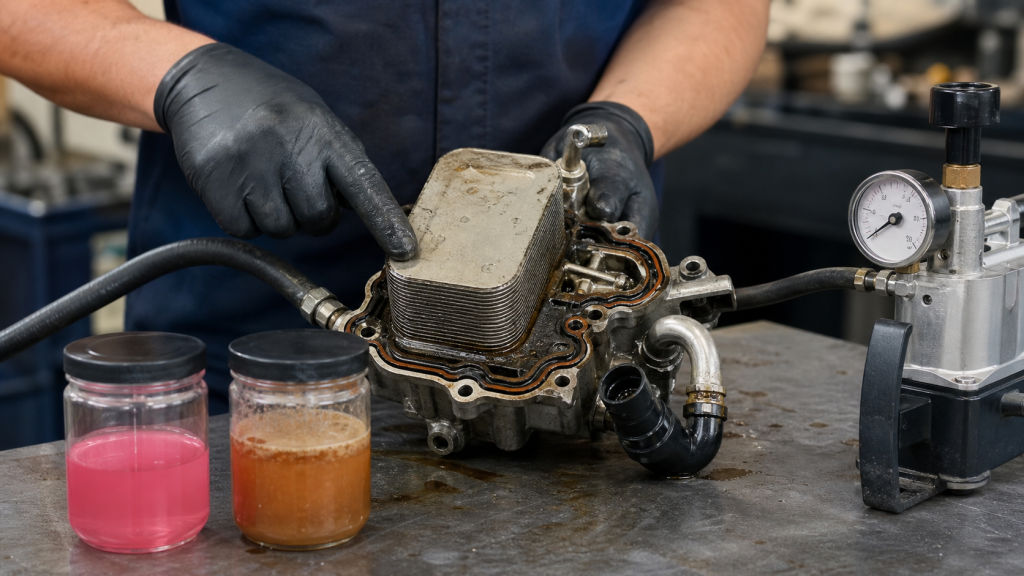
If teardown reveals debris in the oil pan, the technician must identify the source before reassembly. Fine metallic dust indicates normal wear; larger flakes or chunks point to bearing failure, piston scuffing, or timing-component disintegration. When debris is present, the oil passages must be flushed, the oil cooler inspected or replaced, and all bearings examined regardless of measured clearance, because contamination accelerates wear even in parts that initially met specification.
Engines with high mileage, history of overheating, or extended oil-change intervals may justify deeper inspection even if initial measurements appear acceptable. A compression test and cylinder leak-down test reveal ring seal and valve condition; if compression is low or leak-down excessive, repairing the oil system without addressing combustion-chamber wear leaves the engine prone to oil consumption and further failure.
Questions to Ask before Approving the Job
Before authorizing oil pump replacement, confirm what diagnostic work the shop has already completed. Ask whether mechanical pressure was measured at idle and rated speed, and request the actual readings compared to specification. Verify that the shop inspected oil condition for fuel or coolant contamination and checked the pickup screen for blockage. If these steps were skipped, the estimate may be based on assumption rather than confirmed failure.
Clarify what the quote includes beyond the pump itself. Does the price cover only parts and labor to swap the pump, or does it include inspection of bearing clearances, timing components, and oil-passage cleanliness? If the quote is for pump replacement only and the shop discovers bearing wear during disassembly, expect a second estimate before work continues. Ask whether the shop will measure crankshaft end play, inspect timing-chain slack, and examine the pan for debris as part of the initial authorization or as an additional charge.
Determine whether the replacement pump is an original-equipment part or an aftermarket equivalent, and whether it includes the pickup tube and pressure relief valve or requires transfer from the old pump. Request the part number and verify fitment for your specific engine variant—some model years use different pump designs even within the same engine family. Confirm whether gaskets, seals, oil, and filter are included in the quoted price or listed separately.
Ask how the shop will verify successful repair before returning the vehicle. Proper procedure includes priming the pump by filling it with oil or rotating the engine by hand before starting, running the engine and monitoring pressure with a mechanical gauge, and checking for leaks at all disturbed gaskets and seals. If the shop cannot describe this verification process, consider requesting a post-repair pressure reading in writing.
Finally, inquire about the warranty coverage. Original-equipment pumps typically carry a manufacturer warranty; aftermarket pumps vary. Confirm whether the labor to replace a failed pump under warranty is covered or whether you will pay a second labor charge if the part fails early.
FAQs
Can a failing oil pump damage other engine components before it is replaced?
Yes. Insufficient oil pressure allows metal-to-metal contact at bearings, camshaft journals, and piston skirts, generating heat and wear that permanently damage these surfaces. Even brief operation below minimum pressure specification can score crankshaft journals or spin bearing shells, requiring machining or replacement that far exceeds the cost of the original pump repair. If the oil pressure warning light illuminates, stop the engine immediately and have the vehicle towed to avoid compounding the damage.
Is it possible to replace the oil pump without removing the engine?
Most engines allow in-chassis pump replacement, though access difficulty varies. Front-mounted pumps require only cover removal with the engine in place; pan-mounted pumps require raising the engine slightly on a hoist or jack to clear the crossmember, but full engine removal is rarely necessary unless access is blocked by the vehicle frame, exhaust, or steering components. Some transverse engines in compact cars have insufficient clearance to drop the pan without removing the engine or front subframe, which adds significantly to labor cost.
How long does an oil pump typically last before it needs replacement?
Oil pumps in engines with proper maintenance intervals and clean oil can operate for the service life of the engine without failure. Wear accelerates when oil changes are skipped, contaminated fuel or coolant enters the oil, or debris from upstream component failure enters the pump. Pumps driven by the distributor shaft or intermediate shaft can fail prematurely if the drive gear wears or the shaft breaks, typically due to improper installation or impact damage during prior service. Regular oil analysis and pressure checks at major service intervals identify declining pump performance before complete failure occurs.
Does oil pump replacement require special tools or can it be done with standard hand tools?
Most oil pump replacement jobs require only standard sockets, wrenches, and a torque wrench, but specific engines demand additional equipment. Engines with structural oil pans require a torque-angle gauge for tightening the pan bolts in sequence. Front-cover pumps on engines with press-fit crankshaft pulleys need a harmonic balancer puller and installer to avoid damaging the crankshaft snout. Measuring bearing clearances during inspection requires Plastigage or dial bore gauges. Shops performing this work regularly maintain these tools; attempting the job without them risks improper assembly and repeat failure.
Should I replace the timing chain or timing belt at the same time as the oil pump?
If the engine has a timing chain and the pump requires front-cover removal, inspect chain slack and guide wear while the cover is off. Chains that have stretched beyond specification or guides that show cracking or material loss should be replaced during the same job to avoid a second teardown later. Timing belts follow a scheduled replacement interval published in the service manual; if the belt is approaching its replacement mileage and the cover is already removed for pump access, replacing the belt, tensioner, and idler pulleys saves future labor cost. If the belt or chain is new or mid-interval, replacement is not required unless inspection reveals damage.
Conclusion
Oil pump replacement cost depends on confirming the pump as the root cause through mechanical pressure testing, understanding which components must be removed to access the pump on your specific engine, and verifying that the quoted work includes gaskets, seals, fluids, and bearing inspection rather than pump hardware alone. Labor hours scale with engine layout: front-mounted pumps on inline engines require less teardown than pan-mounted pumps on V-configurations with structural pans and crossmember interference. Before approving the estimate, ask whether the shop measured pressure at idle and rated speed, inspected bearing clearances, and will verify proper pressure after installation. Request the part number for the replacement pump, confirm warranty terms, and ensure the quote covers debris cleanup and timing-component inspection if the front cover or pan must be removed. For sourcing replacement pumps or evaluating engine-specific repair feasibility, consult the service manual for your engine family and compare measured findings against published specifications rather than universal wear limits.