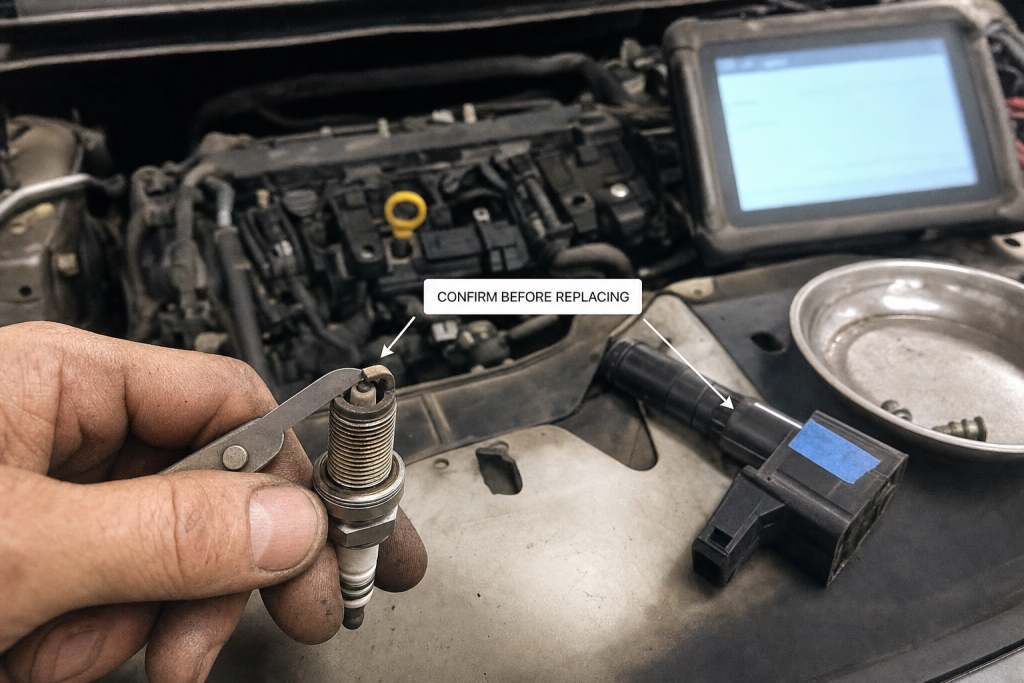
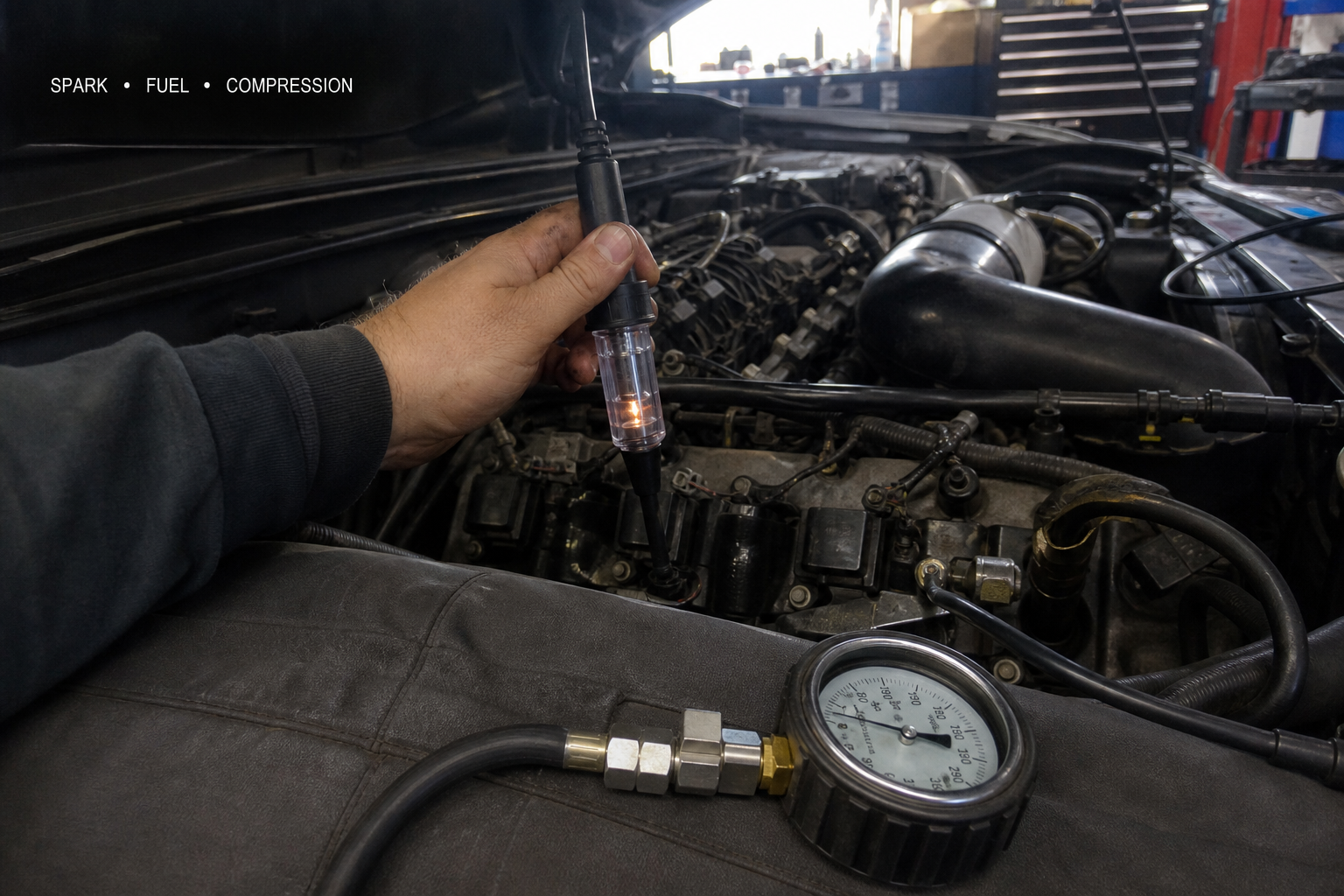
No-combustion diagnosis works fastest when spark, fuel and compression are tested separately.
Introduction
An engine that cranks but shows no combustion is failing one or more of four requirements: air supply, fuel delivery, compression seal, or ignition timing. The diagnostic challenge is separating these overlapping conditions without replacing parts randomly. A flooded cylinder can mask ignition failure. Low compression can prevent ignition even when spark is present. Diesel engines eliminate spark entirely but add injection timing as a variable. This guide walks through the isolation method that separates each requirement, explains the testing order that prevents false conclusions, and identifies the components to inspect once you’ve narrowed the failure domain.
Key Takeaways
- **Four-requirement model**: Combustion needs air, fuel, compression, and ignition; diesel substitutes injection timing for spark
- **Testing order matters**: Start with spark/fuel delivery (external), then move to compression (internal, invasive)
- **Gasoline vs diesel split**: Gasoline failures cluster around ignition and fuel pressure; diesel around injection timing and glow plug/compression interaction
- **Safety first**: Disable ignition or fuel before cranking tests; compressed air and fuel vapor are ignition sources
The Four Combustion Requirements and Where They Fail
Internal combustion engines (https://en.wikipedia.org/wiki/Internal_combustion_engine) convert chemical energy through a rapid oxidation process. That process stops if any single input is missing or mistimed.
Air supply: Intake restriction or throttle body failure cuts airflow. Check for blocked air filter, collapsed intake hose, or stuck throttle plate. Less common: variable valve timing actuator stuck closed, preventing intake valve opening.
Fuel delivery: No fuel pressure, clogged injectors, or failed fuel pump. On carbureted engines, check float level and needle valve. On port injection systems, measure rail pressure with a mechanical gauge. On direct injection, distinguish between low-pressure and high-pressure pump failure.
Compression seal: Burned valves, broken piston rings, or head gasket breach. These require cylinder leak-down or compression testing. A reading below 90 psi on gasoline engines typically prevents combustion even with good spark and fuel.
Ignition and timing: No spark, wrong spark timing, or weak spark that fails under compression. Diesel engines replace spark with precise injection timing; a worn injection pump or failed camshaft position sensor shifts timing outside the combustion window.
Testing Order That Prevents False Diagnosis
Start external, move internal. Start cheap, move expensive.
|
Test Stage |
Action |
What It Rules Out |
Stop If |
|
1. Visual fuel |
Pull spark plug, check for wet/dry condition |
Severe flooding or complete fuel starvation |
Plug bone-dry or dripping |
|
2. Spark presence |
Grounded plug test (gasoline only) |
Ignition coil, distributor, or ECM failure |
No spark visible |
|
3. Fuel pressure |
Rail gauge or carb bowl inspection |
Pump failure, clogged filter, regulator fault |
Pressure <30 psi (port injection) |
|
4. Compression |
Gauge test, all cylinders |
Mechanical seal failure |
Any cylinder <90 psi (gasoline) |
|
5. Timing marks |
Verify cam/crank relationship |
Jumped timing belt/chain |
Marks off by >10° |
Safety note: Disconnect the coil wire or disable the fuel pump relay before cranking for extended spark tests. Pulling fuses alone may not cut power to all ignition modules. Wear safety glasses during compression testing; a failed Schrader valve can release 150+ psi.
Gasoline Engine: Ignition and Fuel Pressure Dominate
Gasoline no-combustion failures concentrate in the ignition system and low fuel pressure.
Ignition path: Battery → ignition switch → ECM → coil pack → spark plug. A failure anywhere stops combustion. Use a spark tester (not a screwdriver) to check for spark under load. A weak coil may fire in open air but fail under compression.
Fuel pressure path: Tank → pump → filter → regulator → rail → injector. Measure pressure at the rail test port while cranking. Specification varies by system (30-45 psi throttle-body, 35-65 psi port, 500+ psi direct high-pressure side).
Common gasoline-specific parts:
- Crankshaft position sensor (tells ECM when to fire coil and injector)
- Camshaft position sensor (synchronizes injection and spark to valve position)
- Ignition coil pack or distributor
- Fuel pump relay or inertia switch (may trip after rough handling)
If you have spark and fuel pressure but no combustion, test compression next. Low compression below 90 psi prevents the air-fuel mixture from reaching ignition temperature even with good spark.
Diesel Engine: Injection Timing and Glow Plug Interaction
Diesel engines achieve combustion through compression heat, not spark. This shifts the failure tree.
Injection timing: The injection event must occur near top dead center (TDC) within a narrow window. A worn injection pump, stretched timing chain, or failed camshaft position sensor can shift timing 15-20 degrees, preventing combustion. Unlike gasoline engines, you cannot "see" diesel timing with a simple test; it requires a timing light adapter or borescope observation.
Glow plug role: Glow plugs preheat the chamber for cold starts. A failed glow plug may prevent cold combustion but allow hot restarts. Test glow plug resistance (typically 0.6-2.0 ohms) and measure voltage supply (10-12V during preheat cycle).
Diesel-specific failure points:
- Injection pump (mechanical or high-pressure common rail)
- Fuel supply pump (feeds injection pump; failure starves the system)
- Glow plug relay or timer module
- Camshaft position sensor (diesel timing is more sensitive than gasoline)
Diesel compression requirement: Diesel requires 300+ psi to generate sufficient heat for auto-ignition. Worn rings or valves drop compression below this threshold. Test all cylinders; a variance above 20% between highest and lowest indicates seal failure.
Parts Checklist by Failure Domain
Once testing isolates the failure domain, inspect these components.
Air supply failure:
- Air filter element
- Mass airflow sensor (check for oil contamination)
- Throttle body and intake manifold gaskets
- PCV valve and hoses (vacuum leaks can trip lean-condition codes that disable injection)
Fuel delivery failure (gasoline):
- Fuel pump and pump relay
- Fuel filter (inline or in-tank)
- Fuel pressure regulator
- Fuel injectors (test resistance and spray pattern on a bench)
Fuel delivery failure (diesel):
- Fuel supply pump (low-pressure side)
- Fuel filter and water separator
- Injection pump (high-pressure side)
- Injector nozzles (carbon buildup clogs spray holes)
Compression failure:
- Piston rings (diagnose with leak-down test or oil-injection method)
- Intake and exhaust valves (bent, burned, or carbon-sealed)
- Head gasket (look for coolant in oil or compression pressure in cooling system)
- Timing chain or belt (jumped teeth can hold valves open)
Ignition/timing failure (gasoline):
- Ignition coil pack
- Spark plugs and wires
- Distributor cap and rotor (if equipped)
- Crankshaft and camshaft position sensors
Injection timing failure (diesel):
- Injection pump timing advance mechanism
- Camshaft position sensor
- Timing chain or belt
- High-pressure fuel pump (common rail systems)
When Multiple Requirements Fail Simultaneously
A single root cause can break multiple requirements. A jumped timing belt can hold valves open (compression loss) and shift ignition timing (spark mistimed to open valve). A failed crankshaft position sensor cuts both spark and fuel injection. A severely clogged air filter can pull the intake manifold into vacuum collapse, sealing the throttle body and preventing air entry while also triggering a rich-condition fuel cut.
Prioritize testing external systems first. Compression and timing tests require partial disassembly and are more expensive to perform repeatedly. Confirm spark and fuel delivery are present and correctly timed before removing the valve cover or disassembling the timing cover.
FAQs
Can low battery voltage prevent combustion even with a good starter?
Yes. The ignition coil requires 10+ volts to generate adequate spark energy. A weak battery may spin the engine but drop voltage below the coil’s firing threshold. Measure battery voltage at the coil positive terminal while cranking. If it falls below 9.6V, charge or replace the battery before continuing diagnosis.
Why does my engine have spark and fuel but still no combustion?
Low compression is the most common cause. Test all cylinders. A reading below 90 psi (gasoline) or 300 psi (diesel) prevents ignition temperature from being reached. Also verify ignition timing; spark that occurs too early or late relative to piston position will not ignite the mixture.
What’s the difference between a flooded engine and fuel delivery failure?
Pull a spark plug. A flooded plug is wet with liquid fuel and smells strongly of gasoline. A fuel delivery failure leaves the plug dry and pale. Flooding is usually caused by excessive cranking with a malfunctioning fuel system or choke. Let a flooded engine sit 10-15 minutes with plugs removed before retesting.
How do I know if the timing belt jumped or broke?
Remove the timing cover inspection plug (if equipped) and verify the cam and crank timing marks align at TDC. On interference engines, a jumped belt often bends valves, which produces zero compression in affected cylinders. A compression test showing multiple dead cylinders suggests timing failure.
Do diesel engines need glow plugs to run once warm?
No. Glow plugs assist cold starts only. If a warm diesel will not start, test injection timing and fuel pressure rather than glow plug function. A diesel that starts cold but dies when warm usually has a fuel supply or injection pump heat-soak issue.
Conclusion
No-combustion diagnosis works by isolating the four requirements in sequence: confirm air entry, verify fuel delivery and pressure, test spark or injection timing, then measure compression as the invasive final step. Gasoline engines fail most often on ignition components and fuel pressure, while diesel engines concentrate failures in injection timing and glow plug preheat. Use the testing order table to prevent false conclusions caused by overlapping symptoms. Once you’ve identified the failure domain, the parts checklist directs inspection to the specific components that control that requirement. The isolation method prevents the expensive mistake of replacing compression-related parts when the failure is external, or chasing ignition problems when the root cause is a mechanical seal failure inside the block.