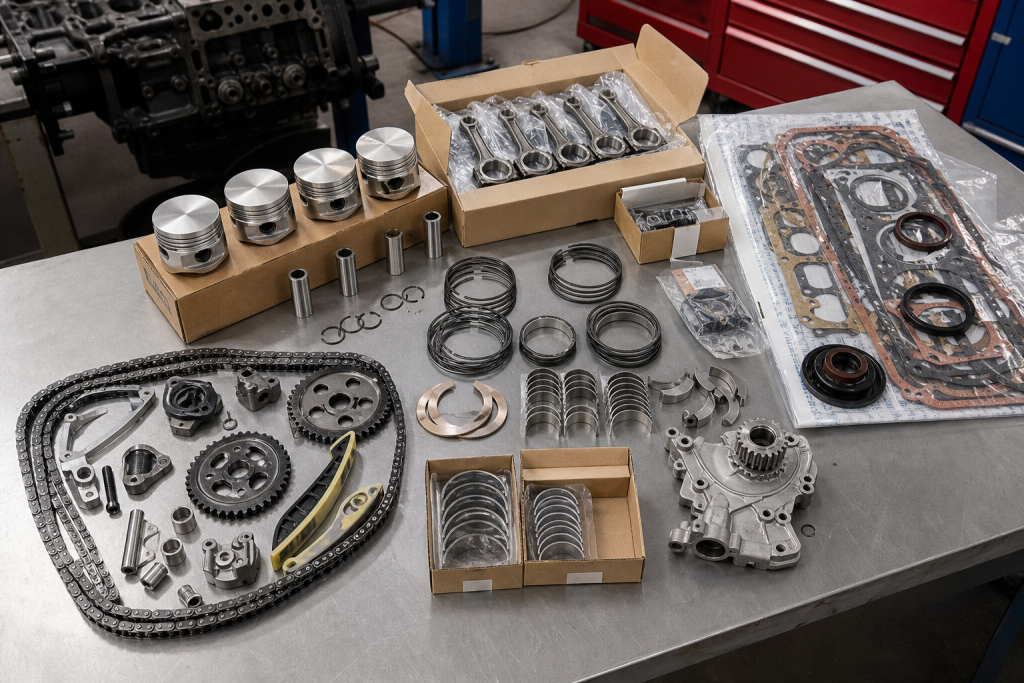
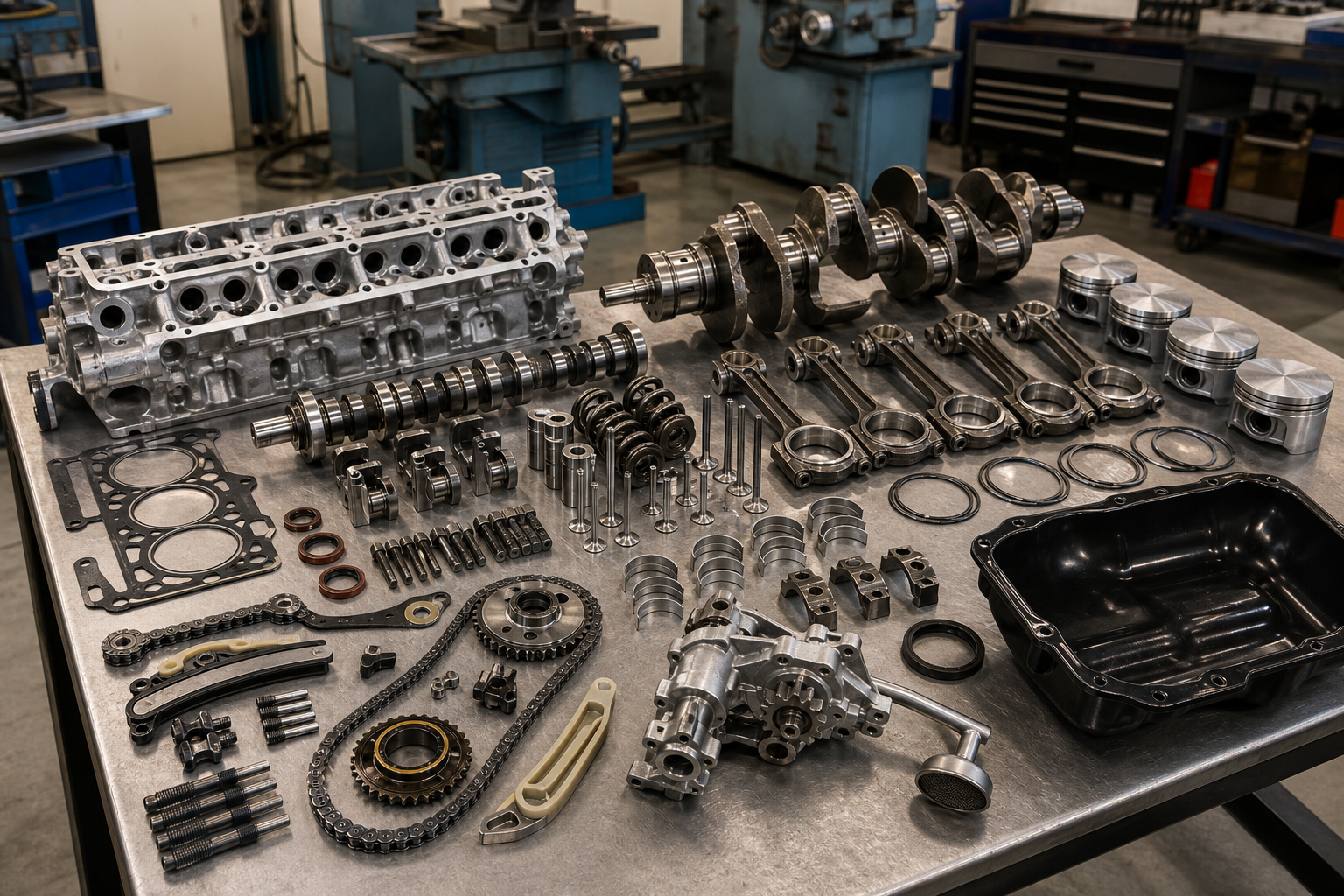
Major internal engine components laid out by system before inspection and assembly.
Introduction
An engine parts list is most useful when it is grouped by system, not when it is just a long dictionary of names. For a typical internal combustion engine, the main parts include the engine block, cylinder head, pistons, piston rings, connecting rods, crankshaft, camshaft, valves, timing components, gaskets, oil pump, water pump, intake manifold, exhaust manifold, fuel injectors, spark plugs or glow plugs, and related sensors and accessories.
The common mistake is asking for "engine parts" as if one name is enough. In real repair or sourcing work, the same part name can change by engine code, displacement, model year, fuel type, casting number, material, emission standard, and installation position. This guide gives you a practical engine parts list you can use before a rebuild, repair quotation, or parts inquiry.
Key Takeaways
- The main engine parts fall into 8 practical groups: structural parts, rotating assembly, valve train, timing system, sealing parts, fuel and ignition, cooling and lubrication, and external accessories.
- A part name alone is not enough for ordering; match engine code, displacement, model year, fuel type, casting or OEM number, and left/right or intake/exhaust position where relevant.
- Hard parts such as the block, cylinder head, crankshaft, camshaft, and connecting rods usually require measurement or inspection before replacement.
- Wear parts such as piston rings, bearings, gaskets, seals, timing belts, and filters are commonly replaced during overhaul even when the large castings are reused.
- After overheating, timing failure, or oil starvation, inspect part groups together; replacing only the visibly broken component can leave the cause of failure inside the engine.
Engine Parts List by System
Use this table as a fast map before going into the detailed sections. It does not include every small bolt, washer, bracket, clip, or model-specific sensor, but it covers the parts most often discussed in repair, rebuild, and sourcing work.
|
Engine system |
Common parts in this group |
Main function |
Replacement note |
|
Structural assembly |
Engine block, cylinder head, cylinder liner, crankcase, oil pan |
Holds cylinders, coolant passages, oil passages, and major rotating parts |
Match casting number, engine code, material, and deck/bolt pattern |
|
Rotating assembly |
Piston, piston rings, wrist pin, connecting rod, crankshaft, bearings, flywheel |
Converts combustion pressure into rotating motion |
Check bore size, journal size, bearing grade, compression height, and balance |
|
Valve train |
Intake valve, exhaust valve, valve spring, rocker arm, lifter, tappet, pushrod, cam follower |
Controls air intake and exhaust flow |
Match engine layout: OHV, SOHC, DOHC, hydraulic or mechanical lifters |
|
Timing system |
Timing belt, timing chain, sprockets, tensioner, guide rail, camshaft gear, crankshaft gear |
Synchronizes crankshaft and camshaft movement |
Replace belt/chain service parts as a set when wear or failure is present |
|
Sealing parts |
Head gasket, valve cover gasket, oil pan gasket, intake gasket, exhaust gasket, oil seals, O-rings |
Keeps compression, coolant, oil, and exhaust gases in the correct passages |
Use correct thickness, material, bore opening, and bolt-torque procedure |
|
Fuel and ignition |
Fuel injector, fuel rail, fuel pump, spark plug, ignition coil, glow plug, throttle body |
Delivers and ignites fuel-air charge |
Gasoline and diesel engines use different ignition hardware |
|
Cooling and lubrication |
Water pump, thermostat, oil pump, oil cooler, oil filter, coolant passages, oil galleries |
Controls heat and reduces friction |
Failures here can damage pistons, bearings, head gasket, or cylinder head |
|
Intake and exhaust |
Intake manifold, exhaust manifold, turbocharger, EGR valve, air duct, catalytic converter connection |
Moves air into the engine and exhaust out |
Match port shape, sensor holes, emission fittings, and turbo/non-turbo layout |
|
Control and accessory parts |
Sensors, ECU-related connectors, alternator bracket, crank sensor, cam sensor, belt pulley |
Supports engine management and external drive |
Often model-specific; confirm connector, voltage, and mounting position |
Core Structural Parts: Block, Head, Pan, and Liners
The engine block is the foundation of the engine. It contains the cylinders, supports the crankshaft, and usually carries coolant and oil passages. In many automotive engines, the block is cast iron or aluminum; some designs use cylinder liners or sleeves to provide the working surface for the piston rings.
The cylinder head sits above the block and forms the top of the combustion chamber. It often contains the valves, valve guides, valve seats, camshafts, spark plug holes or injector holes, and coolant passages. In an overhead cam engine, the head is not just a cover; it is a precision assembly that controls airflow and combustion sealing.
The oil pan closes the bottom of the engine and holds engine oil. The crankcase area supports the crankshaft and connects the lower rotating assembly to the lubrication system. When the oil pan is damaged, leaking, or contaminated with metal particles, it can tell you more about the engine’s internal condition than the outside of the engine does.
When ordering these structural parts, avoid describing them only by vehicle model. A single vehicle line may use several engine codes. For cylinder heads and blocks, ask for or provide:
- Engine code and displacement
- Casting number or OEM number
- Fuel type: gasoline or diesel
- Material: aluminum or cast iron
- Valve count and camshaft layout
- Turbo or naturally aspirated version
- Emission or market version when relevant
Rotating Assembly Parts: Where Combustion Becomes Motion
The rotating assembly is the part group that turns combustion pressure into usable rotation. The piston receives pressure from combustion, the wrist pin links the piston to the connecting rod, the connecting rod drives the crankshaft, and the crankshaft turns that movement into rotation.
Piston rings seal compression, control oil on the cylinder wall, and transfer heat from the piston to the cylinder. Bearings support the crankshaft and connecting rods with a thin oil film. The flywheel or flexplate helps smooth rotation and connects the engine to the transmission.
|
Part |
What it does |
What usually must match |
|
Piston |
Moves inside the cylinder and receives combustion pressure |
Bore size, compression height, crown shape, pin diameter |
|
Piston rings |
Seal compression and control oil |
Bore size, ring thickness, material, ring gap specification |
|
Connecting rod |
Links piston to crankshaft |
Length, big-end diameter, small-end diameter, bearing size |
|
Crankshaft |
Converts reciprocating motion into rotation |
Journal size, stroke, reluctor wheel, balance design |
|
Main and rod bearings |
Support crankshaft and rod journals |
Standard or undersize grade, material, journal measurement |
|
Flywheel/flexplate |
Transfers rotation to transmission |
Bolt pattern, tooth count, manual/automatic application |
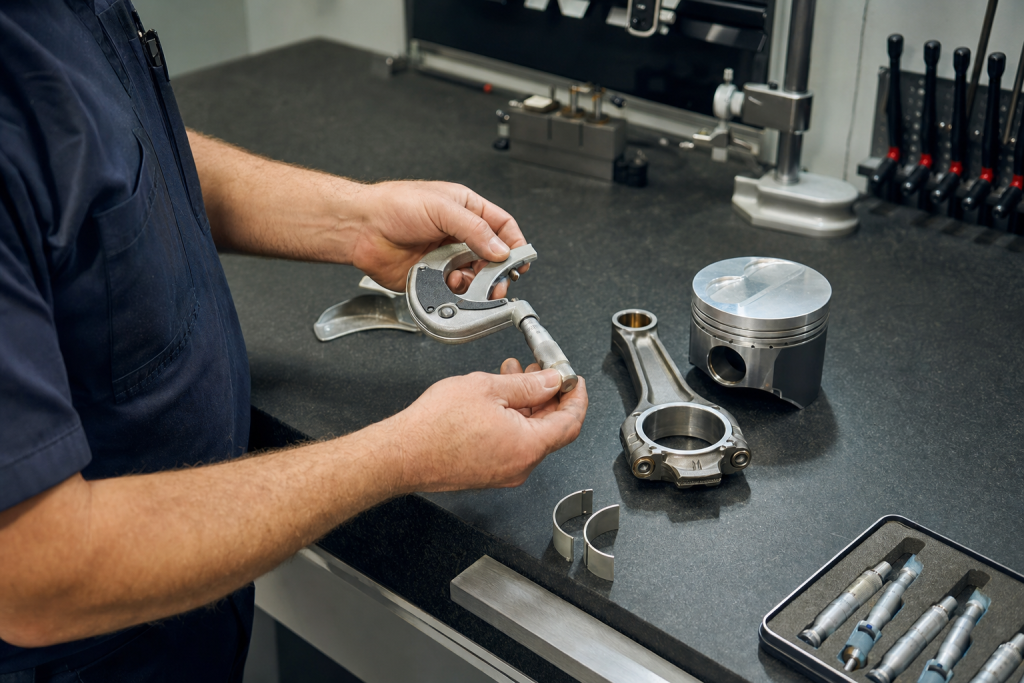
This group should not be ordered blindly after a failure. If an engine has low oil pressure, knocking noise, or metal debris in the oil pan, the crankshaft journals and bearing clearances need inspection. If the cylinder wall is scored, a new piston ring set alone will not restore compression.
Valve Train and Timing Parts: The Airflow Control Group
The valve train opens and closes the intake and exhaust valves at the correct time. A typical group includes intake valves, exhaust valves, valve springs, retainers, guides, seats, rocker arms, lifters, pushrods on OHV engines, cam followers, and one or more camshafts.
The timing system keeps the camshaft and crankshaft synchronized. Depending on the engine design, this system may use a timing belt, timing chain, gears, sprockets, guides, rails, and a tensioner. If the timing system jumps, the valve train can be damaged, especially in interference engines where the piston and valve occupy overlapping space at different points in the cycle.
Common matching details include:
- SOHC, DOHC, or OHV layout
- Number of valves per cylinder
- Intake-side vs exhaust-side position
- Hydraulic lifter vs mechanical adjustment
- Timing belt vs timing chain design
- Camshaft sensor or variable valve timing features
A practical rule: after a timing belt or chain failure, do not price only the belt or chain. Check valves, valve guides, rocker arms, camshaft caps, tensioners, sprockets, and related seals. If the engine is interference-type and the belt broke while running, bent valves are a real possibility.
Sealing Parts: Small Components That Decide Compression, Oil, and Coolant Control
Gaskets and seals look less impressive than pistons or cylinder heads, but they often decide whether a repair lasts. The head gasket seals combustion pressure, oil passages, and coolant passages between the block and cylinder head. Valve cover gaskets stop oil leaks at the top of the engine. Intake and exhaust gaskets control air leaks and exhaust leaks. Front and rear crankshaft seals stop oil from escaping around the crankshaft.
The head gasket is especially sensitive. Thickness, bore diameter, fire-ring material, coolant-hole layout, and bolt-torque procedure matter. On some engines, a head gasket replacement also requires new torque-to-yield head bolts.
Do not treat gasket sets as universal. Before ordering, confirm:
- Full set, head set, lower set, or single gasket
- Engine code and cylinder count
- Bore diameter and gasket thickness where specified
- Turbo or non-turbo layout
- Intake/exhaust port shape
- Whether bolts, seals, or O-rings are included
If a vehicle had overheating, the gasket is only one part of the diagnosis. The cylinder head may need a flatness check, pressure test, or crack inspection. Replacing the gasket without checking the mating surfaces can create the same failure again.
Fuel, Ignition, Cooling, and Lubrication Parts
Fuel and ignition parts differ sharply between gasoline and diesel engines. A gasoline engine usually uses spark plugs and ignition coils to ignite the fuel-air mixture. A diesel engine relies on compression ignition and may use glow plugs for cold starting, not spark plugs for normal combustion. This distinction matters for later keywords in the project, such as diesel engines and spark plugs.
Fuel injectors, fuel rails, fuel pumps, throttle bodies, and intake control parts must match flow rate, connector type, pressure range, and emission version. A visually similar injector may fit the rail but deliver the wrong amount of fuel.
Cooling and lubrication parts protect the hard parts from heat and friction. The water pump circulates coolant, the thermostat controls coolant flow, the oil pump supplies pressurized oil, and the oil filter removes contamination. The internal combustion engine page on Wikipedia also identifies cooling and lubrication as major engine topics, which reflects how central these systems are to engine durability: https://en.wikipedia.org/wiki/Internal_combustion_engine
|
Failure event |
Parts usually checked together |
Why they are connected |
|
Overheating |
Head gasket, cylinder head, thermostat, water pump, radiator, coolant passages |
Heat can warp the head and break the seal between combustion, oil, and coolant |
|
Low oil pressure |
Oil pump, bearings, crankshaft journals, oil pickup, oil filter, oil pan |
Oil starvation damages rotating surfaces before external symptoms look dramatic |
|
Misfire |
Spark plugs, ignition coils, injectors, valves, compression sealing |
A misfire can be electrical, fuel-related, or mechanical |
|
Timing failure |
Belt/chain, tensioner, guides, valves, rocker arms, camshaft, crank sensor |
Loss of synchronization can damage valve train parts |
|
White smoke or coolant loss |
Head gasket, cylinder head, block deck, intake gasket, coolant passages |
Coolant entering combustion may come from more than one sealing point |
Intake, Exhaust, and External Engine Parts
The intake manifold distributes air to the cylinders. The exhaust manifold collects exhaust gases from the cylinders. On turbocharged engines, the exhaust path may also drive a turbocharger, while the intake path may include intercooler piping, pressure sensors, and boost-control parts.
External engine parts include pulleys, brackets, sensors, belt tensioners, alternator mounting parts, crankshaft position sensors, camshaft position sensors, and related connectors. These parts are easy to underestimate because they sit outside the engine’s main castings, but they can prevent the engine from starting, charging, cooling, or reading timing correctly.
For intake and exhaust components, match port shape, bolt pattern, sensor holes, EGR fittings, turbo flange, and gasket shape. For sensors, match connector type and signal design. The wrong crankshaft or camshaft sensor may physically mount but fail to communicate correctly with the engine control unit.
What to Check Before You Order Engine Parts
Before sending a parts inquiry, prepare a short, precise data set. This saves time and prevents the most common fitment errors.
- Confirm the engine code, not only the vehicle model.
- Record displacement, cylinder count, and fuel type.
- Photograph casting numbers on the block, cylinder head, manifold, or cover when available.
- Identify the exact part position: intake or exhaust, front or rear, left or right bank.
- Note turbo, naturally aspirated, emission version, and market version.
- For rotating parts, provide measurements or confirm standard/oversize/undersize grade.
- For gasket sets, confirm full set, upper set, lower set, or individual gasket.
- For electrical parts, compare connector shape, pin count, and sensor position.
- For rebuild jobs, list the failure reason: overheating, oil starvation, timing failure, high mileage, or collision damage.
A parts supplier can work much faster with an engine code and casting number than with a photo of a dirty part on a bench. Photos help, but they should support the identification data, not replace it.
Common Repair Situations and the Parts Usually Checked Together
When an engine fails, the damaged part is not always the root cause. A parts list becomes more useful when it is connected to repair logic.
After overheating, inspect the head gasket, cylinder head, thermostat, water pump, radiator, and coolant passages. A warped head or blocked coolant path can destroy a new gasket.
After oil starvation, check the oil pump, oil pickup, main bearings, rod bearings, crankshaft journals, camshaft journals, and oil pan debris. A new bearing set will not survive if the crankshaft journal is scored or the oil pickup is blocked.
After timing failure, inspect timing belt or chain components, tensioners, guides, valves, rocker arms, camshafts, and crank/cam sensors. On interference engines, valve damage should be assumed possible until compression or leak-down testing proves otherwise.
For a high-mileage rebuild, the usual inspection list includes piston rings, bearings, gaskets, oil seals, timing components, water pump, oil pump, valve seals, and cylinder head condition. Whether pistons, crankshaft, or camshaft are reused depends on measurement, not mileage alone.
FAQs
What are the main parts of an engine?
The main parts of an engine include the engine block, cylinder head, pistons, piston rings, connecting rods, crankshaft, camshaft, valves, timing belt or chain, gaskets, oil pump, water pump, intake manifold, exhaust manifold, fuel injectors, and ignition or glow-plug components. For repair work, it is better to group these by system than memorize them alphabetically.
Is a sensor considered an engine part?
Yes, if the sensor is mounted on or directly controls engine operation. Crankshaft position sensors, camshaft position sensors, temperature sensors, knock sensors, and oil pressure sensors are often treated as engine-related parts. They are usually more model-specific than hard parts, so connector and position checks matter.
What is the difference between a short block and a long block?
A short block usually includes the engine block and lower rotating assembly, such as crankshaft, connecting rods, pistons, and bearings. A long block usually adds the cylinder head and valve train. Exact contents vary by supplier, so always confirm what is included before comparing prices.
Which engine parts are replaced most often in a rebuild?
Common rebuild replacement parts include piston rings, bearings, gaskets, oil seals, timing components, valve seals, filters, and sometimes oil pump or water pump. Large parts such as the block, crankshaft, cylinder head, camshaft, and connecting rods may be reused if inspection and measurement show they are within specification.
Why does the same engine part have different versions?
Engine parts change because manufacturers revise engine codes, emission systems, materials, sensor positions, port shapes, and casting designs. Two parts may look similar but differ in bolt pattern, oil passage, compression height, valve size, or connector type. That is why engine code and OEM or casting number are so important.
Conclusion
An engine parts list should help you do more than name components. The useful version groups parts by system, shows what each group does, and tells you what to verify before repair or ordering. Start with the big structure: block, head, rotating assembly, valve train, timing, sealing, fuel and ignition, cooling and lubrication, intake and exhaust, and control parts.
For a parts inquiry, the best handoff is simple: engine code, displacement, fuel type, model year, casting or OEM number, part position, and the failure reason. With those details, an engine parts list stops being a generic glossary and becomes a working checklist for accurate sourcing.