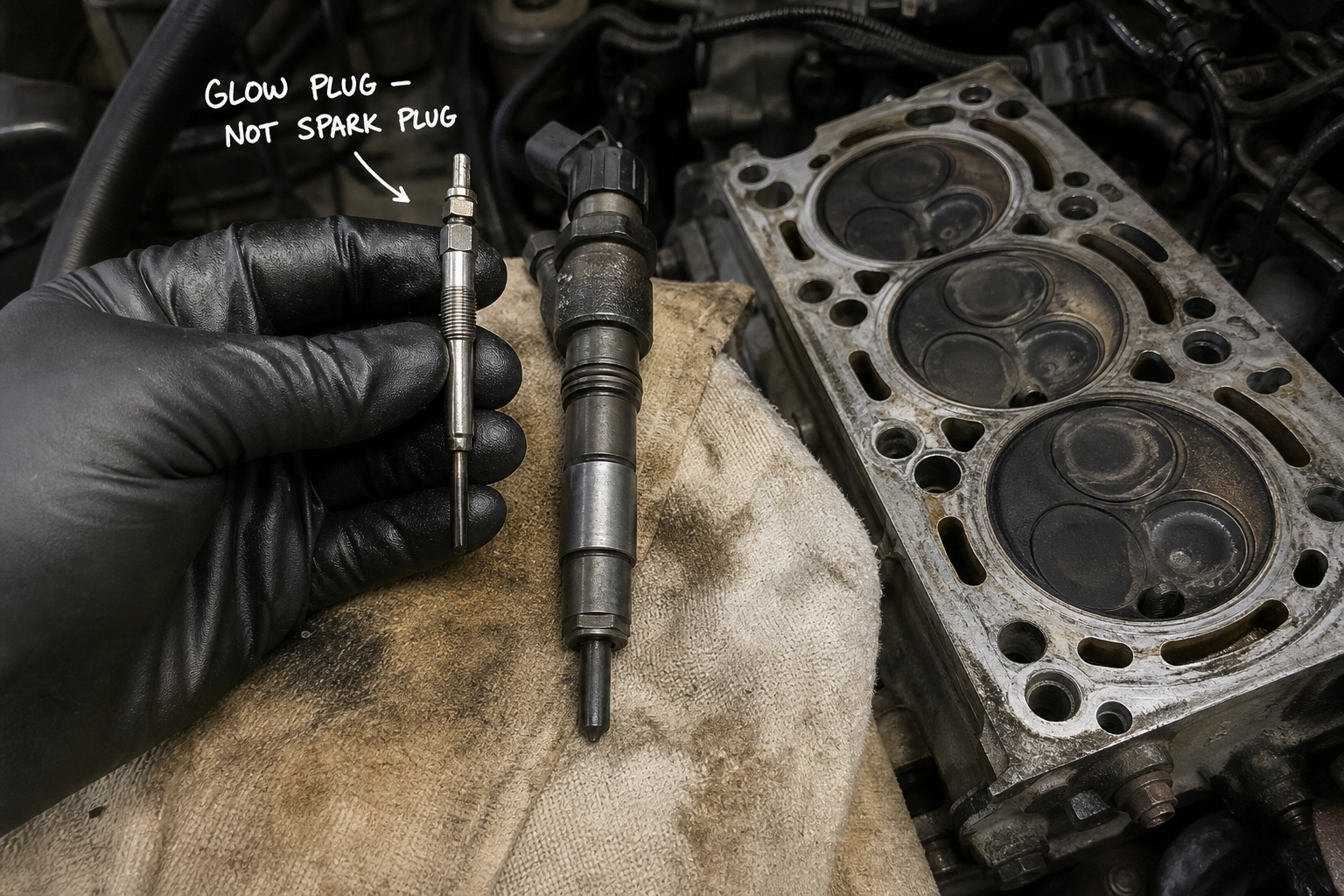
A diesel glow plug assists cold starting; it does not ignite each combustion event like a spark plug.
Introduction
If you’ve worked on gasoline engines, you know spark plugs are essential for ignition. When you move to diesel engines, that assumption breaks down. Standard diesel engines do not have spark plugs. They rely on compression ignition: fuel ignites from the heat of compressed air, not from an electric spark. This fundamental difference shapes everything from maintenance schedules to cold-start systems.
There is one exception. Some small model diesel engines—used in radio-controlled aircraft and boats—do use a glow plug that stays hot during operation, functioning somewhat like a continuous spark source. But in automotive, marine, and industrial diesel engines, you will not find spark plugs.
This article explains why diesel engines skip spark plugs, how compression ignition works, what glow plugs actually do, and when the model engine exception applies.
Key Takeaways
- **No spark plugs in standard diesel engines**: Diesel fuel ignites from compression heat, not an electric spark.
- **Glow plugs are not spark plugs**: Glow plugs warm the combustion chamber for cold starts, then shut off once the engine runs.
- **Model engine exception**: Small hobby diesel engines use a continuously heated glow plug as part of the ignition process.
- **Compression ignition is the core difference**: Diesel engines compress air to over 500°F before fuel injection, causing spontaneous ignition.
Why Diesel Engines Don’t Need Spark Plugs
Diesel engines omit spark plugs because the ignition process does not require a timed electric spark. Instead, diesel engines (https://en.wikipedia.org/wiki/Diesel_engine) compress air to a much higher ratio than gasoline engines—typically 14:1 to 25:1 compared to 8:1 to 12:1 in gasoline engines. This compression raises air temperature above the autoignition point of diesel fuel, around 410°F to 500°F depending on fuel grade and conditions.
When the injector sprays diesel fuel into this superheated air, the fuel ignites on contact. The timing comes from the injection event, not from a spark plug firing. There is no ignition coil, no distributor, and no spark plug wires in a diesel ignition system.
This design offers several advantages:
- **Fewer ignition components to maintain**: No spark plugs to replace every 30,000–100,000 miles.
- **Higher thermal efficiency**: The high compression ratio extracts more energy from each unit of fuel.
- **Better low-end torque**: Compression ignition delivers power at lower engine speeds, useful for trucks and heavy equipment.
The tradeoff is higher mechanical stress on the engine block, pistons, and crankshaft due to the elevated compression forces.
Compression Ignition: How Diesel Fuel Ignites Without a Spark
Compression ignition follows a four-stroke cycle similar to gasoline engines, but the ignition mechanism is entirely different.
Intake stroke: The piston moves down, drawing in air only. No fuel enters during intake.
Compression stroke: The piston moves up, compressing the air to 400–700 psi and heating it to over 500°F. No fuel is present yet.
Power stroke: Near the top of the compression stroke, the fuel injector sprays a fine mist of diesel fuel into the hot, compressed air. The fuel ignites immediately without any spark. The expanding gases push the piston down.
Exhaust stroke: The piston moves up again, expelling combustion gases through the exhaust valve.
The key difference from gasoline engines is that air and fuel never mix before ignition. Diesel fuel enters only after the air is already compressed and hot. This separation allows the engine to control ignition timing purely through injection timing, not spark timing.
Compression ignition also explains why diesel engines are harder to start in cold weather. When ambient temperature drops, compressed air may not reach the autoignition threshold, especially on the first few cranks when the engine block is cold. This is where glow plugs come in.
Glow Plugs vs Spark Plugs: What’s the Difference?
Glow plugs and spark plugs serve entirely different functions, though both thread into the cylinder head.
Spark plugs create a timed electric arc that ignites a premixed air-fuel charge. They fire thousands of times per minute, synchronized with piston position. Gasoline engines depend on spark plugs for every combustion event.
Glow plugs are resistive heating elements that warm the combustion chamber before and during cold starts. They do not create a spark. Instead, they glow red-hot—around 1,800°F to 2,700°F depending on design—raising the temperature of the air in the prechamber or main combustion chamber. This helps diesel fuel ignite during the first few compression cycles when the engine block is cold.
Once the engine reaches operating temperature, glow plugs shut off. Combustion heat alone is sufficient to maintain compression ignition. In modern diesel engines with glow plug (https://en.wikipedia.org/wiki/Glow_plug) controllers, the plugs may cycle on for 5–30 seconds before cranking, then stay on for another 30–180 seconds after start to smooth idle during warm-up.
|
Feature |
Spark Plug |
Glow Plug |
|
Function |
Creates ignition spark |
Preheats combustion chamber |
|
Operating mode |
Fires every combustion cycle |
On during cold start only |
|
Voltage |
10,000–45,000 volts |
6–12 volts DC |
|
Ignition role |
Required for every ignition |
Assists cold start, not ignition source |
|
Found in |
Gasoline engines |
Diesel engines |
Glow plugs are not interchangeable with spark plugs. They have different thread sizes, heat ratings, and electrical connectors. If you try to install a spark plug in a diesel engine, it will not fit the electrical system and will not function.
The One Exception: Model Diesel Engines
The one place where diesel engines do use something resembling a spark plug is in small model engines for radio-controlled aircraft, cars, and boats. These engines use a glow plug that remains powered during operation, not just during starting.
Model diesel engines are typically two-stroke designs under 1 cubic inch displacement. They burn a fuel mixture of kerosene, ether, and a small amount of lubricating oil. The glow plug filament stays hot throughout operation, acting as a continuous ignition source in the low-compression environment of a small engine.
This setup differs from automotive diesel engines in several ways:
- **Lower compression ratio**: Model engines run around 8:1 to 12:1, not high enough for pure compression ignition.
- **Continuous glow plug power**: The plug stays energized by an external battery or internal magneto coil.
- **Fuel mixture**: Ether lowers the autoignition temperature, and the glow plug provides the remaining heat.
Model diesel engines are sometimes called "compression ignition glow engines" to distinguish them from true compression ignition diesels. If you are diagnosing a full-size diesel engine in a truck, generator, or tractor, this exception does not apply. Those engines do not have spark plugs or continuously powered glow plugs.
Gasoline vs Diesel: The Ignition System Divide
The absence of spark plugs in diesel engines is part of a broader design divide between gasoline and diesel ignition systems.
Gasoline engines:
- Premix air and fuel before compression.
- Use a lower compression ratio to avoid autoignition (knock).
- Require precise spark timing controlled by ignition coils, distributors, or coil-on-plug systems.
- Replace spark plugs as a regular maintenance item.
Diesel engines:
- Compress air only, then inject fuel at the right moment.
- Use a much higher compression ratio to guarantee autoignition.
- Control ignition timing through fuel injection timing, not spark timing.
- Replace glow plugs less frequently, typically every 60,000–100,000 miles or when cold-start issues appear.
This design difference also affects fuel economy, emissions, and maintenance cost. Diesel engines generally deliver 20–30% better fuel economy due to higher thermal efficiency, but they require more robust (and expensive) injection systems to handle high-pressure fuel delivery.
When you are sourcing parts or planning maintenance, the ignition system is one area where gasoline and diesel engines have almost no overlap. Spark plugs, ignition coils, and distributor caps belong to gasoline engines. Glow plugs, glow plug controllers, and high-pressure fuel injectors belong to diesel engines.
FAQs
Can you put spark plugs in a diesel engine?
No. Diesel engines do not have the electrical infrastructure (ignition coils, spark plug wires, or spark timing control) to fire spark plugs. Even if you physically installed a spark plug in a glow plug hole, it would not function.
What happens if a glow plug fails?
A failed glow plug makes cold starts difficult or impossible. The engine may crank but not fire until the block warms up from repeated cranking. You may also notice rough idle or white smoke during warm-up. In multi-cylinder engines, one bad glow plug often causes misfires in that cylinder until the engine reaches operating temperature.
Do all diesel engines have glow plugs?
Most do, but not all. Large industrial and marine diesel engines with very high compression ratios may start without glow plugs, relying on compression heat alone. Some older indirect-injection diesels use intake air heaters instead of individual glow plugs. Modern direct-injection diesel engines in cars and trucks almost always have glow plugs.
How do you know if your diesel engine has glow plugs or spark plugs?
Check the cylinder head. Glow plugs have a single heavy-gauge wire connection, usually 6–12 volts. Spark plugs have a thick rubber boot and high-voltage wire. If you see no ignition coils or coil packs under the hood, you have a diesel engine with glow plugs, not spark plugs.
Why do diesel engines last longer than gasoline engines?
The absence of spark plugs is a small factor. The main reasons are stronger engine construction (needed to handle high compression), no throttle plate (reducing pumping losses), and lower engine speeds (reducing mechanical wear). Diesel fuel also has lubricating properties that help protect injectors and cylinder walls.
Conclusion
Standard diesel engines do not have spark plugs. They use compression ignition, where fuel ignites from the heat of compressed air rather than from an electric spark. Glow plugs may be present, but they only preheat the combustion chamber for cold starts—they do not fire repeatedly like spark plugs in gasoline engines.
The one exception is small model diesel engines used in hobby applications, which rely on a continuously powered glow plug to maintain combustion in a low-compression environment. This design does not apply to automotive, marine, or industrial diesel engines.
Understanding this distinction helps when ordering parts, diagnosing cold-start problems, or converting from gasoline to diesel power. If you are working on a diesel engine and someone asks for spark plugs, you know the question reflects a misunderstanding of how diesel ignition works.