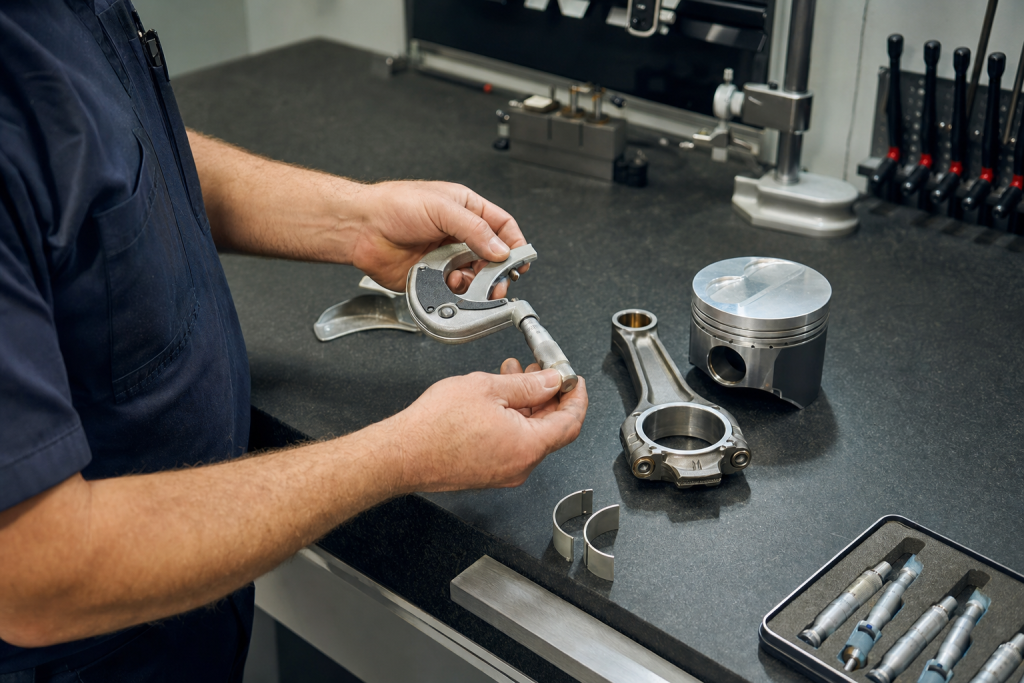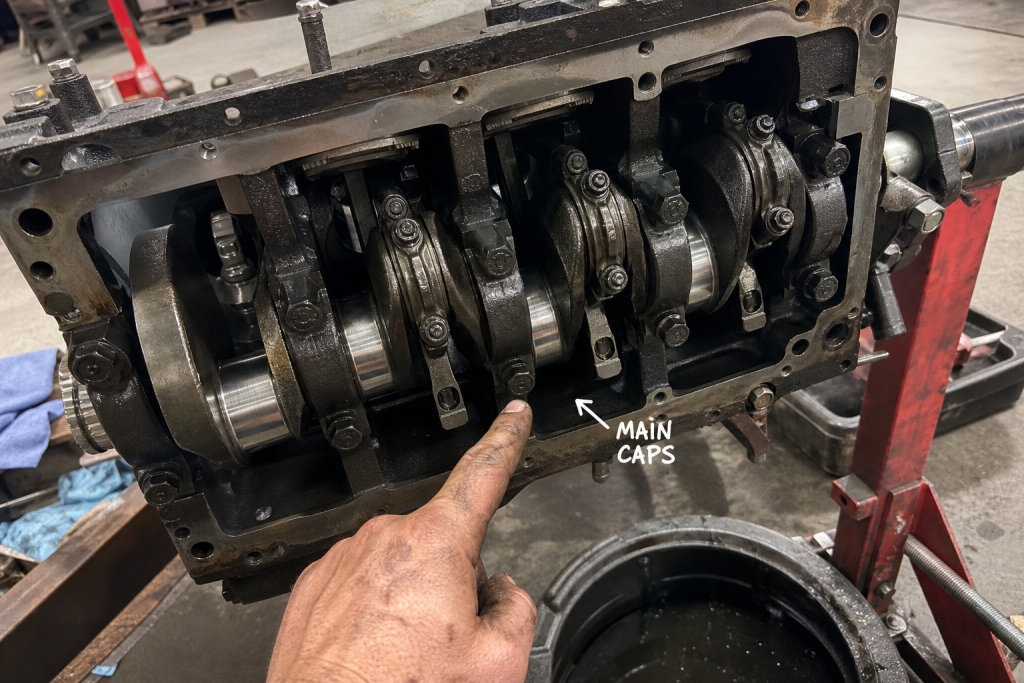
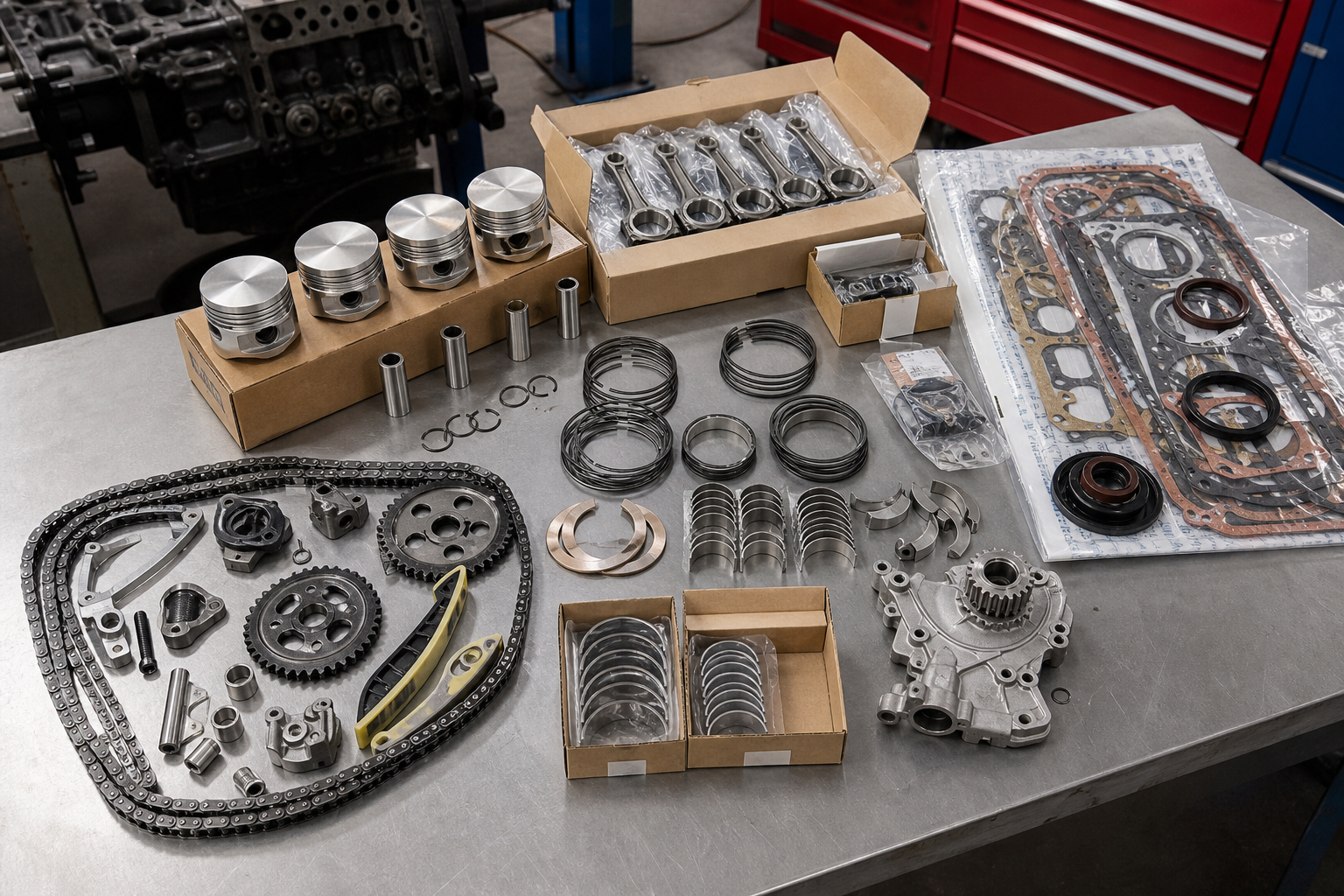
A stock rebuild kit should be checked as a complete system, not judged by one component alone.
Should you order an Engine Tech rebuild kit for your next stock engine job, or source components separately? The answer depends on whether you value convenience over control and whether your block requires machine work.
Engine Tech kits work well as time-saving bundles when you’re rebuilding a stock-specification engine with predictable wear—standard bores, journals within tolerance, and no performance modifications planned. They bundle gaskets, bearings, seals, and rings into one part number, which speeds up ordering and reduces the chance of missing a $3 seal that delays the job.
But these kits contain mixed-origin components, not uniformly premium parts. Some items match OE specifications closely, while others sit at the economy end of the aftermarket range. If your rebuild demands precision matching to measured clearances or includes performance upgrades, you’ll need to verify each component or source separately.
Key Takeaways
- Engine Tech kits bundle the consumables needed for a typical stock rebuild: gaskets, bearings, seals, rings, and timing components
- Components are sourced from multiple suppliers and vary in quality tier—some OE-equivalent, some budget aftermarket
- Kits save ordering time and reduce part-number mistakes for straightforward stock rebuilds with minimal machine work
- Machine shop inspection of bearings and rings remains necessary; kit inclusion doesn’t guarantee fit to your measured clearances
- Skip the kit if you need performance-grade parts, custom clearances, or have an engine with significant bore/journal wear
What Engine Tech Rebuild Kits Actually Include
An Engine Tech rebuild kit (https://enginetech.com/engine-kits/) typically contains:
Gasket set: Head gasket, intake/exhaust manifold gaskets, valve cover gaskets, oil pan gasket, timing cover gasket, and minor seals. These are full-replacement sets, not just the high-wear items.
Bearings: Main bearings and rod bearings in standard size. Some kits include cam bearings for pushrod engines; others list them separately.
Piston rings: One set per cylinder, usually moly-faced or chrome top rings with standard tension. Sized for standard bore or common oversize increments (.020", .030", .040").
Seals: Front and rear crankshaft seals, valve seals (if applicable to engine design), and cam seals.
Timing components: Timing chain and sprocket sets for pushrod engines, or timing belt kits for applicable overhead cam engines. Some kits separate these as optional add-ons.
Freeze plugs: Expansion plugs for block and head water jacket holes.
The kits do not include pistons, connecting rods, crankshaft, camshaft, valves, or cylinder head components beyond gaskets and seals. If your pistons are worn or you’re changing compression ratio, you’ll source those separately.
Kit part numbers are engine-specific. A small-block Chevy 350 kit differs from a Ford 302 kit in every component. Engine Tech’s catalog (https://enginetech.com/engine-kits/) organizes kits by make, engine family, and year range, but you must verify fitment against your exact engine code and year.
The OE-Specification Claim vs. Reality
Engine Tech markets their kits as meeting or exceeding OE specifications. This claim is accurate for dimensional fit—gaskets seal the mating surfaces, bearings fit the housing bores, rings fit the piston grooves—but it oversimplifies the quality range.
Here’s what "OE-spec" means in practice:
Gaskets: Typically multi-layer steel (MLS) head gaskets for modern engines or composite gaskets for older designs, matching the original gasket type and thickness. Bolt hole locations and coolant passage shapes align with factory dimensions. Material grade and long-term sealing performance vary by supplier.
Bearings: Aluminum-based bearings with tri-metal or bi-metal construction, sized to SAEJ506 tolerances. They fit standard or oversize journals, but bearing material composition (copper-lead, aluminum-tin) and oil clearance characteristics differ from premium brands like King or Clevite.
Rings: Cast iron or ductile iron construction with moly or chrome facing on the top ring. Ring end gap and radial wall thickness meet SAE standards, but ring seal speed and break-in behavior differ from file-fit or premium gapless rings.
Seals: Nitrile or Viton lip seals with the correct shaft diameter and spring tension. Seal longevity under high heat or synthetic oil exposure varies by rubber compound grade.
The key point: a rebuild kit can combine several component categories under one part number. Do not assume every item in the box has the same supplier, material, or origin. Check the kit contents, packaging, and supplier documentation when those details matter.
This mixed sourcing works for stock rebuilds because the parts meet minimum interchangeability standards. It becomes a problem if you need consistency—matching ring tension across cylinders, bearing crush uniformity, or gasket compression control for high-boost applications.
When Engine Tech Kits Make Sense for Stock Rebuilds
Choose an Engine Tech kit when these conditions apply:
Your engine has standard-size bores and journals: The bearings and rings in the kit assume standard dimensions or common oversize increments. If your machinist measures .0015" oversize on a main journal—a size between standard and .010" oversize—the kit bearings won’t fit.
You’re rebuilding to factory power and RPM limits: Stock ring tension, standard bearing clearances, and OE gasket thickness are calibrated for factory power output. A 350 Chevy rebuilt with an Engine Tech kit will handle 300 hp and 5,500 rpm reliably. It’s not built for 7,000 rpm or 600 hp.
The block and heads don’t require significant machine work: Kits assume standard deck height, standard head thickness, and flat mating surfaces. If your machinist removes .030" from the block deck to true it, the head gasket compressed thickness may need adjustment. Some kits include multiple gasket thicknesses; most don’t.
You want to reduce ordering errors: A single part number replaces 40+ individual part numbers. For a shop rebuilding multiple engines per week, this cuts order processing time and reduces the chance of missing a $2 O-ring that stops the job.
You’re working on a common engine platform: Engine Tech’s coverage is strong for domestic V8s (small-block Chevy, Ford modular, Chrysler LA/Magnum) and popular import four-cylinders (Honda D/B/K series, Toyota 2JZ/1JZ). Obscure engines or industrial applications have limited kit availability.
A typical use case: A 2005 Silverado with a 5.3L Vortec that spun a bearing at 180,000 miles. The crank journals clean up at .010" undersize, the bores are standard, and the heads are flat. An Engine Tech kit with .010" bearings and standard rings gets the truck back to stock reliability in a weekend. The kit’s $300 cost is justified by the time saved vs. ordering 40 parts separately.
Why Machine Shop Inspection Still Matters
Ordering a rebuild kit doesn’t eliminate the need to measure and verify. Here’s what your machinist must check even with kit parts in hand:
|
Component |
What to Verify |
Why It Matters |
|
Main/rod bearings |
Bearing clearance with Plastigage or micrometer after installation |
Kit bearings are sized nominally; your crank journals may measure at the tight or loose end of the tolerance band |
|
Piston rings |
End gap in the bore with a feeler gauge |
Ring end gap must match bore diameter; kit rings assume standard bore, but thermal expansion varies by alloy |
|
Head gasket |
Compressed thickness vs. piston-to-deck clearance |
Gasket thickness affects compression ratio and piston-to-valve clearance; stacking a kit gasket on a milled block can cause interference |
|
Freeze plugs |
Bore diameter and press-fit interference |
Some blocks have worn freeze plug bores from corrosion; kit plugs may not seal if the bore is oversized |
The inspection matters because Engine Tech kits are built to catalog specifications, not your specific engine’s measured dimensions. Bearing clearances that work on a freshly machined crank may be too loose on a polished but unworn crank. Ring gaps sized for a 4.000" bore won’t seal properly in a 4.005" worn bore.
A competent machine shop will measure first, then use the kit parts that fit and source replacements for parts that don’t. The kit’s convenience value drops if half the components require substitution.
Scenarios Where You Should Skip the Kit
Don’t order an Engine Tech kit if any of these apply:
Your engine requires custom clearances: Turbo builds, high-RPM naturally aspirated engines, or race applications need specific bearing clearances (.002"–.003" on mains, .0025"–.0035" on rods for high-RPM use) and custom ring gaps. Kit bearings and rings are sized for stock clearances.
You’re mixing performance upgrades with stock parts: If you’re installing forged pistons, aftermarket rods, or a performance cam, the gasket set in a stock kit may not match. Forged pistons often require different ring packs than cast pistons. Aftermarket rods may use different bearing widths.
The block or heads have been significantly machined: If your machine shop removes .040" from the block deck or .020" from the head surfaces, the kit’s head gasket may be too thick or too thin for the resulting piston-to-deck clearance. You’ll need to source a gasket with the correct compressed thickness.
You need traceable component sourcing: Some professional engine builders require documentation of bearing material composition, ring coating type, and gasket torque-to-yield specifications. Engine Tech kits don’t include detailed component datasheets because the suppliers vary.
You’re rebuilding a high-value or rare engine: A numbers-matching engine for a classic car or a low-production performance variant deserves individually sourced, verifiable parts. The cost of a botched rebuild exceeds the convenience savings of a kit.
In these cases, source components individually from known manufacturers—Mahle or Wiseco pistons, King or Clevite bearings, Cometic or Fel-Pro gaskets—and verify each part’s specification before installation.
Are Engine Tech Kits Worth It for Your Shop?
For volume rebuilders working on common platforms at stock specifications, Engine Tech kits reduce order processing time and part-number errors. The quality is adequate for stock rebuilds that stay within factory power and RPM limits.
For performance shops, custom builds, or high-value engines, the mixed sourcing and generic specifications make kits a poor fit. You’ll spend more time verifying and substituting parts than you save on ordering.
The middle ground: Use Engine Tech kits for straightforward jobs where speed matters more than precision, and source components individually when the build demands it. A competent shop knows which category each job falls into before ordering parts.
FAQs
Can I use an Engine Tech kit with aftermarket pistons?
Only if the pistons use the same ring groove dimensions as the stock pistons. Many forged pistons require different ring thicknesses (1.5mm/1.5mm/3mm vs. stock 1.2mm/1.2mm/2.8mm) or different ring tensions. Check the piston manufacturer’s ring specification before assuming the kit rings will work.
Do Engine Tech kits include ARP head studs or bolts?
No. Kits include OE-style head bolts (torque-to-yield or reusable, depending on the engine). If you want ARP studs, order them separately and discard the kit bolts.
How long do Engine Tech gaskets last?
In stock applications with proper torque and surface prep, expect 100,000+ miles from MLS head gaskets and 50,000+ miles from rubber-coated gaskets. Gasket life depends more on installation quality and cooling system maintenance than gasket brand.
Can I return unused parts from a kit?
Most suppliers treat rebuild kits as non-returnable once the packaging is opened, because the components can’t be re-kitted. Check the return policy before ordering if you’re unsure about fit.
Conclusion
Engine Tech rebuild kits serve a specific role: fast, economical parts bundles for stock engine rebuilds with minimal complications. They cut ordering time, reduce mistakes, and deliver adequate quality for street-driven vehicles operating within factory specifications.
They don’t replace careful measurement, machine shop inspection, or the need to verify clearances. And they’re not suited for performance builds, heavily machined blocks, or applications where component traceability matters.
Know which type of rebuild you’re doing before ordering. If your job fits the kit’s design envelope—standard sizes, stock power, common platform—you’ll appreciate the convenience. If it doesn’t, save yourself the substitution hassle and source parts individually from the start.