A pushrod V8 and a four-cylinder DOHC engine both use camshafts to open and close valves. The pushrod engine mounts its single camshaft low in the block where it can be reached by removing the timing cover, oil pan, and front accessories. The DOHC engine mounts two camshafts in each cylinder head, requiring valve-cover removal, timing-chain extraction, and often cylinder-head disassembly. Same part name, completely different access paths, and camshaft replacement cost that reflects this difference. The estimate depends on how many camshafts exist, where they sit, what must be removed to reach them, and what related components failed when the camshaft wore out or seized.
Key Takeaways
- Camshaft replacement cost is driven by engine configuration: overhead-valve designs place the camshaft in the block with simpler access, while single and dual overhead-cam layouts require cylinder-head work and timing-component removal.
- Diagnostic confirmation requires oil-pressure measurement, compression or leak-down testing, and visual inspection of cam lobes and journals rather than assuming the camshaft is the root cause based on noise or performance loss alone.
- The parts list extends beyond the camshaft itself to include timing chains or belts, tensioners, guides, lifters or followers, seals, gaskets, and engine oil, with total parts cost varying by engine family and component quality.
- Related valvetrain damage from low oil pressure, contaminated oil, or timing-component failure often expands the repair to include lifters, rocker arms, cylinder-head resurfacing, or complete engine replacement when bearing surfaces are scored.
- Labor requirements vary substantially based on whether the camshaft is in the block or cylinder head, whether the engine must be dropped or tilted for access, and whether machining or cylinder-head work is required.
- Accurate estimates require documentation of measured clearances, visible damage, parts availability, and labor scope before authorizing work, with the decision between camshaft replacement and engine replacement depending on the cost ratio and vehicle value.
Why Camshaft Replacement Cost Varies So Widely
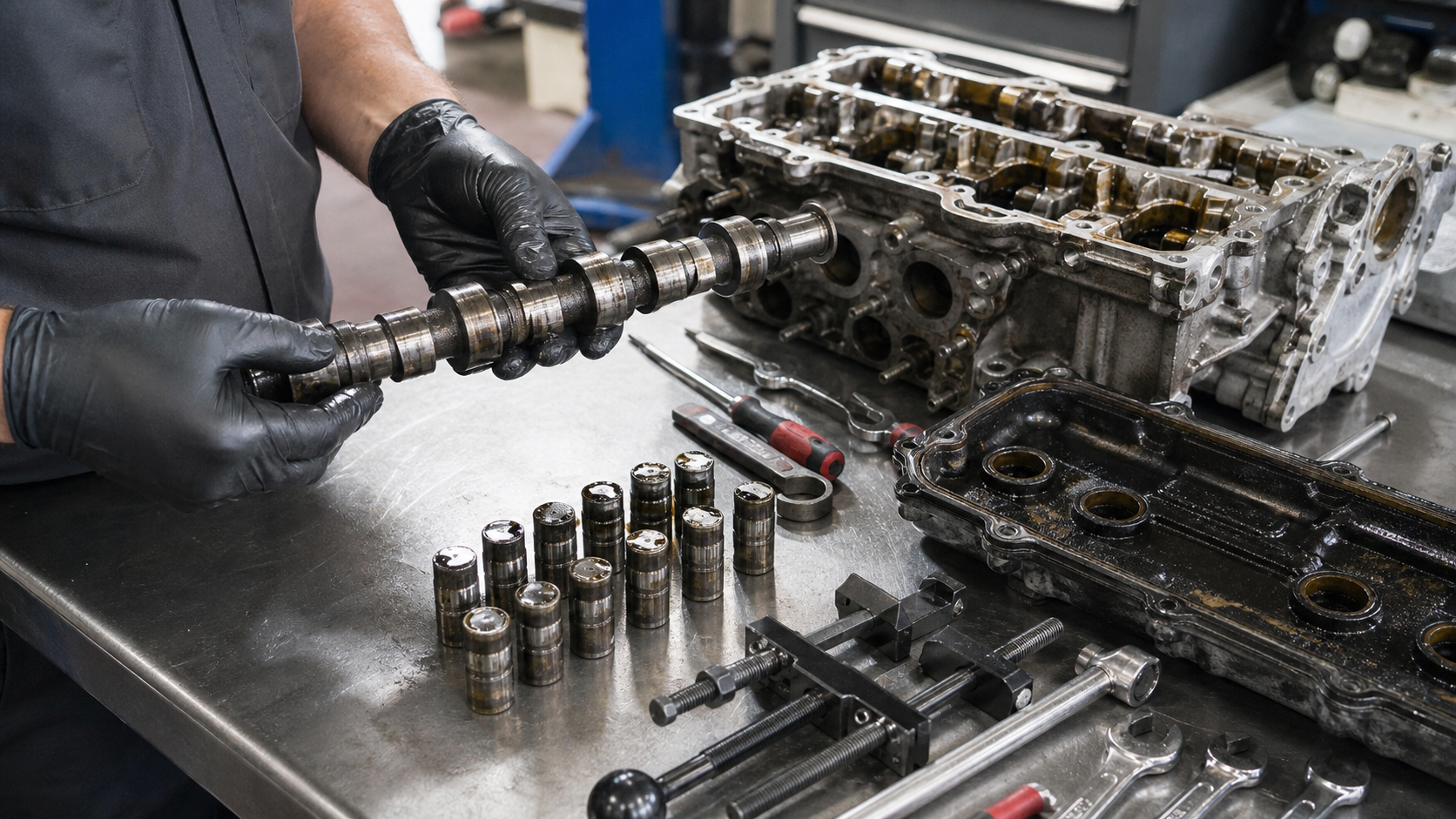
The camshaft’s mounting location determines the disassembly sequence and parts list. Overhead-valve engines position a single camshaft in the engine block where it drives pushrods that transfer motion to rocker arms. Accessing this camshaft requires timing-cover removal, timing-chain or gear extraction, and often oil-pan removal to drop the camshaft past the crankshaft journals. Single-overhead-cam (SOHC) engines mount one camshaft per cylinder head, requiring valve-cover removal and timing-chain or belt disassembly but avoiding deep block work. Dual-overhead-cam (DOHC) engines use two camshafts per head—one for intake valves, one for exhaust—doubling the parts count and often requiring cylinder-head removal for complete inspection and reassembly.
The number of cylinder heads multiplies the parts and labor. An inline-four DOHC engine has one cylinder head with two camshafts. A V6 DOHC has two heads with four camshafts total. Each camshaft brings its own timing components, seals, and associated valvetrain parts into the estimate.
Engine mounting and clearance create labor multipliers. Transverse-mounted engines in front-wheel-drive vehicles often require engine lifting, tilting, or partial lowering to access timing covers and cylinder heads. Longitudinal engines in rear-wheel-drive vehicles typically provide more room for top-side disassembly but may still need accessory removal, radiator extraction, or transmission separation depending on year and model.
Related component condition adds unpredictability. A camshaft rarely fails alone. If oil starvation caused cam-lobe wear, the same condition damaged lifters, rocker arms, and bearing surfaces. If a timing chain stretched and skipped, valve-to-piston contact may have bent valves or damaged piston crowns. The final bill reflects what is discovered during teardown rather than what the initial symptom suggested.
Confirm the Camshaft before Opening the Engine
Camshaft replacement is a major teardown. Confirmation testing narrows the fault before committing to the repair. An oil-pressure test verifies that the lubrication system can supply the camshaft journals and lobes with the flow and pressure required by the service manual. Low pressure or slow pressure rise points to a worn oil pump, clogged pickup, or excessive bearing clearance rather than the camshaft itself. Measuring oil pressure at the port nearest the camshaft under operating temperature and specified RPM isolates the supply side from the wear side.
A compression test or leak-down test measures cylinder sealing. Low compression across all cylinders suggests valve-timing loss from a worn or broken timing component rather than cam-lobe wear. Low compression on adjacent cylinders only may indicate valve damage from timing-chain skip or interference. Leak-down testing quantifies leakage past valves, rings, and gaskets and identifies where compression is escaping.
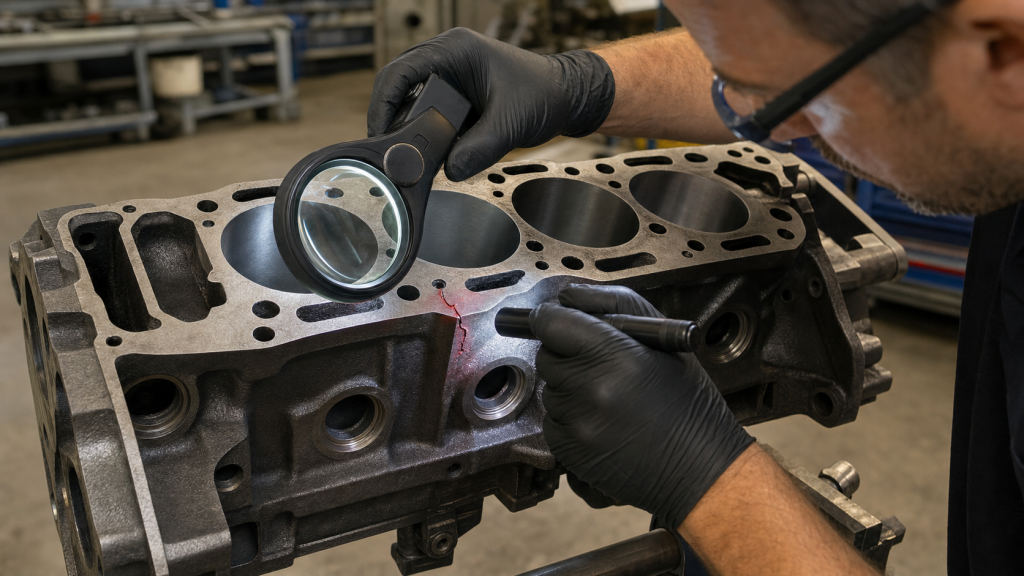
Visual inspection through the valve cover or timing cover reveals cam-lobe condition, journal finish, and follower wear without full disassembly. Many engines allow valve-cover removal as a preliminary step. Scoring, pitting, or material loss on cam lobes confirms mechanical wear. Discoloration or varnish buildup suggests oil breakdown or contamination. Metal particles in the oil or stuck to magnetic drain plugs indicate active wear and support the camshaft diagnosis.
The camshaft position sensor provides timing data but does not measure mechanical wear. A sensor fault code will trigger the check-engine light and may cause no-start or rough-running conditions, but replacing the sensor is a separate, minor repair. Sensor replacement takes significantly less time and costs a fraction of camshaft replacement. Always verify sensor function and wiring before assuming internal engine damage.
Parts Included beyond the Camshaft Itself
The camshaft is never replaced in isolation. The parts list begins with the camshaft or camshafts, but expands to every component that interfaces with the cam or must be removed to reach it.
Timing components include the timing chain or belt, tensioner, guides, sprockets, and gears. Reusing a worn chain or tensioner after installing a new camshaft allows timing slack, noise, and potential skip. Most service procedures specify timing-set replacement as mandatory during camshaft work. Timing belts have scheduled replacement intervals and should never be reused after removal. Tensioners use internal springs or hydraulic pressure that degrade over time and mileage.
Lifters or cam followers transfer motion from the cam lobes to the valves. Hydraulic lifters contain internal check valves and oil chambers that wear when the camshaft wears. Mechanical lifters and bucket-type followers develop wear pockets on their contact faces. Reusing damaged lifters with a new camshaft accelerates wear on the new cam lobes. The service manual will specify whether lifter replacement is required or conditional on measured wear.
Seals and gaskets include the front crankshaft seal, camshaft seals, valve-cover gaskets, timing-cover gasket, and oil-pan gasket if the pan must be dropped. Every seal and gasket in the disassembly path is replaced to avoid oil leaks after reassembly. Multi-layer steel gaskets and molded-rubber gaskets are single-use. Cork and composite gaskets may be reusable in low-pressure applications but are typically replaced for reliability.
Engine oil and filter are changed after any internal engine repair. Metal particles, gasket material, and assembly lubricant contaminate the oil during teardown and reassembly. Running new components on contaminated oil defeats the purpose of the repair.
Accessory drive components—belts, pulleys, water pumps, and tensioners—are evaluated and often replaced during the same service interval. If the serpentine belt or water pump has remaining life but will require similar labor to replace later, bundling the work saves duplicate teardown cost.
Labor Differences for OHV, SOHC, and DOHC Engines
Labor requirements scale with access difficulty and component count. Overhead-valve engines with a single camshaft in the block require timing-cover removal, harmonic-balancer extraction, timing-chain or gear removal, and camshaft extraction past the crankshaft. Additional time applies if the oil pan must be dropped and whether the engine must be tilted or lifted for clearance. Further labor is required if the radiator, transmission cooler lines, or engine mounts must be disconnected.
Single-overhead-cam engines require valve-cover removal, accessory drive removal, and timing-chain or belt disassembly to lift the camshaft from the cylinder head. The head may remain installed if the camshaft journals are not damaged and if the service procedure allows in-place reassembly. V-configuration engines with two cylinder heads require substantially more time than inline engines. Removing the cylinder head for inspection or machining extends the labor significantly.
Dual-overhead-cam engines double the camshaft count and typically require cylinder-head removal for complete service. Each head contains two camshafts, multiple cam journals, and twice the number of seals and bearing caps. DOHC configurations increase both parts and labor cost compared to pushrod designs, with V6 and V8 DOHC engines requiring the most extensive work.
The labor estimate assumes standard tooling, a lift, and unobstructed access. Specialty tools for timing-chain tensioning, camshaft alignment, or valve-spring compression add cost if the shop does not already own them. Rusted fasteners, broken studs, or seized components extend labor when penetrating oil, heat, or extraction tools are required. The estimate should account for the vehicle’s age, mileage, and service history when setting the labor expectation.
Related Damage That Expands the Repair
Camshaft failure is usually secondary to another fault. Oil starvation from a clogged pickup, failed oil pump, or low oil level starves the cam journals and lobes, causing metal-to-metal contact and rapid wear. The same condition damages lifters, rocker arms, and valve stems. Replacing the camshaft without addressing oil supply or lifter damage leaves worn components in the valvetrain and accelerates wear on the new camshaft.
Timing-chain stretch or guide failure allows the camshaft to move out of phase with the crankshaft. Valve timing shifts, reducing power and fuel economy. In interference engines, excessive timing slip causes the valves to contact the piston crowns, bending valve stems and damaging piston faces. The repair expands from camshaft and timing components to cylinder-head removal, valve replacement, and potentially piston replacement if crown damage is severe.
Contaminated oil from extended service intervals, coolant intrusion, or fuel dilution deposits varnish and sludge on cam lobes and bearing surfaces. Cleaning the oil passages, galleries, and pan becomes part of the repair. If the contamination source was a failed head gasket or cracked head, the cylinder head requires pressure testing, resurfacing, and gasket replacement in addition to the camshaft work.
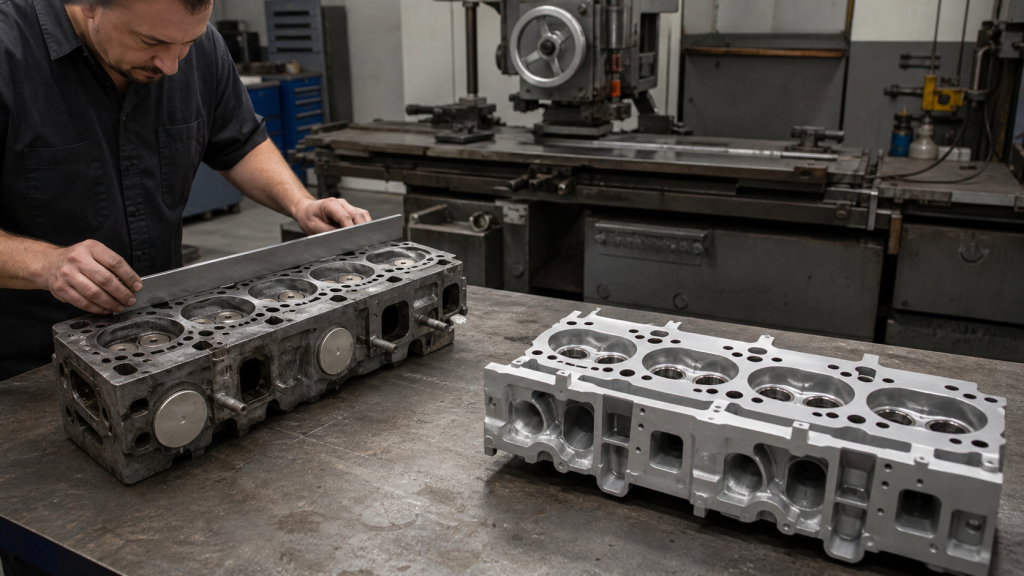
Overheating warps cylinder heads and damages valve guides and seats. If a camshaft replacement occurs after an overheating event, the cylinder head should be removed, inspected on a surface plate, and resurfaced if warpage exceeds the service limit. Valve guides and seats may require machining or replacement to restore sealing. The combined repair approaches the cost of a remanufactured cylinder head or complete engine.
Replacement, Cylinder-Head Work, or Engine Replacement
The decision point is the ratio of repair cost to engine replacement cost and the vehicle’s remaining value. If camshaft replacement with related valvetrain work approaches the cost of a remanufactured engine, and if cylinder-head damage or bearing wear is present, engine replacement provides a longer warranty and addresses hidden wear in the bottom end.
Cylinder-head removal for inspection and machining is justified when valve-guide wear, seat recession, or warpage is suspected. The head is removed, cleaned, and measured on a surface plate. Warpage beyond the service manual limit requires resurfacing to restore flatness and sealing. Valve guides are measured for wear, and worn guides are replaced or knurled. Valve seats are cut or ground to restore contact width and angle. The cost of this work is added to the camshaft replacement labor and parts.
Remanufactured or rebuilt engines include new or reground camshafts, new lifters, resurfaced cylinder heads, new timing components, and new bearings. The core exchange reduces the net cost, and the warranty covers both top-end and bottom-end components. Installation labor is similar to or less than camshaft replacement labor because the engine is removed as a unit rather than disassembled in the vehicle.
The break-even calculation requires three numbers: the cost of camshaft replacement plus related repairs, the cost of engine replacement including installation, and the vehicle’s current market value. If the camshaft repair is substantially lower than engine replacement cost and the cylinder head and bottom end are sound, replacement is the correct choice. If the camshaft repair approaches or exceeds engine replacement cost, or if multiple related faults are present, engine replacement provides better long-term reliability.
Estimate Questions That Prevent Surprise Charges
A complete estimate specifies which components are included and which are conditional. The baseline scope covers the camshaft, timing components, seals, gaskets, oil, and filter. Conditional items include lifters, rocker arms, cylinder-head removal, resurfacing, valve work, and oil-pump replacement. The estimate should state whether these items will be inspected during teardown and added if wear is found, or whether they are included in the quoted price.
Ask whether the cylinder head will be removed and inspected. If the head remains on the engine, cam-journal wear and cylinder-head flatness cannot be measured. If the head is removed, ask whether resurfacing and pressure testing are included or quoted separately. Cylinder-head work can add substantially to the repair cost and timeline.
Ask whether new lifters are included. If the estimate assumes lifter reuse, ask what the cost will be if the lifters are worn or damaged during teardown. Lifter replacement on a V8 engine adds sixteen lifters to the parts list.
Ask whether the oil pump will be inspected and replaced. If oil starvation caused the camshaft failure, the oil pump may have worn impeller clearances or a damaged relief valve. Replacing the oil pump during camshaft work prevents a second teardown.
Ask what warranty applies to the camshaft and installation. Parts-only warranties do not cover labor to replace a defective camshaft. Parts-and-labor warranties cover both. The warranty period and mileage limit determine whether the repair is protected for the vehicle’s expected remaining service life.
Ask whether break-in procedures are required and included. Flat-tappet camshafts require an initial break-in period at specified RPM with high-zinc break-in oil. The shop should plan for this procedure and confirm that the correct oil and additives are used. Roller camshafts do not require break-in but still need proper lubrication and initial inspection.
FAQs
Can I replace just one camshaft on a DOHC engine?
If one camshaft is damaged and the other is within service limits, single-camshaft replacement is mechanically possible but depends on parts availability and wear symmetry. Most DOHC engines with cam-lobe wear from oil starvation show similar wear on both intake and exhaust camshafts because they share the same oil supply. Replacing one camshaft leaves the worn camshaft in service, shortening the repair lifespan. If both camshafts are accessible during the same teardown, replacing both eliminates future repeat work.
Do timing marks have to be perfect when installing a new camshaft?
Timing marks align the camshaft and crankshaft to the positions specified in the service manual. Camshaft timing directly controls valve opening and closing relative to piston position. Misalignment by even one tooth changes valve timing, reduces power, causes rough running, and may result in valve-to-piston contact in interference engines. The alignment procedure uses marks on the sprockets, gears, or timing cover and often requires a timing tool or holding fixture. Deviation from the specified marks is not acceptable.
Will camshaft replacement fix low oil pressure?
Camshaft replacement addresses worn cam journals and lobes but does not fix low oil pressure if the root cause is a worn oil pump, clogged pickup, or excessive bearing clearance elsewhere in the engine. Oil pressure must be measured and the lubrication system diagnosed before assuming the camshaft is the source. If the camshaft journals are worn, they contribute to pressure loss, but replacing the camshaft without addressing oil-pump wear or bearing clearance leaves the pressure fault unresolved.
How long does a new camshaft last?
A properly installed and lubricated camshaft in a clean, maintained engine typically lasts the life of the engine. Service life depends on oil change intervals, oil quality, and operating conditions. Extended oil-change intervals, low-quality oil, or contaminated oil reduce cam-lobe life. Flat-tappet camshafts wear faster than roller designs and require higher-zinc oil for protection. The replacement camshaft’s expected life matches the maintenance conditions rather than providing a universal interval.
Is camshaft replacement covered under warranty?
New-vehicle powertrain warranties typically cover internal engine components including the camshaft for the specified period and mileage, but exclude wear from neglect or improper maintenance. Extended warranties and third-party policies vary in coverage. Camshaft failure from oil starvation due to missed oil changes may be denied. Failure from manufacturing defects in the camshaft itself is more likely to be covered. Review the warranty terms and document oil-change history before filing a claim.
Conclusion
Camshaft replacement cost depends on how many camshafts the engine uses, where they are mounted, and what related damage is present. The estimate should specify parts, labor, inspection scope, and conditional repairs discovered during teardown. Before authorizing work, confirm the diagnosis with oil-pressure measurement, compression testing, and visual inspection of cam lobes and journals. Request documentation of measured wear, a detailed parts list, labor expectations, and the warranty period. If the repair cost approaches engine replacement cost or if cylinder-head damage is present, compare both options and select the one that fits the vehicle’s remaining value and expected service life.