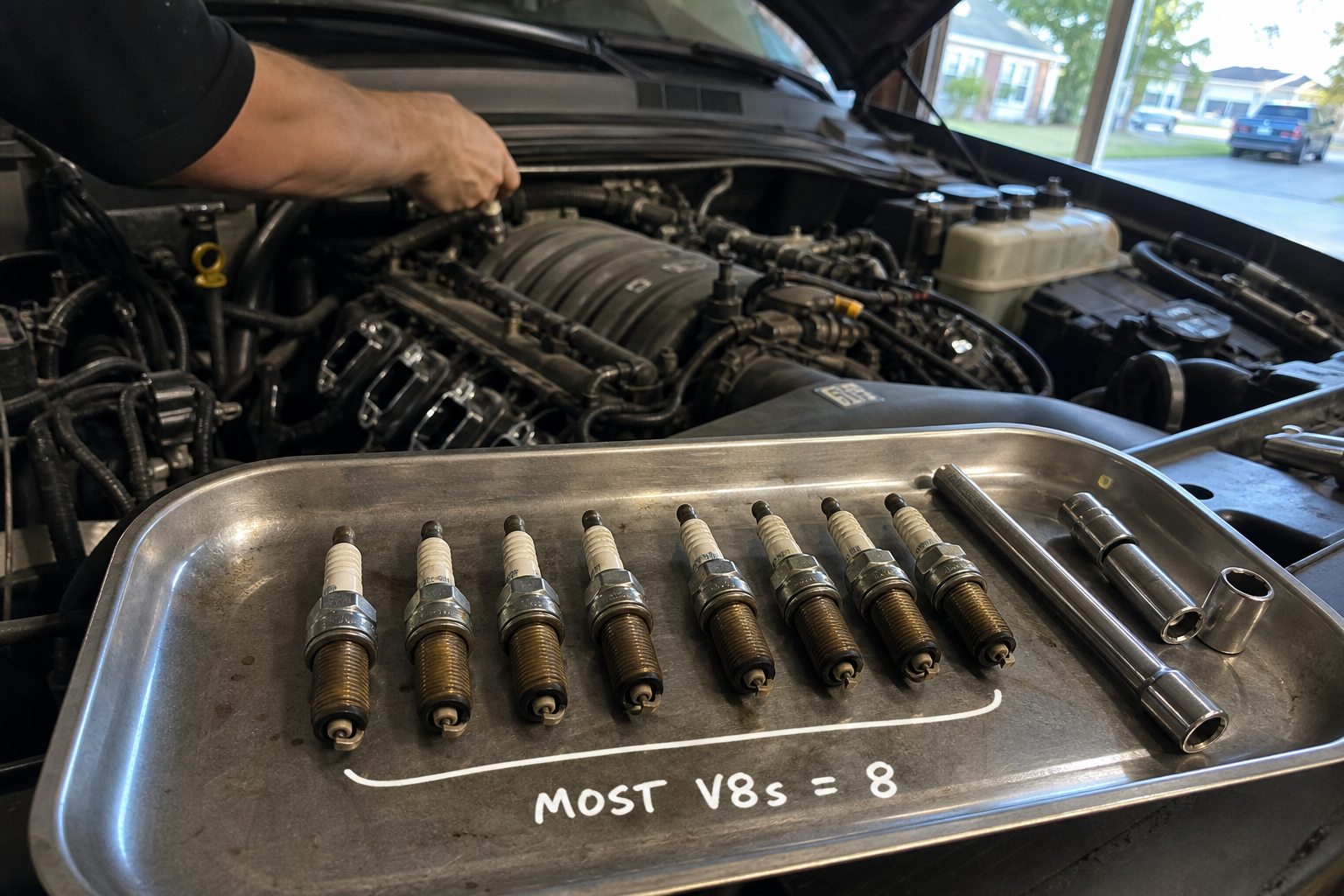
Most V8 engines use one spark plug per cylinder, for a total of eight.
Most V8 engines use 8 spark plugs—one for each cylinder. The basic formula is simple: cylinders x plugs per cylinder = total plug count. Standard V8 configurations follow this 8-cylinder, 8-plug design.
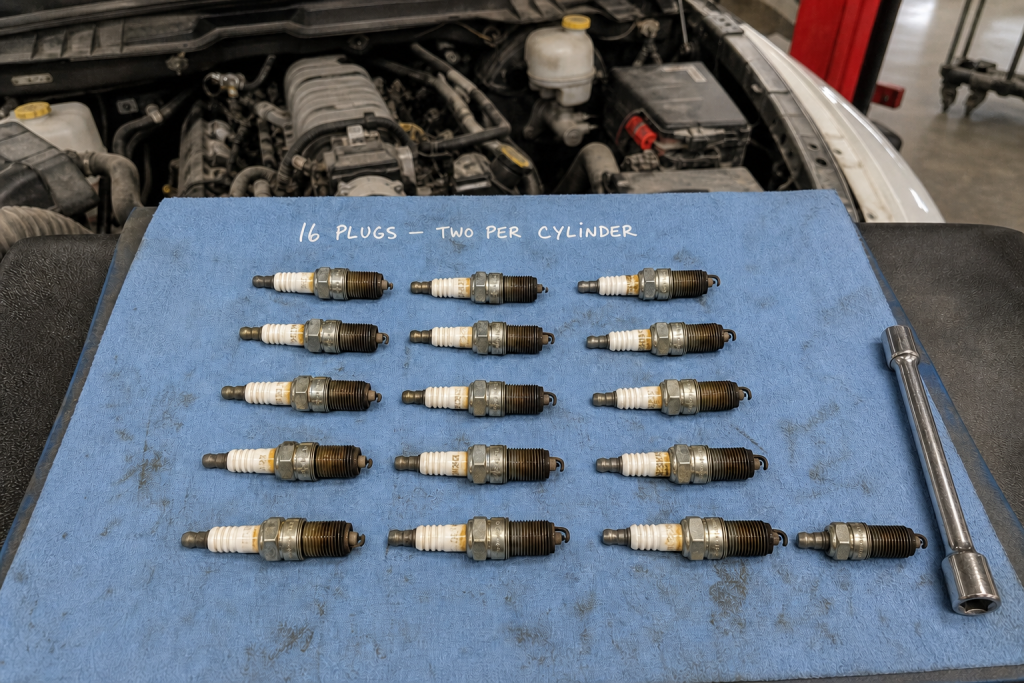
However, some V8 engines use 16 spark plugs—two per cylinder. These dual-ignition systems appear in performance engines, heavy-duty truck motors, and certain high-compression designs. Dual plugs improve combustion efficiency, reduce emissions, and support higher compression ratios.
Before ordering replacement plugs or planning service work, verify your engine’s configuration. The plug count affects parts ordering, labor time, and tool requirements.
Key Takeaways
|
Factor |
Standard V8 |
Dual-Ignition V8 |
|
**Plug count** |
8 plugs |
16 plugs |
|
**Plugs per cylinder** |
1 |
2 |
|
**Common applications** |
Most passenger vehicles, trucks |
Performance engines, heavy-duty trucks, aircraft-derived designs |
|
**Service cost** |
Lower parts cost |
Double plug cost, longer labor |
|
**Ignition coils** |
8 (coil-on-plug) or 1 distributor |
16 individual coils or 8 dual-output coils |
The Standard Formula: Cylinders x Plugs Per Cylinder
The plug count formula works for any engine configuration:
Total spark plugs = Number of cylinders x Plugs per cylinder
For a standard V8:
- 8 cylinders x 1 plug per cylinder = **8 spark plugs**
This applies to most V8 engines in passenger cars, SUVs, and light trucks. Each cylinder receives one spark plug, positioned in the combustion chamber to ignite the air-fuel mixture. The single-plug design handles ignition reliably in most operating conditions while keeping parts and service costs manageable.
When you open the hood, you’ll see 8 spark plug wires (on older distributor systems) or 8 individual ignition coils (on coil-on-plug systems). Each plug wire or coil corresponds to one cylinder.
Why Some V8s Use 16 Spark Plugs
Dual-ignition systems (https://en.wikipedia.org/wiki/Dual_ignition) install two spark plugs per cylinder, doubling the total count to 16 plugs in a V8. Each cylinder has two ignition points, firing simultaneously or with slight timing offsets.
Performance and Efficiency Benefits
Two plugs per cylinder create two flame fronts during combustion. This dual-flame propagation:
- **Burns the air-fuel mixture faster**: The two flame fronts meet in the middle, completing combustion in less time than a single flame front traveling across the chamber.
- **Reduces knock tendency**: Faster burn reduces the time available for end-gas auto-ignition, allowing higher compression ratios or more aggressive timing.
- **Improves cold-start reliability**: Redundant ignition sources increase the chance of successful ignition when fuel vaporization is poor.
- **Lowers emissions**: More complete combustion reduces unburned hydrocarbon output.
Common Dual-Ignition V8 Applications
Ford 5.4L and 6.8L Triton V8/V10: Ford’s modular engines in F-Series trucks (1997-2010) and the V10 in Super Duty trucks use two plugs per cylinder. These engines require 16 spark plugs (V8) or 20 plugs (V10) during service.
Dodge/Ram HEMI engines (some years): Certain Chrysler HEMI (https://en.wikipedia.org/wiki/Chrysler_Hemi_engine) V8s use dual plugs. The 5.7L HEMI in trucks and the 6.1L/6.4L performance HEMIs feature two plugs per cylinder to support higher compression and output.
Aircraft-derived engines: Some high-performance V8s adapted from aircraft powerplants retain dual ignition for reliability and power density.
The HEMI Exception and Other Special Cases
The HEMI combustion chamber design influences plug configuration. The hemispherical chamber shape places the spark plug centrally in older single-plug HEMIs, but modern HEMI engines with dual plugs position two plugs on opposite sides of the chamber.
HEMI Plug Positioning
Single-plug HEMI (classic design): The hemispherical shape centers one plug in the dome. The flame front travels outward in all directions from this central point.
Dual-plug HEMI (modern design): Two plugs sit on opposite sides of the chamber. This arrangement shortens the flame travel distance and supports the higher compression ratios used in modern performance applications.
Not all HEMI engines use dual plugs. Check your specific engine code and model year. For example:
- **5.7L HEMI (2003-2008)**: Single plug per cylinder = 8 plugs
- **5.7L HEMI (2009+)**: Dual plugs per cylinder = 16 plugs
- **6.4L HEMI (392)**: Dual plugs per cylinder = 16 plugs
Turbocharged and Supercharged V8s
Forced-induction V8s typically use 8 plugs (one per cylinder), not 16. The boost pressure increases cylinder pressure and temperature, which can actually make dual ignition unnecessary or undesirable due to increased knock sensitivity. Single-plug systems with advanced ignition timing control handle boost applications effectively.
Service Checklist: Counting Plugs Before Replacement
Use this checklist to verify plug count and prepare for service:
1. Physical Inspection
Count the ignition coils or plug wires: On coil-on-plug systems, the number of visible coils equals the plug count. If you see 16 coils on a V8, the engine uses 16 plugs.
Check both cylinder banks: V8 engines have two banks (left and right). Count plugs or coils on each bank and add them together.
Look for dual coil packs: Some dual-ignition systems use coil packs with two outputs per cylinder. Count the plug wire connections, not just the coil bodies.
2. Documentation Check
Owner’s manual: The maintenance schedule lists spark plug replacement intervals and quantities. Look for "spark plug (x8)" or "spark plug (x16)."
Service manual: Factory service information specifies plug part numbers and locations. Dual-ignition engines show two plug locations per cylinder in the removal procedure.
Engine code lookup: Use your VIN or engine code to confirm specifications. Online parts catalogs show the correct plug count when you enter vehicle information.
3. Parts Ordering Considerations
|
Item |
Standard V8 (8 plugs) |
Dual-Ignition V8 (16 plugs) |
|
**Spark plugs** |
Order 8 (or 8-pack) |
Order 16 (or two 8-packs) |
|
**Ignition coils** |
8 (if replacing) |
16 (if replacing) |
|
**Plug wire set** |
8-wire set |
16-wire set (rare; most use coil-on-plug) |
|
**Labor time** |
~1-2 hours |
~2-4 hours (more removal/installation) |
Cost example: If premium plugs cost $12 each, parts cost is $96 for 8-plug systems and $192 for 16-plug systems. Labor costs also increase with dual-plug engines due to longer removal and installation time.
4. Gap and Torque Specification
Gap setting: Dual-ignition systems sometimes use smaller plug gaps than single-plug systems because the redundant ignition source compensates for the reduced gap. Always check factory specifications rather than assuming standard gaps.
Torque specification: Over-torquing plugs damages threads, especially in aluminum heads common on modern V8s. Use a torque wrench and follow the manufacturer’s specification (typically 10-15 lb-ft for tapered-seat plugs, 15-25 lb-ft for gasket-seat plugs).
FAQs
Can I replace just one spark plug in a dual-ignition V8?
Replace all plugs at the same interval. Mixing old and new plugs creates uneven combustion characteristics across cylinders. In dual-ignition systems, replace both plugs in a cylinder together—don’t replace only one of the two plugs.
Do dual-ignition V8s need special spark plugs?
Most use standard plug designs, but always match the factory part number or verified equivalent. Some dual-ignition engines specify platinum or iridium plugs with particular heat ranges. Using incorrect plugs causes misfires or pre-ignition.
How do I tell if my V8 has 8 or 16 plugs without counting?
Check the parts catalog entry for your vehicle’s VIN. The plug quantity appears in the listing. Alternatively, look at the cylinder head: dual-plug engines have two plug holes visible per cylinder when valve covers are removed.
Does the plug count affect ignition timing?
Timing settings account for the plug configuration. Dual-ignition systems may use simultaneous firing (both plugs fire together) or sequential firing (slight offset between plugs). The engine control module handles timing—no manual adjustment needed on modern systems.
Are 16-plug V8s more reliable?
Dual ignition improves combustion consistency and can improve cold-start reliability, but it also doubles the number of plugs that can fail. Service costs are higher. Overall reliability depends on maintenance—replace plugs at recommended intervals regardless of system type.
Can I convert an 8-plug V8 to 16 plugs?
No. Dual-ignition requires cylinder heads designed with two plug holes per cylinder, a compatible engine control system, and double the ignition coils. The modification cost exceeds any practical benefit.
Conclusion
Standard V8 engines use 8 spark plugs—one per cylinder—covering most passenger vehicles and light trucks. Dual-ignition V8s use 16 plugs—two per cylinder—appearing in select performance engines, heavy-duty trucks, and HEMI designs.
Before ordering parts, count the ignition coils or check your owner’s manual to verify the plug quantity. The difference affects parts cost, service time, and plug specifications. Use the formula (cylinders x plugs per cylinder) to calculate the correct count, and confirm plug type and gap specifications in factory documentation.
When scheduling service, account for the longer labor time required by 16-plug systems. Both configurations deliver reliable ignition when maintained properly—the key is matching parts to your specific engine design.