A used cylinder head advertised cheaply can become expensive once the machine shop adds pressure testing, valve grinding, spring replacement, and surface milling—then discovers a crack between valve seats. Cylinder head repair cost depends on test results, measured warpage, crack location, required machining, valve train condition, and whether the existing casting is worth saving. Cylinder head replacement cost includes the condition of the replacement assembly (bare, complete, new, used, or remanufactured), transfer of remaining parts, and total installed scope. The decision starts with inspection data, not the advertised price of a bare casting.
Key Takeaways
- Pressure testing and straightedge measurement determine whether repair is viable before any machining begins
- Repair scope can include resurfacing, valve work, guide replacement, seat machining, crack repair, and cleaning—each adds cost and time
- Replacement heads arrive as bare castings, complete assemblies, new OEM, used cores, or remanufactured units with different warranties
- Total installed cost includes the head itself, machining, gaskets, hardware, fluids, timing components, and labor for removal and installation
- Cracks between valve seats, in combustion chambers, or extending into water jackets often make replacement the better choice
- Quote comparison must include the same scope: bare casting price vs bare casting price, complete assembly vs complete assembly with labor
Repair vs Replacement Starts with Test Results
The first cost driver is confirming the fault exists and measuring its severity. A cylinder head reaches a shop after symptoms like coolant consumption, white exhaust smoke, overheating, or compression loss. The technician performs a compression test and leak-down test to isolate the failure to the head rather than rings, valves, or gasket. If multiple cylinders show low compression or air escapes into the cooling system during leak-down, the head is removed for inspection.
Once the head is on the bench, three measurements determine repair feasibility:
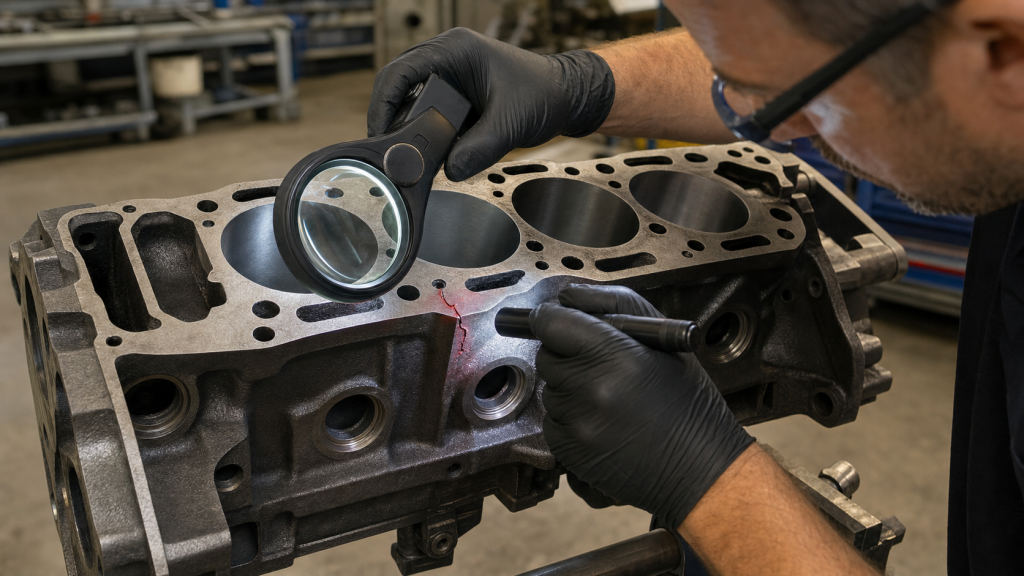
Pressure testing: The machine shop seals all ports and pressurizes the water jacket. Bubbles reveal cracks in the casting. Small cracks in non-critical areas may be weldable; cracks between valve seats, in combustion chambers, or connecting coolant passages to oil galleries usually mean replacement.
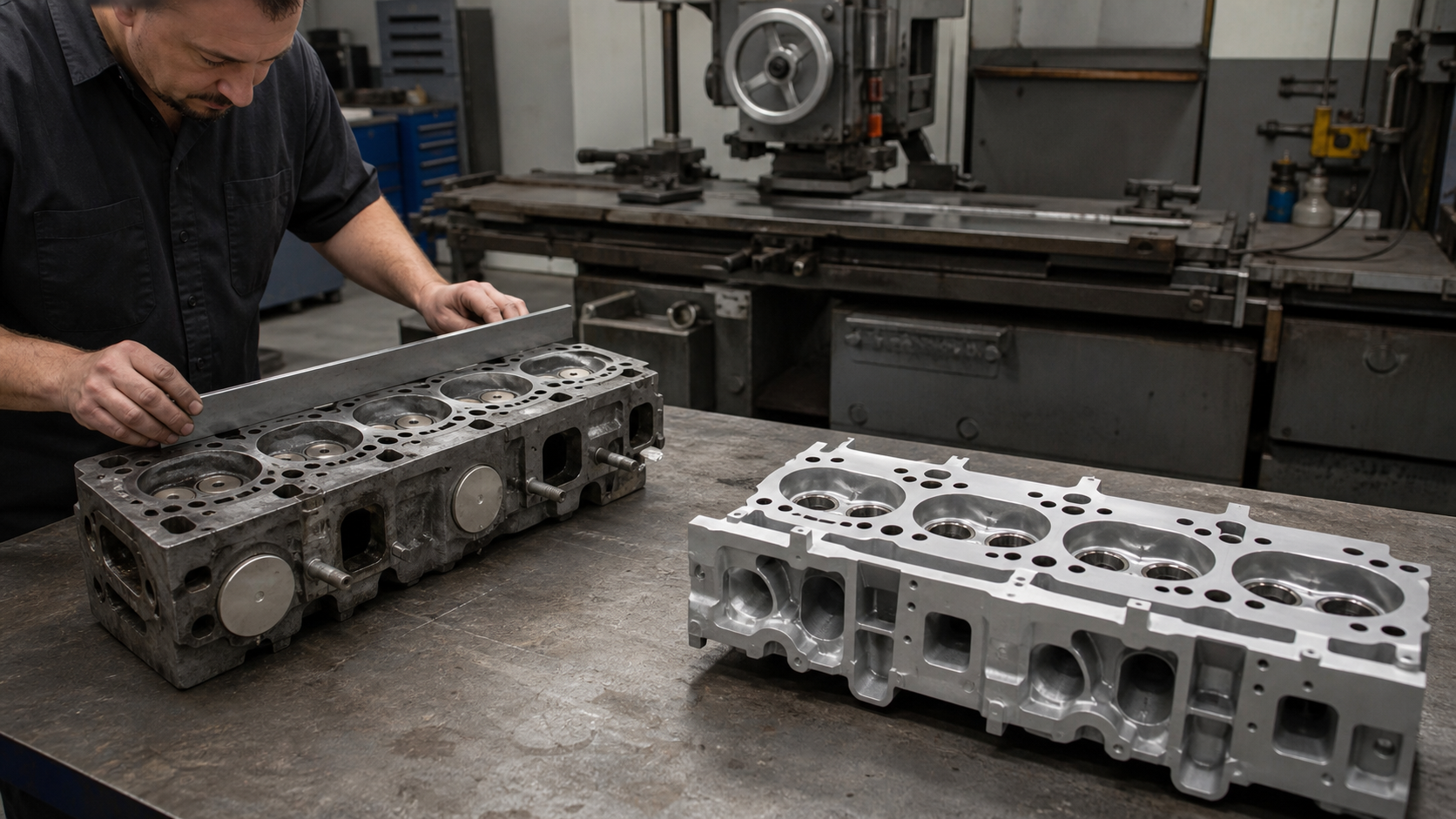
Straightedge and feeler gauge: The deck surface is checked for warpage in multiple directions. Service manuals specify maximum warpage limits that vary by engine family and head material. Cast iron heads generally tolerate more milling than aluminum before compression ratio, valve-to-piston clearance, or timing geometry becomes unsafe.
Valve seat and guide wear: The machinist measures valve seat width, concentricity, and guide clearance against service manual specifications. Excessive wear requires new guides, seat machining, or both.
These three tests create the decision boundary. A head with acceptable warpage, no cracks, and repairable valve train damage is a candidate for repair. A head with cracks, excessive warpage, or seats that cannot be re-machined to specification moves to replacement.
What Cylinder Head Repair Can Include
Repair scope varies widely. A head that overheated slightly may need only resurfacing. A head with valve damage, worn guides, and minor warpage requires a full rebuild. Each operation adds cost, and the final bill reflects what is actually necessary, not a fixed "repair" price.
Resurfacing (milling or grinding): The deck surface is machined flat to restore sealing and meet the gasket manufacturer’s surface finish requirement. The required finish depends on gasket type—multi-layer steel gaskets typically require smoother surfaces than composite gaskets, verified with a profilometer. Material removal reduces chamber volume and increases compression ratio; the service manual specifies maximum cut depth. Machine shop pricing depends on material, complexity, and equipment used.
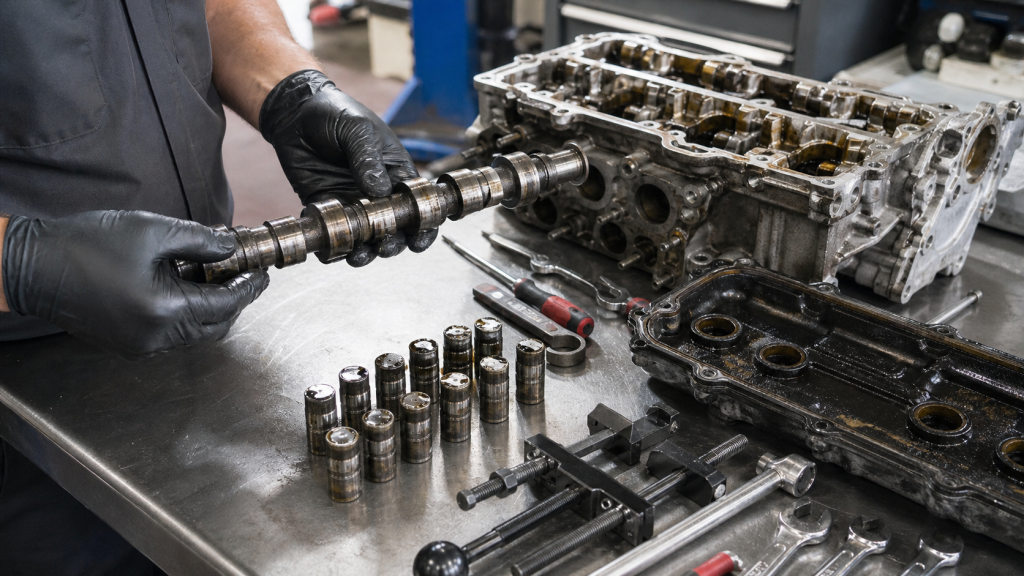
Valve work: Valves are removed, cleaned, and inspected. Worn or burned valves are replaced. Valve seats are re-cut to the specified angles (commonly 45° with relief cuts) to restore sealing and proper contact width. Valve guides are measured; if clearance exceeds specification, guides are replaced or knurled. The cost of full valve work varies with cylinder count and guide condition, as noted in cost analyses of cylinder head machining.
Spring and retainer replacement: Valve springs lose tension over time. The machinist checks installed height and spring pressure with a tester. Weak springs cause valve float at high RPM. Replacement is often recommended during teardown. Spring and retainer costs scale with cylinder count and engine design.
Crack repair: Small cracks in low-stress areas can be stop-drilled, welded, or pinned. Cast iron is weldable with nickel rod; aluminum requires specialized TIG welding. Crack repair success depends on location and length. Cracks in combustion chambers or between valves are high risk and often lead to replacement.
Hot tank cleaning and magnetic particle inspection: The head is chemically cleaned to remove carbon and oil deposits, then inspected under UV light with magnetic particles to reveal hidden cracks. This is standard procedure before any machining.
Bare, Complete, New, Used, and Remanufactured Replacement Heads
Replacement heads arrive in different conditions, and the advertised price rarely reflects total installed cost.
Bare casting: A bare head has no valves, springs, camshaft(s), or sensors. The buyer transfers all components from the old head and handles all machining. Bare castings have the lowest initial price but require valve work, resurfacing, and hardware transfer. Total cost including machining and labor often exceeds a complete assembly.
Complete assembly: A complete head includes valves, springs, camshafts, and sometimes sensors already installed. The deck surface is usually pre-machined. Complete heads cost more upfront but eliminate valve work and hardware transfer. Labor is lower because fewer parts are handled.
New OEM: Original equipment manufacturer heads match factory specifications and come with a warranty. They are the most expensive option but ensure correct material, port geometry, and combustion chamber shape. Critical for emission-controlled engines where chamber volume affects calibration.
Used core: A used head from a salvage yard carries unknown history: the core may have cracks, warpage, or valve damage that only appears after purchase. Pressure testing and measurement add time and cost before any work begins. Pricing varies widely with vehicle availability and regional market conditions.
Remanufactured: Reman heads are processed by a specialist and may include cleaning, testing, machining, valve work, replacement parts, and warranty coverage. Scope varies by rebuilder, so verify the pressure test, guide and seat criteria, installed components, inspection records, and written warranty rather than assuming every remanufactured head receives the same work.
The correct comparison is total installed cost with the same scope. A cheap bare casting becomes expensive after machining, valve work, and gaskets. A more expensive complete assembly with no additional machine work may be cheaper when labor is included.
Machining, Valve Work, Parts, and Labor Cost Drivers
Cylinder head cost breaks into parts, machining, and labor. Each driver depends on engine design, damage severity, shop rate, and regional labor markets.
Parts: Head gasket sets vary in price by engine and gasket type. Multi-layer steel gaskets are more expensive than composite. Head bolt or stud replacement is often required; bolts are torque-to-yield in many modern engines and cannot be reused. Timing components (belt, chain, tensioner, guides) are replaced during teardown to avoid repeat labor. Timing kits range from simple single-belt designs to complex dual-overhead-cam engines with variable valve timing.
Machining and valve work: Costs scale with the operations required. Resurfacing, valve seat cutting, guide replacement, crack repair, and cleaning/inspection each contribute to the final machine shop bill. The total depends on what inspection reveals and what the service manual specifies.
Labor: Removal and installation time varies widely by engine layout. Inline-four engines with accessible heads require fewer hours than V6 and V8 engines with buried heads, especially rear banks. Overhead-cam engines require timing alignment and camshaft installation; pushrod engines are simpler. Labor rates vary by location and shop type. Industry estimates for cylinder head replacement reflect the wide variation in engine accessibility and regional labor markets.
Testing after installation: Some shops perform a post-repair compression test, leak-down test, or pressure test of the cooling system to confirm sealing. This adds labor time but catches problems before the customer drives away.
When Cracks or Distortion Make Repair a Poor Choice
Not all cylinder head damage is repairable. Three conditions make replacement the better decision.
Crack location: Cracks in the water jacket near freeze plugs or in low-stress bolt boss areas can be repaired if they are short and do not connect to pressurized passages. Cracks between valve seats, in combustion chambers, or connecting coolant to oil galleries cannot be reliably repaired. The crack will likely reopen under thermal cycling and combustion pressure. Welding aluminum combustion chambers distorts the sealing surface and chamber volume. These cracks mean replacement.
Excessive warpage: Service manuals specify maximum resurfacing depth before compression ratio, valve-to-piston clearance, or timing geometry becomes unsafe. The allowable cut depth depends on head material and engine architecture. Cast iron heads often allow more material removal than aluminum heads because material removal brings the camshaft closer to the crankshaft and changes timing-belt tension or chain wrap. If measured warpage exceeds the maximum allowable cut specified in the service manual, the head must be replaced. Attempting to save a heavily warped head by over-milling creates interference, timing errors, or gasket failure.
Material condition: Heads from high-mileage engines or those with a history of overheating may have pitting in coolant passages, erosion around valve seats, or porous castings. Porosity appears as clusters of tiny holes and indicates degraded material. These heads fail pressure testing even without visible cracks. A head that fails pressure testing twice—once before machining, again after resurfacing—is not salvageable.
When any of these conditions are present, the machine shop will recommend replacement. Attempting repair wastes money on machining and parts that will fail shortly after installation.
Compare Total Installed Cost and Warranty Scope
The decision between repair and replacement comes down to total installed cost and warranty. A repair may be cheaper upfront but carries risk if the head has unknown damage. Replacement has higher parts cost but includes a warranty and known condition.
Repair total cost includes the original head (already owned), pressure testing, machining operations, gasket set, hardware, timing components, and labor for removal and installation. The labor component varies significantly with engine accessibility and whether the engine is inline or V-configuration.
Replacement total cost includes the replacement head (with price determined by whether it is bare, complete, new, used, or remanufactured), gasket set, hardware, timing components, and labor. If the replacement is a complete assembly, machine work is eliminated but the head itself costs more.
The warranty matters. A repaired head has no warranty on the casting itself, only on the machining and parts. If a crack reappears later, the customer pays for removal, testing, and reinstallation. A remanufactured or new head typically carries a warranty covering the casting, valves, and machining. If it fails, the supplier replaces it at no cost for parts.
When the cost difference is small and the original head has questionable history, replacement is the safer choice.
Cylinder Head Quote Checklist
Cylinder head quotes vary widely in scope. Use this checklist to compare quotes and ensure all necessary work is included.
Inspection and testing:
- Pressure test to detect cracks
- Deck surface measurement with straightedge and feeler gauge
- Valve guide clearance measurement
- Valve seat inspection and measurement
Machining and valve work (repair):
- Deck resurfacing to specified finish (state surface finish requirement from gasket manufacturer)
- Valve seat re-cutting to specified angles
- Valve guide replacement if clearance exceeds specification
- Hot tank cleaning and magnetic particle inspection
Replacement head condition (if replacing):
- Bare casting or complete assembly?
- New, used, or remanufactured?
- Warranty duration and coverage (casting, valves, machining)
- Pre-machined deck surface or requires resurfacing?
Parts included:
- Head gasket set (verify multi-layer steel if required)
- Head bolts or studs (are they reusable or must be replaced?)
- Valve cover gasket
- Intake and exhaust manifold gaskets
- Timing belt or chain kit, tensioner, guides
- Coolant and oil for refilling
Labor scope:
- Removal and installation hours
- Timing alignment and camshaft installation
- Post-repair testing (compression test, leak-down, cooling system pressure test)
Not included (watch for add-ons):
- Machine shop delivery and pickup
- Additional hardware if bolts strip during removal
- Sensor or injector replacement if damaged during disassembly
- Thermostat, water pump, or other components accessed during teardown
Request written quotes with the same scope. Comparing a bare casting repair quote to a complete reman head quote is meaningless if one excludes valve work and the other includes it.
FAQs
Can I reuse head bolts after removing the cylinder head?
If the bolts are torque-to-yield (TTY), they cannot be reused. TTY bolts stretch permanently during tightening to achieve clamping force. Reusing them risks insufficient clamping and gasket failure. Non-TTY bolts can be reused if threads are undamaged and they have not been over-torqued. Check the service manual; if it specifies an angle-tightening procedure (e.g., "torque to specification then rotate additional degrees"), the bolts are TTY. Most modern engines use TTY bolts.
How much can be milled from an aluminum cylinder head?
The maximum resurfacing depth is specified in the service manual and depends on camshaft-to-crankshaft timing geometry and valve-to-piston clearance. Aluminum heads typically have tighter limits than cast iron heads. Removing too much material brings the camshaft closer to the crankshaft, altering timing-belt length or chain tension. It also reduces combustion chamber volume, increasing compression ratio and advancing ignition timing beyond calibration limits. If measured warpage exceeds the allowable cut specified in the service manual, the head must be replaced. Never mill beyond the specified limit to save a warped head.
Is a used cylinder head from a salvage yard worth the risk?
Used heads are cost-effective if the seller provides a return policy and the buyer performs pressure testing and straightedge measurement before installation. A used head that passes testing and requires only resurfacing costs less than a remanufactured head. However, used heads have unknown history. They may have hidden cracks, previous repairs, or worn guides. If the used head fails testing, the buyer loses time and testing cost. Remanufactured heads cost more but include testing, machining, and a warranty. For high-stakes repairs (commercial vehicles, high-value engines), reman heads reduce risk.
Do I need to replace the timing belt or chain when replacing a cylinder head?
Yes. The cylinder head must be removed to access the timing belt or chain, and labor to install the head is the same whether the timing components are new or old. If the belt or chain fails shortly after head installation, the entire job must be repeated. Timing belt service intervals are specified in the owner’s manual and service schedule. Timing chains last longer but tensioners, guides, and solenoids wear. Replace timing components during cylinder head work unless they were recently serviced with documented evidence.
What causes cylinder head failure in the first place?
The most common cause is overheating. Coolant loss, failed thermostat, radiator blockage, or water pump failure allows cylinder head temperature to exceed material limits. Aluminum expands more than cast iron; uneven expansion warps the deck surface and cracks the casting. Detonation (pre-ignition caused by low-octane fuel, carbon buildup, or incorrect timing) creates shock waves that crack combustion chambers. Improper installation (incorrect bolt torque sequence, reused TTY bolts, contaminated gasket surface) causes gasket failure and subsequent overheating. Preventing failure requires maintaining cooling system health, using correct fuel octane, and following service manual procedures during assembly.
Conclusion
Cylinder head repair or replacement cost depends on test results, measured damage, required machining, valve train condition, and total installed scope. Start with pressure testing and straightedge measurement to determine whether the existing head is salvageable. Compare total installed cost—not advertised part price—when choosing between repair and replacement. Request written quotes that include the same scope: inspection, machining, parts, and labor. For engines with cracks between valve seats, excessive warpage beyond service limits, or porous castings, replacement is the safer choice. Document the failure cause (overheating, detonation, or improper maintenance) and address it before installing the repaired or replacement head to prevent repeat failure.